Introduction of the first oilabsorption value measurement method
The degree of grinding of the pigment and oil is also a factor that has a significant impact on the oil absorption value. It has been pointed out before that the pigments (ultramarine blue, chromium oxide, titanium dioxide, etc.) formed by generally fired and very firm aggregates can undergo aggregate fragmentation and pore volume reduction during grinding, so that The oil absorption is correspondingly reduced.
1. Determination of oil absorption by mixing pigment and oil
This method essentially involves mixing the paint with the oil without applying pressure.
Weigh 5 grams of paint into a round-bottomed beaker; then drop the oil into the beaker from the dropper. Add 0.3 ml initially, then 2-3 drops each time, and finally 1 drop. Every time after injecting 1~2 minutes of potassium in the oil, stir the mixture with a glass rod or Bakelite rod with a cap (without adding pressure).
As the amount of oil added to the pigment increases, more and more individual agglomerates are formed which, when stirred, initially break up and then coalesce into larger agglomerates. Stop adding oil until all the paint turns into a ball.
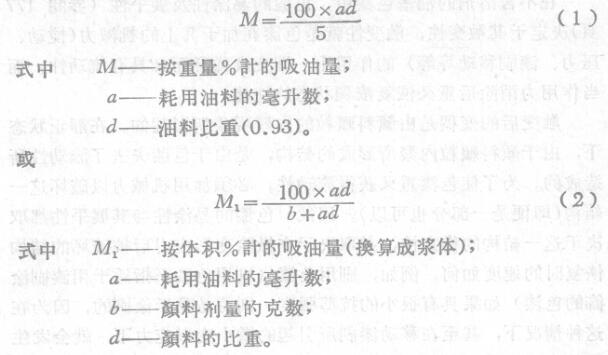
The oil absorption can be obtained by connecting formulas (1) and (2):
2. Determination of oil absorption by co-grinding pigment and oil
This method was developed by Yakubovich and Golidberg. The characteristic of this method is that the pigment is ground when it is mixed with the oil. The test was carried out as follows. Pour 1 gram of oil on the board; weigh the pigment in any container (keg, weighing bottle) (the amount should be slightly more than the expected amount). The pigment is added to the oil in small portions, and the mixture is ground carefully with a pestle until a differential is formed.
As the amount of pigment added, the body becomes thicker and thicker, from fluid to thick, and then begins to decompose and form flakes. From this moment on, the pigments are added in smaller portions, and the pestle is replaced by a grinding knife, with which the pestle is first carefully scraped.
After each addition of paint, the flake is stirred for a long time until it begins to spread. Then weigh the combined weight of the container and the remaining pigment to determine the amount of pigment. Then calculate the oil absorption according to the formula listed above.