How is Pigment Volume Measured?
1. Determination of the dispersed volume of the pigment and the volume after shaking
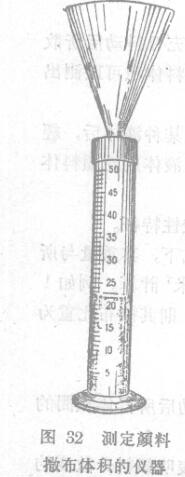
This method was developed by Yakubovich and Terekhov. In a glass measuring cylinder with a height of 17 cm and a diameter of 2.2 cm (volume 50 ml), through a special funnel set on the cylinder (Figure 32), evenly withdraw 10 grams of the pigment to be tested, and then measure the volume it occupies ( withdrawal volume). Remove the funnel, plug the mouth of the cylinder with a stopper, shake it violently 150 times with your hands, and tap the cylinder with a soft pad (rubber, felt) or palm. Then tap again 15-20 times, if after this, the volume of the pigment in the tube does not change, the test is completed. The volume measured in this way is the volume of the pigment after it has been moved. If it is intended to measure the specific gravity of the withdrawn fabric or the specific gravity of the pigment after Contemporary Controls, it can be obtained by taking the reciprocal of the obtained data.
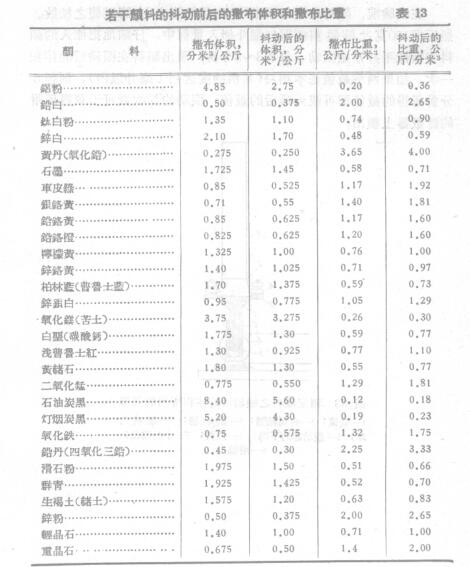
Table 13 presents data for some pigments measured by various authors.
2. Determination of the volume after material movement with a special instrument
 In order to more accurately measure the volume of the pigment section, a special instrument can be used.
This instrument (Fig. 33) is a graduated measuring cylinder 1, the lower end of which is fixed on a circular base plate by means of a metal shaft 2. The substrate is properly placed on the cutout of the vibrator 3 flat plate, and the substrate is connected with the vibrator through the embedded ring 4 with screws. The lower end 5 of the vibrator (which terminates in a shaft) slides into the cylinder 6 . The shaft rod slides along a small steel camshaft 7, which is driven by a pulley 8. When the camshaft rotates each time, the vibrator with the cylinder immediately rises and then descends. The height of raising or lowering is exactly 3 millimeters. The rotation speed is 250 revolutions per minute.
Before the test, the pigments were first sieved on a 2144-mesh sieve per centimeter to loosen them. Then, withdraw 100 grams of the sieved pigment into the measuring cylinder through the wide-mouth funnel, and carefully vibrate the micro-injected pigment surface and the injection well. Every 3 to 5 minutes, read the volume of the pigment after vibration. If the two numerical values are basically the same (the accuracy is within 1 ml), the numerical value obtained after 5 minutes can be regarded as the final numerical value. The total number of vibrations can be read on the counter attached to the transmitter.
- 1Pigment related ASTM testing standards
- 2Determination of pigment light fastness under natural light
- 3Pigment specific gravity measurement method
- 4Sieve residue (fineness of ground) Determination of Pigment dispersion
- 5Determination of tinctorial strength of Pigments by "sensory limit" method
- 6Summary of special test methods for Pigment
- 7Determination of Pigment light fastness under natural light
- 8Pigments and paints - Determination of light resistance
- 9Determination of Pigment Volume