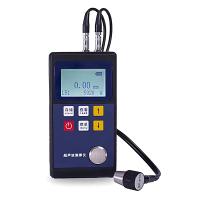
TT120 Ultrasonic Thickness Gauge Operation Application Instructions
1 Overview
1.1 Scope of Application
TT120 ultrasonic Thickness Gauge can be used to measure the thickness of steel in the field of industrial production, can monitor various pipes and pressure vessels in production equipment, monitor the degree of thinning after corrosion during use, and can also accurately measure various parts. Its distinctive feature is that it has the function of high-temperature thickness measurement.
1.2 Rationale
The principle of ultrasonic thickness measurement is similar to that of light wave measurement. The ultrasonic pulses emitted by the probe reach the object to be measured and propagate through the object, and when they reach the material interface, they are reflected back to the probe to determine the thickness of the material by accurately measuring the time it takes for the ultrasonic waves to propagate through the material.
2. Performance indicators
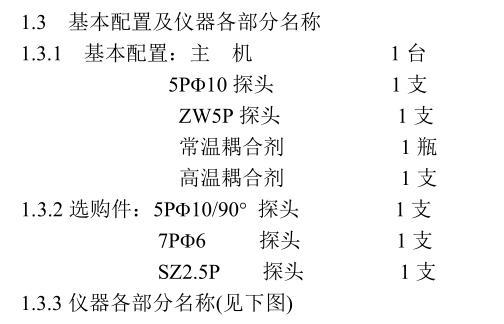
Display mode: four-digit LCD display
Minimum unit of display: 0.1mm
Operating frequency: 5MHz
Normal temperature measurement range: 1.2mm~225.0mm
High temperature measurement range: 4.0mm~80.0mm
Lower pipe measurement limit: Φ20mm×3.0mm
Measurement error: ± (1%H+0.1)mm, H is the actual thickness of the measured object
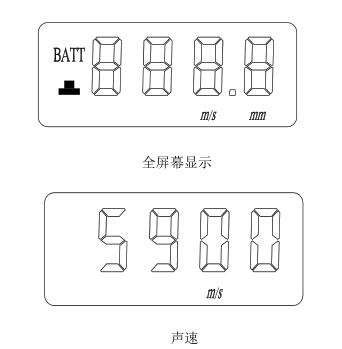
Sound speed: 5900m/s
Operating temperature range: 0°C~40°C
Measuring temperature range: 0°C~300°C
Power supply: 2 x No. 5 dry batteries
Power consumption: Operating current<20mA (3V)
Dimensions: 126mm× 68mm× 23mm Weight: 170g
3 main functions
●Automatic calibration of the zero point, which can correct the system error;
●Conversion between normal temperature measurement and high temperature measurement;
●Nonlinear automatic compensation: the nonlinear error of the probe is corrected by computer software in the whole range to improve the measurement accuracy;
●Coupling state prompt: provide a coupling flag, and know whether the coupling is normal by observing its stable state;
●Low voltage prompt;
●Automatic shutdown: Scheduled automatic shutdown will help you cut off the power;
●Full key membrane closed operation anti-oil pollution, improve service life;
4 Measurement steps
4.1 Measurement preparation
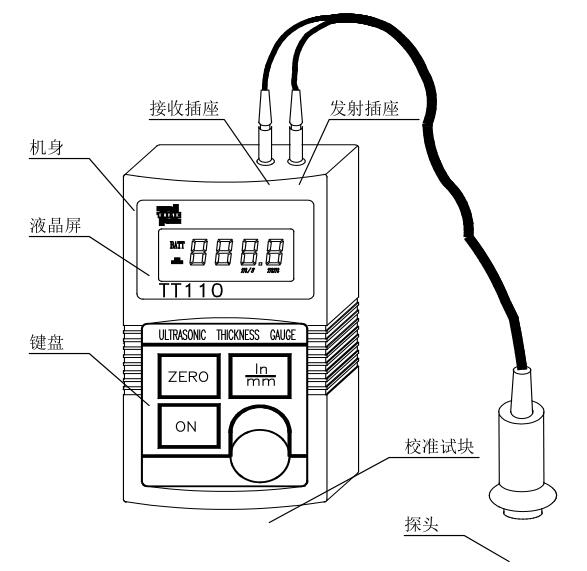
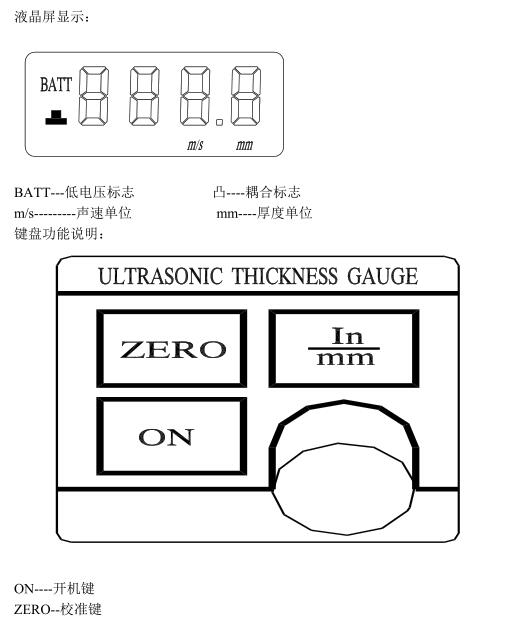
Insert the probe plug into the host probe socket, press the ON button to power on, and the sound velocity will be displayed after a few seconds of full-screen display, as shown in the figure below. At this point, the measurement can begin.
4.2 Calibration
Calibration should be performed each time the probe is replaced, the battery is replaced, and the ambient temperature changes greatly. This step is critical to ensure the accuracy of the measurement. Repeat as many times as necessary. Press the ZERO button to enter the calibration state, and the screen displays:
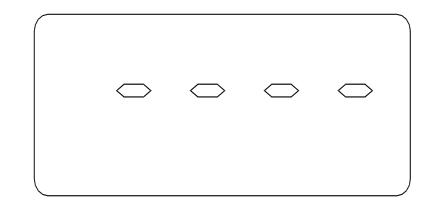
Apply couplant to the random test block, couple the probe to the random test block, and the horizontal lines displayed on the screen will disappear one by one until the screen shows 4.0mm, that is, the calibration is completed.
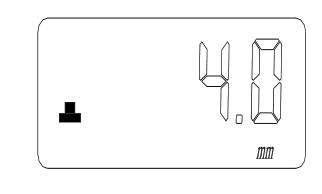
Note: n Press the ZERO button to enter the calibration state, if you want to give up the calibration, press the ZERO button again to return to the measurement state, and the screen displays the sound speed of 5900m/s.
n When the normal temperature mode is corrected to zero, the horizontal lines displayed on the screen will slowly disappear one by one, and when the high temperature mode is corrected to zero, the horizontal lines displayed on the screen will disappear one by one very quickly.
4.3 Measure the thickness
Apply the couplant to the measured place, couple the probe with the measured material to measure, and the screen will display the thickness of the measured material, as shown in the figure:
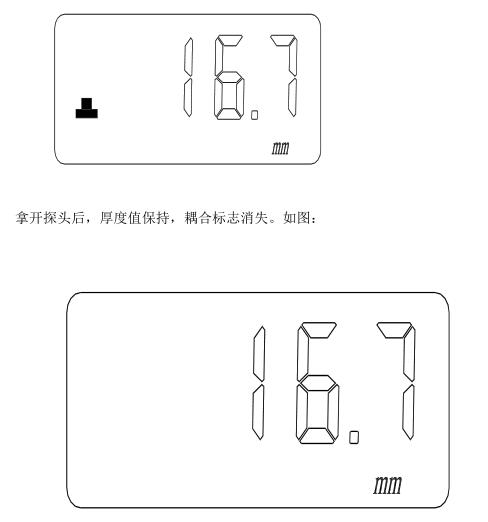
Description: When the probe is coupled to the material being measured, the coupling flag is displayed. If the coupling sign flashes or does not appear, the coupling is not good.
When the actual sound velocity of the material is different from 5900m/s, the actual thickness value is calculated as follows:
H0=H×V0/5900
where: the thickness value is measured at the sound velocity of H-5900m/s;
V0—the actual sound velocity value of the material;
H0—The actual thickness value of the material.
4.4 Conversion between normal temperature measurement and high temperature measurement
After the instrument is turned off, press and hold the ZERO button, and then press the ON button to turn on the machine, and you can switch between room temperature measurement and high temperature measurement. The measurement pattern is automatically maintained and needs to be reset when the battery is replaced.
5. Low voltage indication
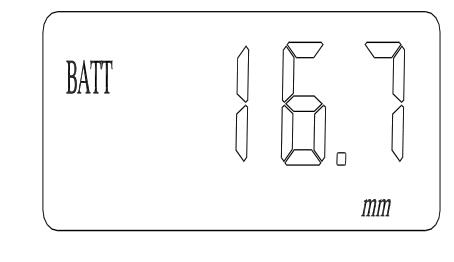
If the BATT logo is displayed on the screen, it means that the battery voltage has dropped and the battery should be replaced in time before continuing to use.
6. Automatic power off
If nothing is done within two minutes, it will automatically shut down.
7. Measurement technology
7.1 Influence of temperature of materials
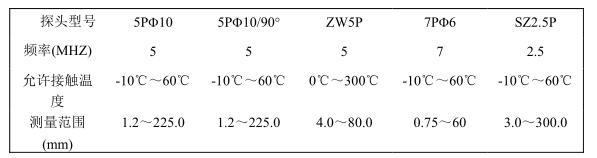
The thickness of the material and the ultrasonic propagation speed are affected by the temperature, if the measurement accuracy is required to be high, the test block comparison method can be used, that is, the test block of the same material is measured under the same temperature conditions, and the temperature compensation coefficient is obtained, and the measured value of the measured workpiece is corrected with this coefficient. For steel, high temperatures will cause large errors, which can be used to compensate for corrections. The ZW5P probe can be used to measure steel thickness with surface temperatures up to 300°C. Considerations when measuring high-temperature steels:
(1) Apply the random high-temperature couplant evenly on the surface of the ZW5P probe, and the dosage of couplant should be moderate;
(2) Hand-held probe for point contact measurement. The contact time between the probe and the object to be measured is not more than 5 seconds. After each measurement, the following should be:The probe is cooled with water or free. Calibration should be performed before measuring again. Due to the use of point contact measurement for high-temperature measurementsThe contact time between the probe and the measured object is short, so sometimes the measurement fails when measuring high-temperature materialsIt is necessary to repeat the measurement many times.
(3) For every 100°C increase in the general temperature of steel, the sound velocity of the material decreases by about 1%, so the measured value should be corrected.
For example, H0 is defined as the actual thickness value of the material, and H1 is defined as the displayed value measured with TT120.
Then: at 100°C, H0≈H1×0.99
At 200°C, H0≈H1×0.98
At 300°C, H0≈H1×0.97
7.2 Clean the surface
Before measuring, all dust, dirt and rust should be removed from the surface of the measured object, and paint and other covering materials should be removed.
7.3 Reduce roughness
Excessively rough surfaces can cause measurement errors or even no readings on the instrument. Before measuring, the surface of the material to be measured should be as light as possible
Slippery, you can use grinding, throwing, filing and other methods to make it smooth. High-viscosity couplants can also be used.
7.4 Rough machining surface
The regular groove caused by the rough machined surface (such as a lathe or planer) will also cause measurement error, and the method of making up for it is the same as 7.2, and adjust the angle between the transducer crosstalk separator plate (passing through the thin layer in the center of the bottom surface of the probe) and the fine groove of the measured material, so that the separator plate and the fine groove are perpendicular or parallel to each other, and the minimum value in the reading is taken as the measurement thickness, which can achieve better results.
7.5 Measure cylindrical surfaces
To measure cylindrical materials, such as pipes, oil drums, etc., select the angle between the transverse sound barrier plate of the probe and the axis of the material to be measuredThe importance is beyond words. To put it simply, the probe is coupled to the material to be measured, the transducer crosstalk barrier plate is parallel or perpendicular to the axis of the material being measured, and the probe is slowly shaken perpendicular to the axis of the material being measured, and the readings on the screen will vary regularly, selecting the minimum value in the reading as the exact thickness of the material.
The criterion for selecting the angle direction of the intersection of the probe crosstalk separator plate and the axis of the measured material depends on the curvature of the material, the pipe with a larger diameter, the probe crosstalk separator plate is perpendicular to the axis of the tube, and the pipe with a smaller diameter is selected to be parallel and perpendicular to the axis of the tube, and the minimum value in the reading is taken as the thickness of the measurement.
7.6 Composite shape
When measuring materials with composite profiles (e.g., at pipe elbows), the method described in 7.5 can be used, but the difference is to advanceThe second measurement is carried out, and the two values of the transcultural diaphragm plate and the axis are read perpendicular and parallel to the axis, and the smaller number is used as the thickness of the material at the measurement point.
7.7 Non-parallel surfaces
In order to obtain a satisfactory ultrasonic response, the other surface of the material to be measured needs to be parallel or coaxial to the surface being measured.Failure to do so will result in measurement errors or no reading display at all.
7.8 Reference test blocks
In order to obtain satisfactory measurement accuracy, it is better to choose a material with the same material and a similar thickness as the material to be measuredTest blocks. Take the uniform material to be measured with a micrometer and use it as a test block.
For thin materials, do not measure materials below the lower limit when its thickness is close to the lower limit of probe measurements. If a thickness range can be estimated, then the upper limit of the thickness of the test block should be selected.
The internal structure of most forgings and castings is directional, and there will be a small change in sound velocity in different directions.To solve this problem, the test block should have an internal structure in the same direction as the material being measured, and the sound waves should propagate in the same direction as in the test material.
The velocity of sound of the material to be measured may be unknown in the actual measurement, in which case the thickness of the object can be calculated by the following formula:
H0=(h0/h1)×H1
H0: the actual thickness of the object to be measured
H1: The thickness of the object measured with the TT120 ultrasonic Thickness Gauge
h0: the actual thickness of the test block
h1: The thickness of the test block measured with the TT120 ultrasonic Thickness Gauge
7.9 Several Methods in Measurement
a) Single measurement method: Measurement at a point.
b) Double measurement method: use the probe to make two measurements at one point, and the probe crosstalk partition plate should be hung down from each other during the two measurementsStraight. The minimum value in the reading is selected as the exact thickness of the material.
c) Multi-point measurement method: multiple measurements are carried out within a certain measurement range, and the minimum value is taken as the material thickness value.
7.10 Probe Selection
7.11 The wear and tear of the transverse sound compartment plate of the probe will affect the measurement, and the probe should be replaced when the following phenomena occur.
1. When measuring different thicknesses, their measurements always show a certain value.
2. When the probe is plugged in, there is an echo indication or a measured value without measurement.
8. Prevention methods for measurement errors
8.1 Ultra-thin materials
With any ultrasonic Thickness Gauge, the thickness of the material to be measured falls below the lower limit of the transducer's use, resulting in measurement errors, and if necessary, the minimum limit thickness can be measured using the block comparison method.
When measuring ultra-thin materials, an erroneous result called "double refraction" sometimes occurs, which results in a display read
In order to prevent such errors, the measurement of the lower limit of the material should be repeated when measuring the material of the lower limit.
8.2 Rust spots, corrosion pits, etc
Rust spots and pits on the other surface of the material to be measured will cause irregular changes in readings, and in extreme cases, even no readings, and small rust spots are sometimes difficult to detect. When a pit is found or when doubts are made, this area needs to be measured with great care, and the probe can be positioned at different angles for multiple tests.
8.3 Wear and tear of the probe
The surface of the probe is made of acrylic resin, which will increase the roughness and reduce the sensitivity due to long-term use, and the user can use sandpaper or stone to smooth the surface of the probe with a small amount of sandpaper or stone to ensure the parallelism if it can be determined that the error is caused by this reason. If it is still unstable, the probe will need to be replaced.
8.4 Use of the "ZERO" key
This key should only be used to calibrate the instrument by coupling the probe to a standard block on the instrument panel, and not on any other block, as this will cause measurement errors.
8.5 laminated materials, composite materials
It is not possible to measure uncoupled laminated materials because ultrasound waves cannot penetrate uncoupled spaces. In addition, because ultrasonic waves cannot propagate at a uniform speed in composite materials, instruments that measure thickness by the principle of ultrasonic reflection are not suitable for measuring laminated materials and composite materials.
8.6 Unusual thickness readings
The operator should have the ability to identify anomalous readings, which are usually caused by rust spots, corrosion pits, and internal defects in the material being measured. The solution can be found in Chapters 7 and 8. If necessary, an ultrasonic flaw Detector can be used for a closer inspection.
8.7 Use and selection of couplant
The couplant is used as a high-frequency ultrasonic energy transfer between the probe and the material being measured. If the type is selected or used incorrectly, there is a risk that the error or the coupling mark will flicker, and the value cannot be measured. The couplant should be used in moderation and evenly coated.
It is important to select the right kind of couplant, and when used on smooth material surfaces, low viscosity couplants (e.g., randomly configured couplant, light motor oil, etc.) are suitable. When used on rough material surfaces, or on vertical surfaces and top surfaces, highly viscous couplants (e.g. glycerin paste, butter, grease, etc.) can be used. When measuring high-temperature materials, high-temperature couplants are used. Couplant formulations are available everywhere.
8.8 Probe sheath
When measuring the curved surface, it is recommended to use the curved probe sheath, which can accurately measure the thickness of the curved surface material of the pipeline, and the probe sheath is an optional part, which can be purchased from the sales department of Times Company.
9 Precautions
9.1 Cleaning of test blocks
Since the instrument is calibrated with a random test block, a couplant is applied, so please take care to prevent rust. Wipe the random test block clean after use. Do not sweat when the temperature is high. If it is not used for a long time, a little grease should be applied to the surface of the random test block to prevent rust, and when it is used again, the grease will be wiped off and it can work normally.
9.2 Cleaning of the casing
Alcohol, diluent, etc. have a corrosive effect on the casing, especially the window, so when cleaning, gently wipe with a small amount of water.
9.3 Probe Protection
The probe surface is acrylic and sensitive to rescratching of rough surfaces, so it should be gently pressed in use. When measuring rough surfaces, minimize the scratching of the probe on the working surface.
The surface of the analyte should not exceed 60°C during normal temperature measurement, and 300°C during high-temperature measurement, otherwise the probe cannot be used.
The adhesion of oil and dust will gradually age and break the probe cable, and the dirt on the cable should be removed after use.
When pulling out the probe, you should hold the plug and move the jacket along the axial direction, and do not rotate the probe, otherwise it is easy to damage the cable. 9.4 Replacement of Batteries
After the low voltage indication sign appears, the battery should be replaced in time as follows:
a. Open the battery compartment cover (press down the compartment cover with your thumb and exit again)
b. Remove the battery, put in a new battery, pay attention to the polarity
When the instrument is not in use for a long time, the battery should be taken out to avoid battery leakage and corrosion of the battery box and pole piece.
9.5 Strictly avoid collisions, damp temperatures, etc.
10 repairs
10.1 If the error of the measured value is too large, please refer to Chapters 7 and 8.
10.2 If there are any of the following problems, please contact the maintenance department of Times Group:
A instrument device is damaged and cannot be measured.
B LCD display is not normal.
C When used normally, the error is too large.
D. The keyboard operation is out of order.
10.3 Since TT120 ultrasonic Thickness Gauge is a high-tech product, the maintenance work should be completed by professionally trained maintenance personnel, please do not disassemble and repair by yourself.
- 1Principle, Function, Application and Selection of Multifunctional Ultrasonic Thickness Gauge
- 2Principle, Application and Type Selection of Ultrasonic Thickness Gauge
- 3Principle, Application and Type Selection of Ultrasonic Thickness Gauge
- 4Principle, Application and Selection of Ceramic Ultrasonic Thickness Gauge
- 5The Principle, Application and Precautions of Copper Plate Ultrasonic Thickness Gauge
- 6Principle and Application of Ultrasonic Thickness Gauge
- 7Measurement principle and influencing factors of high temperature ultrasonic Thickness Gauge
- 8Principle of Portable Ultrasonic Thickness Gauge
- 9How does an ultrasonic Thickness Gauge work?