Appearance distinctness of film image
The distinctness of image refers to the degree of clearness of the image reflected by the coating film, expressed in DI0 value (distinctness of image). This performance is mainly for further evaluation of the flatness of high-gloss coatings, that is to say, high-gloss coatings need to have this performance evaluation.
The test principle is shown in Figure 3_8_3. The light source maps the image or digital image on the surface of the coating film, and is reflected by the coating film into the eyepiece, and the reflected image is observed by the human eye. Due to the difference in the flatness of the surface of the coating film, the resolution of the reflected image will be different.
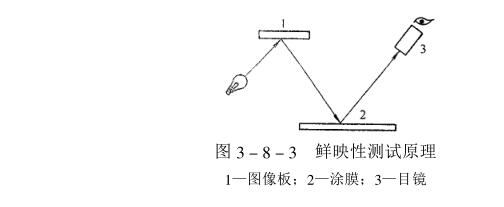
There are 13 rows of numbers that change in size on the digital stone board, and there are DOI values marked next to each row of numbers, which are 0.1, 0.2, 0.3, 0.4, 0.5, 0.6, 0.7, 0.8, 0.9, 1.0, 1.2, 1.5, 2.0, etc., the higher the DOI value, the smaller the row of numbers and the more difficult to identify. The smallest row of numbers that can be clearly identified during the test, and the DOI value marked next to it is the distinctness of image of the paint film.
In GB/T13492-92, there are regulations on distinctness of image for various types of automotive topcoat I-type topcoat, and the requirement is to reach 0.6~0.8. In fact, high-cost car coatings require a DOI value of 1.0 or more, and luxury cars require a DOI value of 1.2 or more, with mirror image clarity.
The freshness of image Testers include the domestic QYG type, the American Pe11egrini imager and the Japanese PG0_4 clearness of imager.
- 1Determination of the distinctness of image film: the fusion of beauty and performance
- 2Determination of the freshness of coating film by freshness Tester
- 3What are the instruments and methods for measuring film distinctness of image?
- 4Summary of several film performance tests
- 5Film Appearance Color Detection
- 6Film Appearance Orange Pattern Detection
- 7Film Appearance performance --- Gloss detection
- 8Film Appearance performance test summary
- 9Analysis of film surface distinctness of image and sheet metal defects
