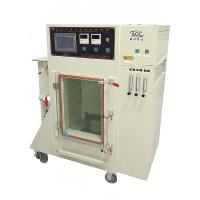
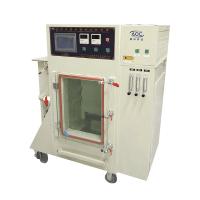
Film salt spray test
In the coastal area, because the atmosphere is full of salt spray, it has a strong corrosion effect on metal products, and also puts forward strict requirements for the protection measures in the coastal area. Therefore, in the research of anti-corrosion protection, people have always used salt spray test as the method of artificially accelerated corrosion test. However, in the process of salt spray test, due to the influence of various factors such as salt spray concentration, spray pressure, spray particle size, and salt spray settlement, the results obtained in different types of test equipment are quite different, and there are also some controversies. But it is still widely used.
The salt spray test is divided into neutral salt spray test (ss) and acetic acid salt spray test (Ass).
Neutral salt spray is in accordance with the provisions of GB/T1771-91, the concentration of sodium chloride aqueous solution is 50g/L±10g/L, the pH is 6.5~7.2, and the temperature is 35°C±2°C. The test plate is 150mmx70mm, and the one that needs to be crossed is 150mmx100mm, and the height of the scratches on either side should be greater than 20mm. The test panel is inclined at 25°±5°, and placed in the salt spray chamber for continuous testing with the tested side facing up. The inspection is performed every 24 hours, and the time for each inspection should not exceed 60 minutes, and the surface of the test panel is not allowed to be in a dry state. . Take it out after the specified time, check and record blistering, rust, adhesion and corrosion spread from scratches. Other standards for neutral salt spray include IS07253, ASTMB117, etc.
The acetic acid salt spray test is to improve the effect of the corrosion test (GB10125-88). The pH of the salt spray is 3.1~3.3, and copper chloride is added to the acetic brine to modify the acetic salt spray test (cAss) to further speed up the corrosion test.
The salt spray test is also combined with the wet and dry test, and is used as a cyclic corrosion test assessment for automotive coatings. For example: at 35°C, spray 5% NaCl solution for 4h→60°C, RH<35%, dry for 2h→50°C, RH>95%, humidity test for 2h, repeat this cycle.
- 1Working Principle and Application Analysis of Ceiling Salt Spray Tester
- 2Principle, significance and method of salt spray test
- 3Salt spray test NSS, ACSS, CASS difference
- 4Different test methods and similarities and differences of salt spray test
- 5Salt Spray Tester in salt spray testing
- 6Hardware salt spray test method
- 7Cyclic corrosion test and its test procedures
- 8The principle and application of salt spray corrosion Test Chamber, the operation and selection method
- 9How Salt Spray Tests Improve the Quality of Metal Plating and Coatings
-
![HZAOC LSO2-100 SO2 corrosion Test Chamber]() HZAOC LSO2-100 SO2 corrosion Test Chamber$ 15010.00
HZAOC LSO2-100 SO2 corrosion Test Chamber$ 15010.00 -
![HZAOC SO2-300 SO2 corrosion Test Chamber]() HZAOC SO2-300 SO2 corrosion Test Chamber$ 15243.00
HZAOC SO2-300 SO2 corrosion Test Chamber$ 15243.00 -
![HZAOC SO2-250 SO2 corrosion Test Chamber]() HZAOC SO2-250 SO2 corrosion Test Chamber$ 15243.00
HZAOC SO2-250 SO2 corrosion Test Chamber$ 15243.00