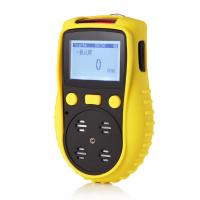
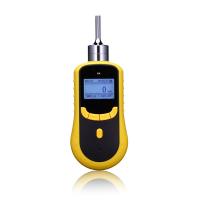
TASI-651 CO Tester operating instructions
Carbon Monoxide Meter Operating Instructions
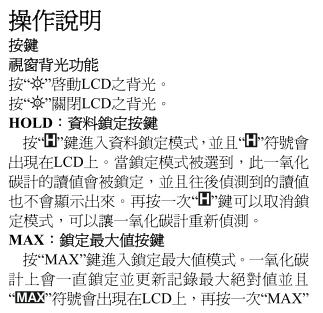
This carbon monoxide meter can detect low concentration (PPM) carbon monoxide. It can also detect the presence . The sensor principle of this carbon monoxide meter is to use redox method without consuming any chemical substances. The useful life depends on the environment to which it is exposed. Commonly used applications are: detecting whether the indoor carbon monoxide concentration is higher than the outdoor carbon monoxide concentration or detecting the source of carbon monoxide. Very sensitive to carbon monoxide detection. When the concentration of carbon monoxide is higher, the sound of the horn will be higher and faster. The frequency of the sound of the horn increases with the increase of the concentration, and when it exceeds about 200PPM, the sound of the horn will continue to sound. This carbon monoxide meter uses a 3.5-digit LCD display to display the concentration of carbon monoxide and is designed for one-handed operation with a backlight function.
Precaution
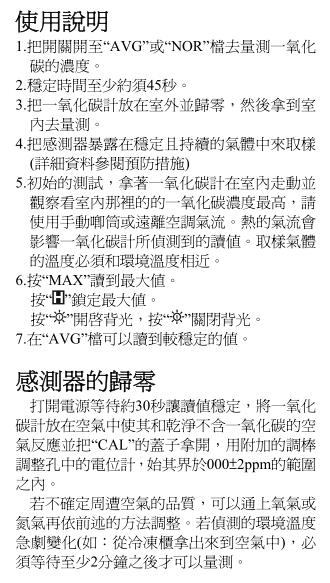
1. Don't put the carbon monoxide meter in the engine exhaust port or places with high concentration of carbon monoxide or in highly polluted gas to detect. High concentrations of carbon monoxide and other air pollution can damage the sensor.
2. Do not put the carbon monoxide meter directly into the airflow of the exhaust port or vent of the air conditioning equipment to take a reading.
3. Wait enough time for the carbon monoxide and the temperature to reach a constant level. The gas to be measured needs to be stable and the temperature needs to be between , and the humidity needs to be between 15% and 90% relative humidity. Changes in temperature and humidity can cause transient readings to change. For better results, use a manual pump to too hot and the relative humidity to equalize with the room.
General Specifications
Display: 3 1/2 digit liquid crystal display (LCD) display, the maximum reading value is 1999.
Low battery indication: When the battery voltage is lower than the normal operating voltage , the "  " symbol will be displayed.
Operating Environment: Temperature 0°C to 40°C (32°F to 105°F)
Relative humidity 15% to 90%RH.
Storage Environment: Temperature -20°C to 60°C (-4°F to 140°F)
Relative humidity 0% to 80%RH.
(The battery must be removed from the carbon monoxide meter)
Batteries: 1.5Vx4pcs (AAA size) UM-4 R03.
Battery Life: The carbon-zinc battery can be used for about 200 hours. (No current consumption in shutdown state)
Dimensions: 18.9 cm (height) x 6.7 cm (width) x 3.5 cm (thickness).
Teans TASI-651 carbon monoxide Tester weight: about 160 grams (including batteries).
Carbon monoxide Detector and broken heat exchanger
A carbon monoxide Detector will not tell you if the heat exchanger is good or bad . A carbon monoxide Detector can tell you that the heat exchanger is broken if the following conditions occur at the same time:
1. Excessive production of carbon monoxide by combustion (lack of oxygen, excess fuel , high temperature).
2. Excessive exhaust gas leakage is ejected from a cracked heat exchanger.
3. The leaking exhaust gas from the rupture of the heat exchanger is diluted a lot before it touches the sensor. A cracked heat exchanger can leak tiny streams , so you can get high concentrations at the point of a leak, but only low readings an inch away.
4. The heat exchanger is the source of your energy to measure carbon monoxide.
safety information
It is recommended to read the Safety and Operating
Health Effects of Carbon Monoxide Concentrations:
0 to 1ppm general environment
9ppm maximum allowable exposure to this environment for 8 hours (US Environmental Protection Agency)
35ppm maximum allowable exposure to this environment for 1 hour (U.S. Environmental Protection Agency)
50ppm maximum allowable exposure in this environment for 8 hours (OSHA)
100ppm flowing gas UL2034 specification for a maximum exposure time of 100 minutes
200ppm 2-3 hours feel headache, fatigue, dizziness, nausea, UL2034 specification is the maximum exposure time is 35 minutes
400ppm 1-2 hours: feel headache, 3 hours: life-threatening, UL2034 specification is the maximum exposure time is 15 minutes
800PPM for 45 minutes: dizziness, nausea, and convulsions , death within 2-3 hours
1600PPM 1 hour death
64 00PPM 50 minutes dead
12800PPM 3 minutes death
The above effects vary according to age, sex, body weight and health status.