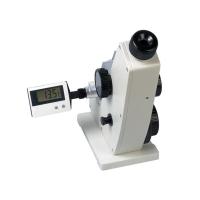
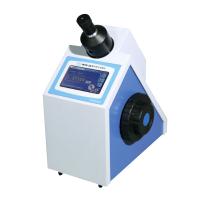
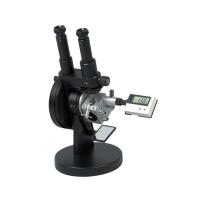
Abbe refractometer related introduction
The Abbe refractometer is used to measure the optical constant refractive index and average dispersion of transparent, translucent liquids or solids. Through the determination of the refractive index and average dispersion, the optical properties, purity, concentration and dispersion of the material can be known. The instrument can measure the percentage of sugar content in sugar solution. It is a commonly used instrument in petroleum, medicine, food crystal, daily chemical and other industrial departments, schools and scientific research units.
1. Basic principles
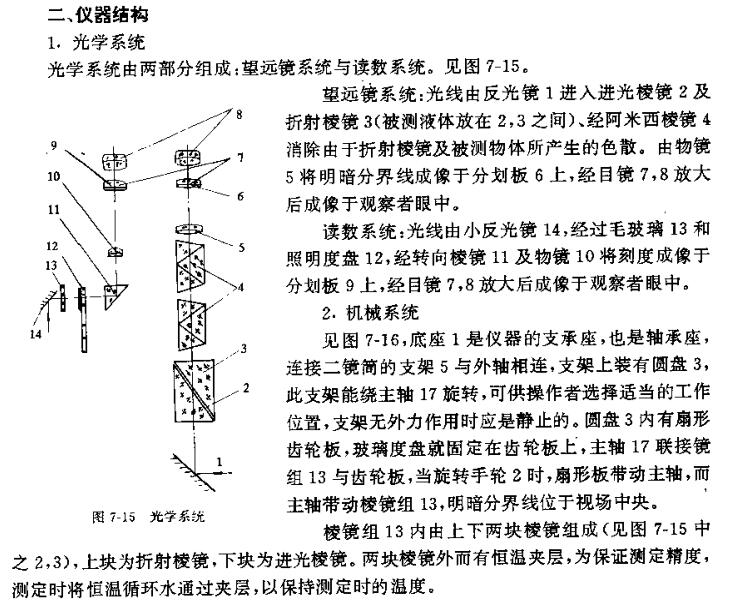
Since light travels at different speeds in different media, refraction occurs when monochromatic light passes from one transparent medium to another. At a certain temperature, the ratio of the sine of the incident angle i to the sine of the refraction angle r is equal to the ratio of its propagation speed v 1 to v 2 in the two media , and the ratio n, 2 is the refractive index, that is, the refractive index, Right now

When it is qualitative, it bends to the normal line (Fig. 7-14). At a certain temperature, the refractive index n,2 is a constant for two given media, so when the incident angle i increases, the refraction angle r must also increase correspondingly, when i reaches the maximum value π/2 , the resulting refraction angle rc is called the critical refraction angle. Apparently, the light incident on the left side of the normal line in the figure is refracted into the second medium, and the refracted lines should all fall within the critical refracted angle r. At this time, if an eyepiece is disposed at M, half light and half darkness appear on the mirror. It can be seen from formula (7-7) that when a medium is determined, the size of the critical refraction angle r. properties of a medium) have a simple functional relationship.

- 1Tips for finding the light and dark boundary of Abbe refractometer [including video explanation]
- 2Application scheme of Abbe refractometer for oil detection
- 3Measurement of oil refractive index by Abbe refractometer
- 4Suoguang WYA-2S Digital Abbe Refractometer Operation Manual
- 5Abbe refractometer operation method and precautions
- 6Instructions for refractometer operation
- 7Optical Path Seat Analysis of Fully Automatic Abbe Refractometer
焦艳艳; 吴建民 - 《一种新型折射仪的光路座分析》
- 8Comparative analysis of several common oil fat detection methods
曹玉华; 杨慧萍; 孙香玲 - 《几种油料粗脂肪测定方法的对照》
- 9Introduction to several methods of liquid refractive index
辛督强;朱民;解延雷;张涛 - 《测量液体折射率的几种方法》
-
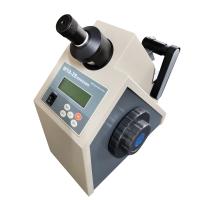
![SUOGUANG WYA-2S digital Abbe refractometer, LCD digital display, with printing interface]()
-
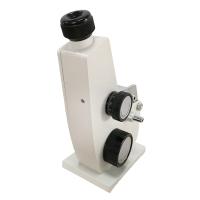
![INESA WYA (2WAJ) Abbe refractometer for determination of refractive index and average dispersion]()
-
![SUOGUANG 2WAJ Monocular Abbe refractometer, measuring range 3000-1.7000 nD]()
-
![INESA WYA-2S digital Abbe refractometer]() INESA WYA-2S digital Abbe refractometer$ 1700.00
INESA WYA-2S digital Abbe refractometer$ 1700.00 -
![INESA WYA-3S digital Abbe refractometer 8 measurement modes]()
-
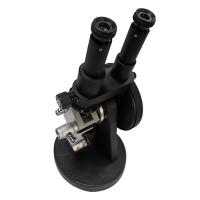
![INESA WYA-2W Abbe binocular refractometer]()