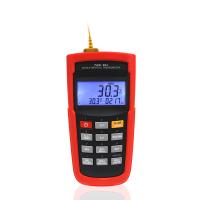
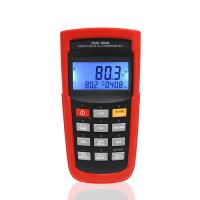
Thermocouple measurement principle and characteristics
1. Principle of temperature measurement
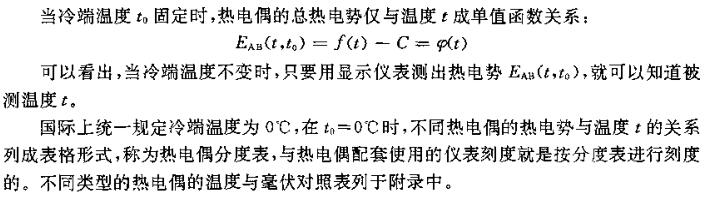
The thermocouple is welded by conductors A and B of two different materials. In practical applications, in order to measure the thermoelectric potential, only the measuring end (called the working end or hot end) is welded together, and the other end is separated into a free end (cold end), thus forming a thermocouple. A single conductor is called a thermode. Connect the thermocouple and the display instrument together through the free end through a wire to form a closed loop, that is, a complete temperature measurement system, as shown in Day 9-24. If the working end is heated or corroded by a heat source, its temperature is t, which is greater than the temperature of the cold end. Then it can be seen on the display instrument that there is thermoelectric potential generated in the closed loop, and the displayed value increases with the increase of temperature. Potential.
There are two main reasons for generating thermoelectric potential: the first is that the materials of the two conductors are different, and their free electron densities are different, so a contact potential is generated on the contact surface of the two conductors; the second is that the same conductor due to the temperature at both ends The temperature difference potential is generated due to the difference, among which the contact potential is the main one.

2. Types and characteristics of commonly used thermocouples
The types of thermocouples commonly used in laboratories and their characteristics are listed in Table 93.
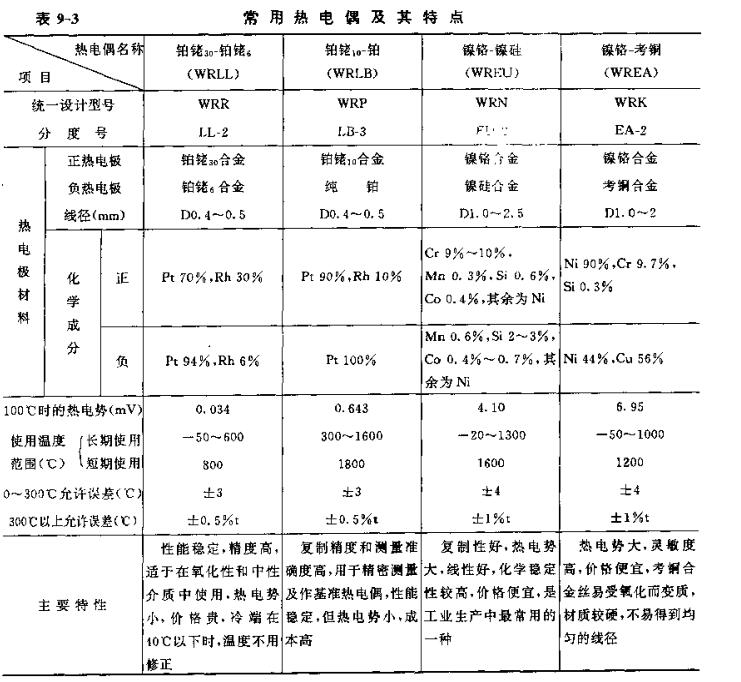
The thermal electrode in front of the thermocouple name is the positive pole, and the latter is the negative pole. For example, the platinum energy-platinum thermocouple, the platinum energy is the positive pole, and the platinum is the negative pole. The thermocouple cold end is marked with positive and negative polarity marks in the junction box. If the meaning of the mark is unclear or there is no junction box, the method shown in Table 9-4 can be used to judge the positive and negative poles to avoid wrong connection with the instrument.
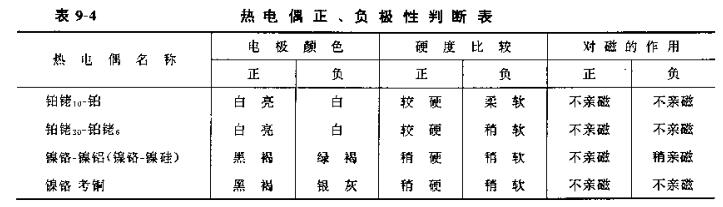
If the polarity of the thermocouple still cannot be judged according to the above table, you can heat it at the working end, and then use a meter to measure the thermoelectric potential. If the reading increases, the one connected to the positive end of the meter is the positive pole, and the other end is the negative pole. This method can also be used to judge the polarity of thermocouples imported from abroad and some special materials.