Detection of inclination fluidity of coating powder
(1) Definition
The oblique fluidity is the distance that the powder is compressed into a test piece of a specified size, and when it is placed at a 65° inclination angle under a certain temperature condition, it will flow when it is melted to the melting point.
(2) Equipment
The temperature of the constant temperature oven is -200°C, and the sensitivity is ±1°C.
Metal plate assembly frame: 50mmx120mm metal frame, installed in the oven, use the external joystick of the oven to keep it in a horizontal position, or at an angle of 65°.
Tin plate: 50mmx12(1mmx(0.2-0.3)mm.
Analytical balance: Sensitivity 0.lmg.
Stopwatch: Scale 0.ls.
Steel ruler: the scale is 0.5mm.
Steel sample compression molder: capable of preparing powder test pieces with a thickness of 6mm and a diameter of 12.7mm (refer to Figure 104 for processing)
(3) Test procedure
 ① Weigh 0.5~0.7g of powder coating and put it into a steel press, and press it into a test piece with a thickness of 6M.
②Put the test piece on the 12.7m-diameter refractory place, and put it on the metal rack in the oven that has been kept at a constant temperature (generally, the curing temperature or the specified temperature), and quickly close the oven door. Keep the metal rack in a horizontal position for 3 min.
③Manipulate the metal frame, tilt it at an angle of 65° from the horizontal position, and keep it at this inertial angle for 30 minutes.
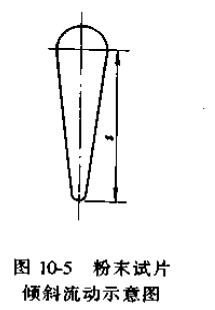
④ Take out the sample plate from the oven, cool it to room temperature and draw a marking line with the maximum flow distance, measure the distance from the center line of the test piece on the original tinplate to the marking line (see s in Figure 10-5), expressed in mm.

- 1Determination of thermal plasticity Resin melt flow rate
- 2Molecular weight and distribution characteristics of polyester resin in thermosetting powder coatings
- 3Density Determination Method and Application
- 4Determination method of cone-plate viscometer and its application
- 5Thermal plasticity polyvinyl chloride (PVC) powder coatings in highway engineering: technical requirements and inspection methods
- 6Determination of compatibility of powder coatings: methods, effects and applications
- 7Evaluation of flowability of powder coatings: key factors and significance
- 8Evaluation and Application of Optical Properties of Powder coatings
- 9Importance of powder coatings curing degree and detection method