How to determine film Adhesion by cross-cutting method?
Scope and description
This method is suitable for assessing the resistance of a coating to detachment from a substrate when the penetration of the coating to the substrate is cut in a rectangular grid pattern. This method is not suitable for coatings with a film thickness greater than 250 μm, nor for textured coatings.
Instruments and Materials
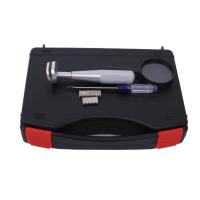
(1) Cutting tool
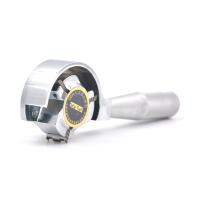
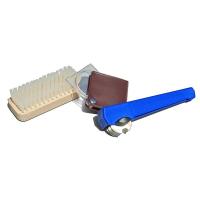
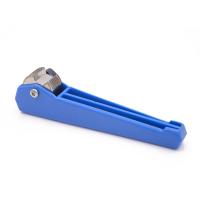
① Single-edged tool, as shown in Figure 1-4-29, is suitable for any substrate. In order to cut the spacing correctly, a series of guide and blade spacing devices are required, as shown in Figure 1-4-30.
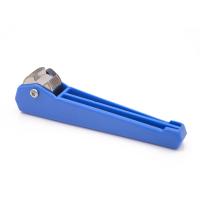
② Multi-edged tool As shown in Figure 1-4-31, it has 6 cutting edges, and the cutting edge interval is 1mm or 2mm (not suitable for thick coating or hard coating greater than 120μm)
(2) Soft brush.
(3) Scotch tape
The width is 25mm, and the adhesion is (10±l ) N/25mm or agreed upon.
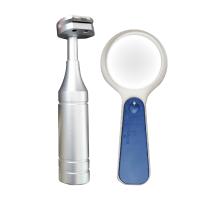
(4) Magnifying glass
The magnification is 2x or 3x.

Figure 1-4-29 Single-edged cutting tool Figure 1-4-30 Sequence of blade spacing
test methods
(1) Select a suitable tool according to the substrate and paint film thickness, and check whether the blade is sharp, otherwise, it should be replaced.
The paint film with a thickness of 0-6 μm and applied on a hard substrate is a cross-cut device with a blade interval of 1 mm; Or the paint film on the soft substrate is a cross-cut device with a blade interval of 2mm; the thickness is 121 ~ 250 μm and applied to a paint film on a hard or soft substrate with a blade interval of 3mm.
(2) Place the painted surface of the sample on a hard, flat surface. Hold the cutting knife so that the knife is perpendicular to the surface of the model, apply force evenly, and draw 6 parallel cutting lines in a steady manner. Then draw 6 parallel cutting lines perpendicular to the original cutting line at an angle of 90° to form a grid pattern. All cuts need to penetrate the surface of the substrate.
(3) Use a soft-bristled brush to gently sweep backwards and forwards several times along each diagonal of the grid pattern.
(4) Apply tape on the sample plate of the hard substrate, remove the front section of the tape, then cut off the tape with a length of about 75mm, place its center point above the grid and flatten it, the length of the tape should exceed the grid by at least 20mm, and ensure that It is in full contact with the paint film (Figure 1-4-32).

Figure 1-4-32 Determine the position of the tape according to the grid Figure 1-4-33 Schematic diagram of tearing off the tape from the grid
(5) Within 5 minutes of sticking the tape, hold the suspended end of the tape, and at an angle of 60° as far as possible with the surface of the sample, tear off the tape smoothly within 0.5~1.0s (Figure 1-4-33) . Then observe the peeling phenomenon of the paint film visually or with a magnifying glass agreed by both parties.
(6) Conduct tests on three different parts of the sample surface, and record the cross-cut test grade.
(7) If a motor-driven cutter is used to cut the coating, the operation steps are the same as manual operation.
The result shows
According to the 6-level classification in Table 1-4-3, evaluate the peeling area of the coating in the cross-cut area of the model.
The results are reported as the consistent results of the three groups of cutting evaluations.
Reference standard
National standard GB/T 9286 "Paint and varnish paint film cross-cut test"

- 1Principle and Application Analysis of Film Adhesion Tester
- 2GB/T 1720 Determination of paint film adhesion: Circle method
- 3Paints and varnishes paint film cross-cut test (GB/T 9286)
- 4Advantages and disadvantages of three methods of film adhesion
- 5Talking about ASTM D4541 film adhesion drawing test
- 6The principle, application, test procedure and result evaluation of cross-cut Tester
- 7Drawing adhesion test purpose, operation method and common problem
吉姆·布朗
- 8What are the tips to prevent sand inclusion and dry spray of paint film?
- 9Analysis of surface defects of blisters/blisters-anti-corrosion coatings