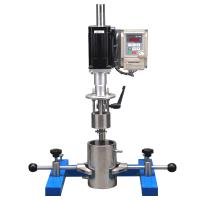
Introduction of emulsion paint grinding and dispersing equipment
The sand mill is composed of a motor, a transmission device, a main shaft, a grinding machine, a dispersion device, a separation device, a frame, and a grinding dispersion medium. Grinding and dispersing media include quartz sand, glass beads, corundum ceramic beads, aluminum oxide beads, etc., and glass beads are commonly used in CHINA. Sand mills are generally divided into vertical and horizontal types.
The main shaft of the vertical sand mill is equipped with multiple dispersing discs, which contain grinding and dispersing media. The motor drives the main shaft to run at a speed of 1000~1500r/min, so that the grinding and dispersing medium is thrown out at a high speed, and bounces back after hitting the grinding cylinder. The grinding material is sent into the sand mill from the bottom, and is dispersed by the shear and impact of the grinding dispersion medium. After multi-stage dispersion, the grinding material reaches the top, and those whose fineness meets the requirements are discharged through the top sieve.
A major disadvantage of the vertical sand mill is that the grinding and dispersing medium will sink to the bottom, which will cause serious damage after parking.
Restarting created difficulties, so horizontal sand mills were developed in the 1970s. Its simplified body and dispersing shaft are installed horizontally, and the distribution of grinding and dispersing media in the axial direction is relatively uniform, thus avoiding this problem.
Although the sand mill has a series of advantages, it is difficult to change the color and clean, and it is only suitable for dispersing low-viscosity, easy-to-disperse pigments and fillers.
Latex paint produced in Europe and the United States generally does not use sand mills
- 1Preparation of Nano Sealing Primer
李琴 - 《吉林大学》
- 2Working principle and advantages of horizontal sand mill
- 3Requirements for materials in the refinement process of vertical sand mill
- 4Production Process of Silk Wallpaper Coatings
- 5Coating production equipment introduction
- 6Preparation of Energy-saving Exterior Wall Thermal Insulation Coatings
- 7Architectural coatings factory production equipment
- 8Polyurethane paint production process
- 9Formulation design and prepative of epoxy silicone high-temperature coatings