How to use Microscope and Precautions
① Preparation before observation
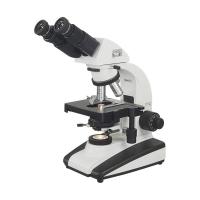
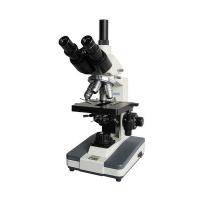
a. When taking the microscope out of the mirror box, hold the mirror arm firmly with your right hand, hold the mirror base with your left hand, place the microscope on the table steadily, about 5cm away from the edge, and do not tilt the straight microscope.
b. Adjust the lighting. Microscopes cannot use direct sunlight, and light or natural light can be used to adjust the lighting through reflectors. Steps to adjust the illumination: First, use a low-magnification objective lens and rotate the coarse adjuster to make the distance between the objective lens and the stage about 3 mm. Then, rotate the condenser screw so that the distance between the condenser and the upper surface of the stage is about 1 mm. Finally, adjust the reflector so that the lighting effect of the field of view is very good (when the light is strong, use a flat reflector). If the effect is not good, it can be further adjusted by opening and closing the aperture diaphragm on the condenser. For the microscope with its own light source, the intensity of light can be adjusted by adjusting the resistance knob.
c. Optical axis center adjustment. When using a microscope with a field diaphragm, first narrow the diaphragm and observe with a low-magnification objective lens, and the polygonal object image of the field diaphragm can be seen in the field of view. Adjust it to the center with an adjusting screw, and then slowly open the field diaphragm until the polygonal object image of the field diaphragm is completely inscribed with the edge of the field of view.
②The use of low power lens and high power lens
a. Lower the mirror stage (or raise the lens barrel), place the specimen piece on the stage, clamp it with the specimen holder, and make the observed specimen directly below the objective lens.
b. Turn the coarse adjuster to raise the stage (or lower the lens barrel), make the front end of the low-magnification objective lens close to the slide, observe on the eyepiece with the left eye, and turn the coarse adjuster to lower the stage (or raise the lens barrel) , until the object image appears, then turn the fine adjuster to make the object image clear. Use the specimen mover to move the specimen slice, find a suitable object image, and move it to the center of the field of view for observation.
c. Turn the objective converter to place the high power lens under the lens barrel. When the microscope is designed and manufactured, it is confocal, that is, after the low-power lens is in focus, it can generally be in focus when switching to a high-power lens, and the object image can be seen, and the object image can be cleared by turning the fine adjuster. Find the part to be observed, and move to the center of the field of view for observation.
③Use of oil mirror
a. Add mirror oil drop by drop. Turn the coarse regulator to lower the stage (or raise the lens barrel), and add 1-2 drops of liquid paraffin or cedar oil to the stained specimen.
b. Change the oil mirror. Rotate the objective converter and place the oil lens under the lens barrel.
c. Focusing. Turn the coarse adjuster to raise the stage (or lower the lens barrel) and let the front end of the lens dip into the lens oil. Observe carefully from the side during operation, and only allow the lens to immerse in the immersion oil and cling to the specimen to avoid the lens hitting the glass slide, resulting in damage to the glass slide and lens. Then observe on the eyepiece, and slowly turn the coarse adjuster to lower the stage (or raise the lens barrel) until the object image can be seen, then turn the fine adjuster to make the object image clear.
If the oil lens has left the oil droplet when the stage is lowered (or the lens barrel is raised) by turning the coarse adjuster, the above focusing operation needs to be performed again. Do not observe on the eyepiece with the left eye while turning the coarse adjuster to raise the stage (or lower the lens barrel) and immerse the front end of the lens into the oil drop, which will easily cause the lens to hit the glass slide and damage the specimen and lens.
d. Adjust the aperture diaphragm and field diaphragm. Open the aperture diaphragm to the maximum to match the numerical aperture of the oil objective. Select the appropriate illumination by adjusting the field diaphragm or the illumination control knob.
e. Disposal of the microscope after use. Turn the coarse adjuster to lower the mirror stage (or raise the lens barrel), take out the specimen slide, and then wipe off the cedar oil on the oil mirror with a lens tissue, and then dip a small amount of xylene with the lens tissue (alcohol is not allowed). Wipe off the oil stained on the oil lens, and finally wipe off the xylene and oil with lens tissue. When liquid paraffin is used as lens oil, it can be wiped off only with lens cleaning paper, without (or only a very small amount of) xylene. Turn the lens into a "eight" shape, put on the lens cover and put it into the microscope box.





- 1Microscope classification, operation and application
- 2How to use trinocular Microscope
- 3How to detect the color difference of fluorescent color-changing materials?
- 4How is the content of non-fibroblasts determined?
- 5 How to measure cell wall thickness and cell cavity diameter?
- 6Determination of Fiber Length How is the distribution frequency calculated?
- 7How to determine the fiber morphology of plant fiber raw materials?
- 8Important instruments in clinical laboratories
- 9Coating Thickness Gauge: How to measure the dry film thickness of non-metallic substrates?