How to calculate Printing ink Film thickness?
A few days ago, I received a consultation from a customer on the WeChat public account of "North and South Tide Mall", how to calculate the ink thickness? This issue answers this question.
In fact, whether it is using the density detection formula in the Colorimeter or using the spectrodensitometer to measure the ink problem in the printing industry, their calculation formulas are the same, but the measurement form has changed, but the result will not change.
The use density value caused by the nature of the ink itself is not directly proportional to the thickness, but presents a more complex relationship model, and is also related to the size of the paper. Experiments have proved that the optical density D of the ink does not increase infinitely because of the thickness of the ink. There is a saturation value here. Using the Colorimeter and densitometer to detect, we will find that when the ink thickness is around 10μ, the light intensity is basically in a stable state, that is, it has reached a saturated state. Assuming the density value at saturation state, the following relationship can be written:
dD=m(D∞-D)·dl
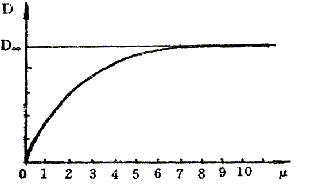
After integration and sorting, there is: D=D∞(1-e-ml) where m is a constant related to the smoothness of printing paper.
In the formula, the density D and ink thickness l can be determined experimentally, so that the other two parameters D∞-1 and m in the formula can be obtained.
For example, use newsprint on the printing suitability Tester (IGT), carry out embossing with l1=1.097μ, l2=2.194μ, and measure the corresponding density as D1=0.69, D2=1.01, then the equation can be written according to the appeal equation :
D1=D∞(1-e-ml1)
Eliminating D∞l, we have
D1=1-e-ml1/1-e-ml2·D2
0.69=1-e-mx1.097/1-e-mx2.194×1.01
D2=D∞(1-e-ml2)
Solve the equation to find the paper smoothness constant
m=0.571
The density value at the saturation state can be obtained from the formula above:
D∞=D1/(1-e-ml1)=0.69/(1-e-0.57lx1.097)=1.484
Substituting the obtained parameters D∞ and m into the formula, the calculation formula for the relationship between ink density and thickness suitable for newsprint can be obtained:
D=1.484 (1-e-0.571l)
The Lambert-Beer law we know is launched under satisfactory conditions. We know that it is impossible in real life to fully satisfy the calculation conditions. This law only considers the absorption of ink, without many factors in the actual printing process. Not to mention the influence of substrate paper, plastic, etc. on ink transfer and color quality, so there are differences between theoretical calculations and actual densitometer or Colorimeter measurement results. However, although the actual situation varies widely and there are many types of influencing factors, "absorption" is still the root cause of the ink's fineness.
The above is an introduction to the calculation method of ink thickness, and I hope it can be used as a reference for relevant operators in the industry.