Rapid determination method of oil color
Using the stepwise linear regression method, the absorbance value of the Lovibond colorimetric film in the wavelength range of 400-700nm was regressed with the nominal value of the Lovibond colorimetric film, and the wavelength of 535nm was determined as the specific wavelength for measuring the Lovibond red value of oil. The absorbance values of 14 parts of sesame oil, 18 parts of rapeseed oil, 15 parts of peanut oil, corn oil and cottonseed oil at specific wavelengths were regressed with their Lovibond red values, and the correlation coefficients were 0.903-0.964. A rapid method for the determination of oil color was established. The method is simple and fast, and the determination results are objective and accurate.
0 Preface
Color is one of the important quality indicators of oil. The Lovibond colorimetric method is an internationally accepted method for measuring oil color. The method is based on visual readings. The readings have large deviations, and the instrument is expensive and has a single purpose. Some people in CHINA determine the color of oil by measuring the content of chlorophyll, lutein and other pigments in oil [1], and some people use potassium permanganate, potassium dichromate and iodine solution to make color scales, and determine the color of oil by comparing with oil [2] ], none of these methods can accurately reflect the Lovibond color value of oil.
In this paper, the linear regression method was used to process the data of Lovibond values and absorbance values at specific wavelengths of 48 different oil samples. The verification results showed that the spectrophotometric method was fast and simple, and the repeated determination range was 0.02, while the repeated determination range of the Lovibond colorimetric method was 0.4.
1 Materials and methods
1.1 Experimental materials
Lovibon color comparison sheet; dark oil: 14 parts of sesame oil; darker oil: 18 parts of rapeseed oil; light oil: 15 parts of peanut oil, soybean oil, cottonseed oil.
1.2 Experimental equipment
Model 721 Spectrophotometer ; Spectrophotometer data processing device (self-developed); Hitachi 330 Spectrophotometer ; P-E3600 data table; Lovibond Colorimeter.
1.3 Experimental method
Using Hitachi 330 Spectrophotometer and P-E3600 data station, the spectral data of Lovibond red, yellow and blue colorimetric chips in the 400-700nm wavelength range were measured, and the stepwise linear regression method was used [3] to analyze the Lovibond red, yellow and blue Process the spectral data and their nominal values of the three groups of colorimetric chips to find out the specific wavelength that can represent the optical characteristics of the three groups of colorimetric chips.
The 721-type Spectrophotometer and the Spectrophotometer data processing device were connected online to measure the absorbance value of the oil at a specific wavelength, and linear regression was performed between it and the Lovibond value of the oil to establish a regression equation.
2 Results and Discussion
2.1 Spectral characteristics of Lovibond color chips
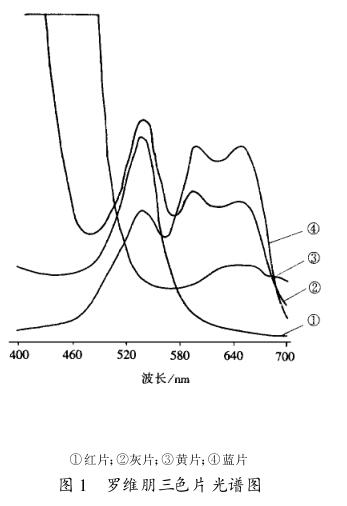
The spectrum diagram of Lovibond colorimetric film is shown in Figure 1. It can be seen from the figure that the absorption peak wavelength of the red film is 535nm; the absorption peak wavelength of the yellow film is 630nm and 650nm, which is a two-color composite film; Three-color composite film; the gray film is composed of three colorimetric films of red, yellow and blue, and is used to adjust brightness.
Lovibond colorimetry is carried out according to the principle of subtractive color mixing, but the three-color film is different from the three primary colors defined in colorimetry. Therefore, the Lovibond value cannot reflect the chroma of the oil, or in other words, the color of the oil determined by the principle of colorimetry cannot represent its Lovibond value.
2.2 Specific wavelength selection
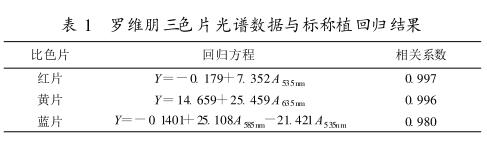
The absorption peak wavelengths of the three groups of color chips were initially selected as the reference wavelength, and the spectral data of the three groups of color chips and their nominal values of Lovibond were subjected to stepwise linear regression processing results as shown in Table 1. The characteristic wavelength of the red film is determined to be 535nm, the characteristic wavelength of the yellow film is determined to be 635nm, and the characteristic wavelength of the blue film is determined to be 535nm and 585nm.
2.3 The relationship between oil absorbance value and Lovibond red value
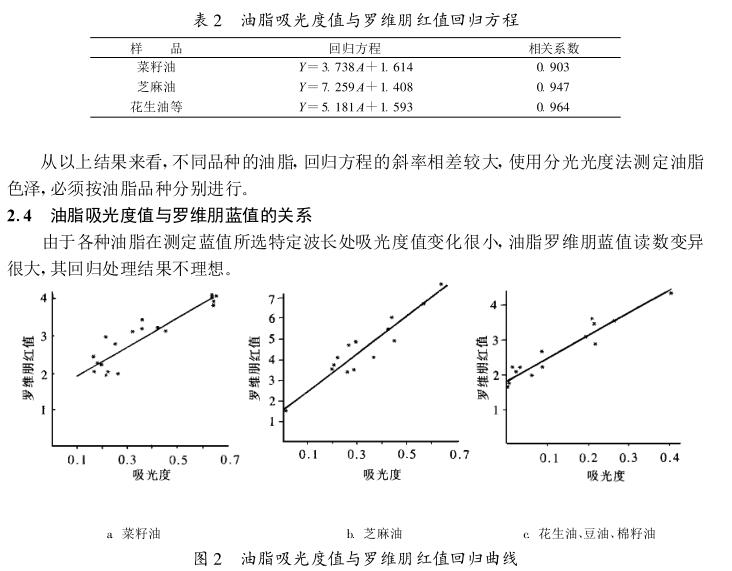
The absorbance values of 14 parts of sesame oil, 18 parts of rapeseed oil, 15 parts of peanut oil, corn oil and cottonseed oil at specific wavelengths were regressed with their Lovibond red values. The results are shown in Table 2 and Figure 2.
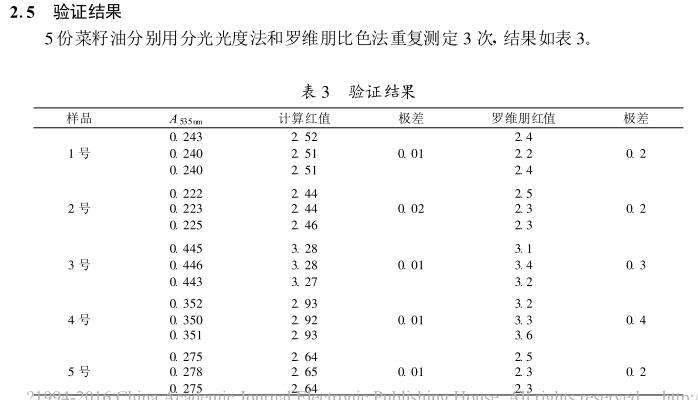
The measurement results of Lovibond colorimetry vary from person to person, and the variation range is large. In the same person's multiple measurements, the first measurement result often affects the subsequent measurements, and the eyes are not sensitive to color value adjustment. The results of spectrophotometry are stable and objective, and can represent the Lovibond value of oil.