How to measure the thickness of galvanized layer _ galvanized layer thickness inspection method
In the national standard GB/T6463-1986 "Review of Measurement Methods of Metal and Other Overlay Thickness", the overlay thickness measurement methods are divided into two categories: non-destructive method and destructive method. Commonly used nondestructive testing methods include: magnetic method, eddy current method, ray ultrasonic method, X-ray fluorescence method, etc., and destructive testing methods include: weighing method, metallographic microscope method, electrolytic method, etc.
Nowadays, fastener companies generally use: weighing method, metallographic microscope method, magnetic method and ray ultrasonic method to measure coating thickness. Give an introduction below.
1. Weighing method
The national standard GB/T13825-2008 "Weighing Method per Unit Area Mass of Hot-dip Galvanized Layer of Metal Covering Ferrous Metal Materials" points out that the principle of the weighing method is to immerse a sample with a known surface area in a corrosion-inhibiting acid solution, and pass Weigh the mass of the sample before and after the coating solution, determine the mass loss of the sample, and calculate the mass of the galvanized layer per unit area of the sample according to the mass loss of the sample. The unit of mass per unit area of hot-dip galvanizing is expressed in g/m3, which is calculated according to the following formula:

In the formula, M1-------the mass of the sample before deplating, g;
M2-------the mass of the sample after deplating, g;
A -------- The exposed area of the sample, mm2.
The advantage of using the weighing method to measure the thickness of the coating is that the measured result is the average weight of the coating, and the accuracy is high. Therefore, the detection has become a commonly used method for the coating, but different instruments are operated by different operators under different operating conditions. Using the same method for detection, the reproducibility of the results is about ±5% of the mean value. As a more traditional immersion deplating method, it is also challenged in terms of detection method, operation level, environment, equipment and result errors. The destructive test carried out by this method will cause certain losses to the finished product; due to the process The impact of galvanized fasteners is that the layer purity is not enough, contains copper, iron, arsenic impurities, or the galvanized layer is uneven. These defects have a very large side effect on the anti-corrosion performance of the product, but it is difficult to find these problems through the results of the galvanized amount measured by the weighing method.
2. Metallographic microscopy
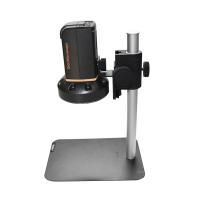
The national standard GB/T6462-2 005 "Measurement method of cross-sectional thickness of metal and oxide coating layer by microscope" pointed out that the microscope method to measure the thickness of coating layer is simple and intuitive, and its basic principle is: select representative After proper sample preparation, through a metallographic microscope, under image magnification, use a calibrated eyepiece micrometer or a high-precision ruler to measure the width of the cross-section of the covering layer, which is the thickness of the covering layer. Today, with the development of optical microscopes to digital photoelectric image display, digital microscope image detection technology has begun to be applied to the field of coating thickness measurement. This technology uses a high-resolution CCD and CMOS camera to convert the optical image of the microscope to the computer, and then uses a dedicated measurement software system for image measurement. The microscope measurement technology of coating thickness was applied earlier and widely used at home and abroad. Its outstanding features are: ①Intuitive and good reproducibility. ②The measurement range is wide, not affected by the thickness of the covering layer, and can be accurately measured from a few microns to hundreds of microns. ③Wide range of applications, not only can measure various electroplating layers and oxide films, but also can measure glazed porcelain, etc. ④The measurement is destructive, and the product must be scrapped by this method. ⑤ The measurement level has a lot to do with the technique of the test personnel, and proficiency in the technique will help to improve the accuracy of the measurement results.
It is precisely because of the above-mentioned characteristics of the thickness measurement by the microscope method that this method is often used for arbitration, or for measuring fastener products with high precision, or for correcting other thickness measurement methods.
3. Magnetic method
The national standard GB/T4956-1985 "Magnetic Method for Measuring the Thickness of Non-magnetic Covering Layers on Magnetic Metal Substrates" points out that the principle of the magnetic measurement method is to measure the magnetic attraction between the permanent magnet (probe) and the base metal due to the presence of a covering layer. , or measure the change in reluctance across the magnetic circuit between the overlay and the base metal. Therefore, magnetic Thickness Gauges also include two types, one is to measure the magnetic attraction between a certain magnet and the base metal, and the other is to measure the reluctance through the magnetic path of the coating and the base metal.
The thickness measurement principle of the magnetic suction thickness measurement method: the suction force between the permanent magnet (probe) and the magnetic steel is related to the distance or a certain proportional relationship between the two, and this distance is the thickness of the covering layer. Using this principle to make a Thickness Gauge, as long as the magnetic permeability between the covering layer and the base material is large enough, it can be measured.
The basic principle of the magnetic induction Thickness Gauge: use the non-ferromagnetic coating on the substrate to form a non-ferromagnetic gap in the measuring magnetic circuit, so that the magnetic induction of the coil is weakened. When measuring the thickness of the magnetic coating on the non-ferromagnetic substrate When the coating thickness increases, its magnetic induction will also increase. The Thickness Gauge using the principle of magnetic induction can measure the thickness of the non-magnetic coating on the magnetic substrate in principle. Generally, the magnetic permeability of the substrate material is required to be above 500H/m. If the overlay material is also magnetic, the difference in permeability from the base material is required to be sufficiently large (such as nickel plating on steel).
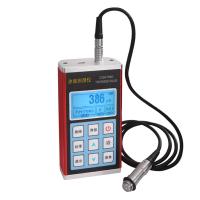
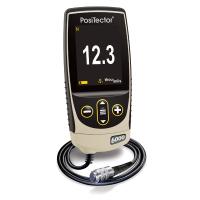
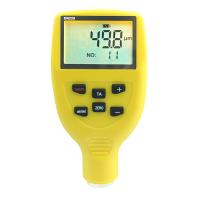
The magnetic principle Thickness Gauge can be used to accurately measure the phosphating layer, electroplating layer, paint layer or enamel, plastic coating, etc. on the surface of steel fasteners. The modern magnetic induction Thickness Gauge has a resolution of 0.1μm, an allowable error of 1%, and a range of 10mm. It is characterized by the advantages of non-destructive, fast and direct measurement of any place on the surface to be inspected. At the same time, it is easy to operate, durable, does not need power supply, does not need to be calibrated before measurement, and is low in price. It is suitable for quality control on the workshop production site.
4. Ultrasonic method
The national standard GB/T11344-1989 "Contact Ultrasonic Pulse Echo Method Thickness Measurement" points out that the ultrasonic Thickness Gauge is based on the principle of ultrasonic reflection to measure the thickness. When the ultrasonic pulse emitted by the probe reaches the material interface through the measured object When the pulse is reflected back to the probe, the thickness of the material under test can be determined by accurately measuring the time that the ultrasonic wave travels in the material. All kinds of materials that can make ultrasonic waves propagate inside them at a constant speed can be measured by this principle.
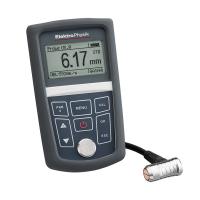
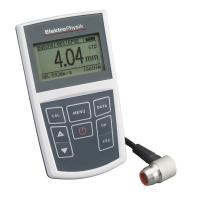
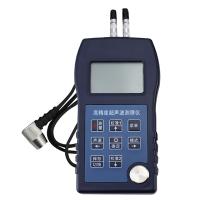
The ultrasonic Thickness Gauge has the following characteristics: ultra-light and ultra-thin body, easy to operate with one hand; two-point calibration function; makes the measured value more accurate; unique blue background light, clear visibility in various environments, low function , Two dry batteries can be used for more than 200h; suitable for measuring all sound-conducting materials, such as steel, iron, ceramics, plexiglass, etc. However, it has not been used in CHINA at present, and very few foreign manufacturers have such instruments, which are suitable for multi-layer coating thickness measurement or occasions where magnetic thickness measurement and eddy current thickness measurement cannot be measured. Its remarkable feature is that it only needs one measurement to determine the total thickness of multi-layer coating and the specified thickness of each layer, and the accuracy can reach (2μm±3%).



- 1Microscope classification, operation and application
- 2How to use trinocular Microscope
- 3How to detect the color difference of fluorescent color-changing materials?
- 4How is the content of non-fibroblasts determined?
- 5 How to measure cell wall thickness and cell cavity diameter?
- 6Determination of Fiber Length How is the distribution frequency calculated?
- 7How to determine the fiber morphology of plant fiber raw materials?
- 8Important instruments in clinical laboratories
- 9Coating Thickness Gauge: How to measure the dry film thickness of non-metallic substrates?