Film thickness measurement methods for Destructiveness coating
The thickness of the coating is one of the important signs to measure the quality of the coating. The thickness of the coating greatly affects the reliability and use value of the coated product. Through the detection of coating thickness, in addition to evaluating whether the coating with tolerance index or repair size requirements is reasonable, it can also directly or indirectly evaluate the corrosion resistance, wear resistance, porosity and other properties of the coating. Therefore, it is very important in coating quality inspection and process research.
Coating thickness measurement method
The inspection of coating thickness is generally divided into two methods: average coating thickness and local thickness. Since the local thickness reflects the quality of the product more than the average thickness in practical applications, in most cases, the local thickness and local average thickness of the coating are measured. When measuring thickness, at least three thicknesses should be measured representatively or not specified, and the average value should be calculated as the result of thickness measurement.
There are two types of coating thickness inspection methods: destructive testing method and non-destructive testing method (also called non-destructive testing method). There are many kinds of destructive testing methods, such as droplet method, liquid flow method, chemical solvent method, Coulomb method, metallographic microscope method, contour method and interference microscopy method; Thickness method, β-ray backscattering method, etc. The destructive thickness measurement method is generally suitable for non-precious coatings or products processed in large quantities, while the non-destructive thickness measurement method is suitable for some expensive or precise coating products.
Introduction to thickness measurement method
Since lossless has been explained a lot on the Internet, let's introduce the destructive method!
1. Time flow method
Principle: The time-flow liquid method belongs to the chemical method. Its principle is to use a certain composition of the test solution to form a thin stream at a certain flow rate. Liu Xiang partially measures the surface of the coating, and the coating is dissolved under the action of the solution, which can be visually observed. In the case of the coating, until the coating is completely dissolved and the color of the bottom metal appears as the end point, the coating thickness is calculated according to the time it takes for the tested part to dissolve completely.
2. Dissolution method
Principle: The coating on the tested sample is dissolved with a solution that does not damage the base metal. Coating solutions can be applied chemically or electrochemically. The thickness of the coating is calculated according to its dissolution weight loss and the part of the surface area that goes out of the coating. In general, the weight loss of the coating can be determined by chemical analysis or weighing.
3. Coulomb method
Principle: On the known area of the surface of the coating to be tested, the coating is used as an anode in the corresponding test solution with a constant current density to dissolve the coating. When the coating metal is dissolved and the base metal or intermediate coating is exposed, A sudden change in cell voltage indicates that the endpoint has been reached. The local thickness of the coating is calculated according to Coulomb's law, the area of the coating dissolved by the current consumed by the dissolved coating metal, the electrochemical equivalent of the coating metal, the density, and the current efficiency of the anodic dissolution.
4. Metallographic microscopy
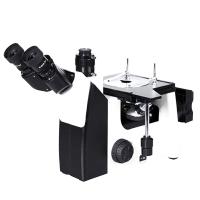
Principle: Metallographic microscope thickness measurement is a method of observing and measuring the cross-sectional thickness of the coating to be tested by using a special metallographic microscope with a certain magnification and a micrometer eyepiece.
5. Drop method
Thickness measurement by drop method is the most convenient coating thickness measurement method. Its advantage is that the instrument is simple and the method is convenient. But the disadvantage is that the accuracy rate is low, and the general accuracy is ±20%. At the same time, this method is not suitable for parts with complex shapes and small parts, so it is only used as a reference for rough measurement methods. The principle is to drop the solution with a certain composition on the surface of the coating to be tested through a dropper with a tip of 1.5-2.0 mm in diameter, and keep it for a certain period of time to dissolve the coating until the coating is completely dissolved and the substrate and the underlying metal coating are exposed. layer. Coating thickness is calculated in drops of solution consumed.

- 1Microscope classification, operation and application
- 2How to use trinocular Microscope
- 3How to detect the color difference of fluorescent color-changing materials?
- 4How is the content of non-fibroblasts determined?
- 5 How to measure cell wall thickness and cell cavity diameter?
- 6Determination of Fiber Length How is the distribution frequency calculated?
- 7How to determine the fiber morphology of plant fiber raw materials?
- 8Important instruments in clinical laboratories
- 9Conductive and non-conductive coating thickness measurement and testing skills
zetec