Colorschemer studio SRICI-PIP and its accuracy evaluation
This paper introduces the basic optical principle and algorithm of a software SRICI-PPI for computer color matching of pigments/plastics, coatings and inks. The software is based on the double constant method of Kubelka-Munk theory, and uses the matrix equation derived under the condition that the three stimulus values are equal to calculate the formula. Its accuracy has been compared with two foreign pigment color matching software based on different types of optical theory, and the results are satisfactory. Experiments have proved that different types of optical theories are not the decisive factors for the accuracy of software color matching, and software designed with more complex 3-flux theories cannot achieve significant improvements in performance/price ratio.
1. The optical theoretical basis and algorithm of the pigment color matching software SRICI-PPI
The computer color matching of pigments is different from dyes/textiles. Due to the following two reasons, the problem is greatly complicated: (1) Pigments exist in the form of particles in the material to be colored, so the scattering of pigment particles (Scattering) plays a role in color matching. very important role.
(2) Pigments can be used in various aspects such as plastics, coatings, inks, etc. The coloring media are various, some require complete hiding power, and some have certain requirements for transparency. Therefore, the simpler single-constant approach of the Kubelka-Munk theory, which can be used for dye/textile color matching, is no longer applicable.
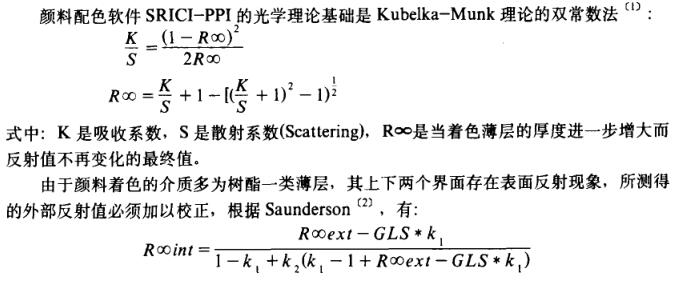
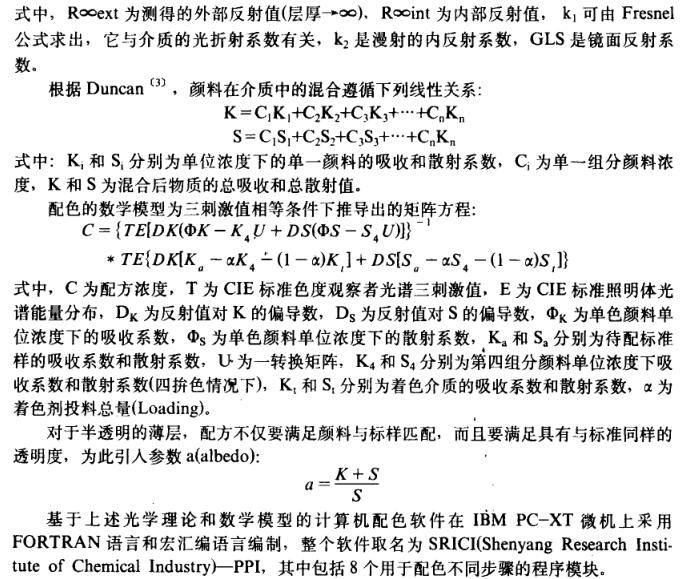
The optical theory basis of the pigment color matching software SRICI-PPI is the double constant method of Kubelka-Munk theory:
2. Accuracy evaluation of SRICI-PPI color matching software
The color matching accuracy of SRICI-PPI is evaluated by parallel comparison with the following two sets of foreign color matching software:
(1) At present, the pigment systems sold in the international market are all based on the double constant method of Kubelka-Munk theory. The pigment color matching software package of the MILTONROY/DIANOMM-350 color matching system in the United States is one of them. Its color matching accuracy has reached It is recognized among users distributed all over the world.
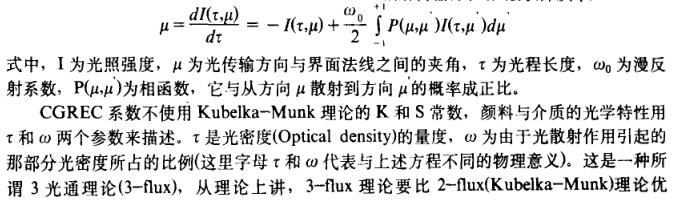
(2) The Physical Research Center and Pigment Department of CIBA-GEIGY have developed a new set of pigment color matching software CGREC, whose optical theory is based on ChandrsSekhar's radiation transfer equation (in layered media):


3. Discussion
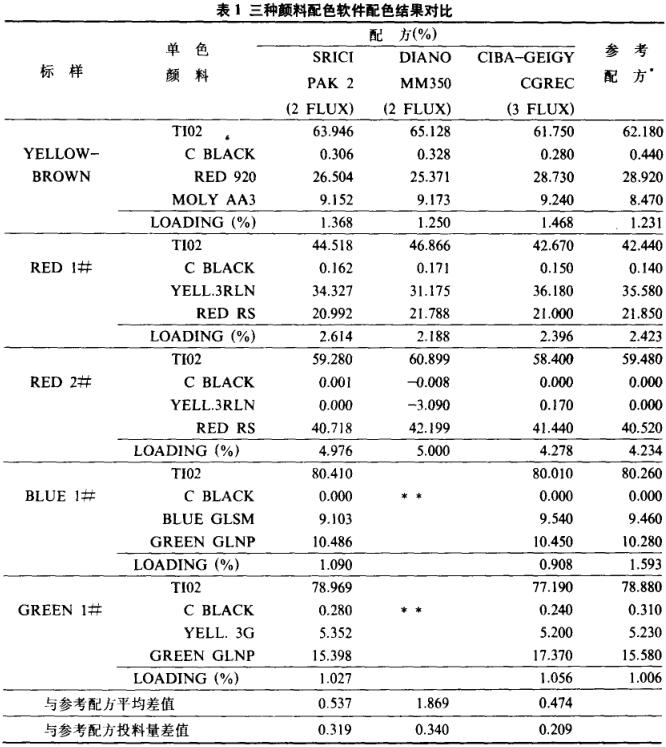
1.对采用以2-fluxKubelka-Munk理论为基础的配色计算方法是否能满足工业实际应用的准确度要求,历来存在不同看法。然而,在配色软件SRICI-PPI编制过程中,对Kubelka-Munk模式进行适当的修正,这样算得的配方与基于3-flux模式的软件CGREC计算的配方并无明显的差别,这一差异要小于基于相同光学理论模式(2-flux)的软件SRICI-PPI与MM-350所计算的配方之间的差异(见表1)。事实表明,尽管Kubelka-Mimk理论的假设与实际情况有差异,但在其基础上发展的配色软件计算的预测配方的误差比起工业加工过程中其它因素所造成的误差还是比较小的,因此在工业界实际应用中被普遍接受。如果采用更为复杂的3-flux或multi-flux理论来配色,复杂性将大大增加,势必需要功能更为强大的计算机和更为复杂的软件,这无疑会增加配色系统的硬件、软件成本,而只能带来有限的准确度上的改进•因而,时至今日,以2-fluxKubelka-Munk理论为基础的颜料配色软件在这一领域的国际市场上和实际应用中仍然占主导地位。
2.将三种配色软件的配色结果与参考配方相比,从与参考配方平均浓度差值可以看出CIBA-GEIGY的CGREC软件计算出的配方较接近参考配方,本院开发的SRICI-PF>I次之,美国MILTONROY/DIANOMM-350PAK2的差值稍大。
3.以3-flux理论为基础的CGREC软件的特点是可以计算出的比较准确的颜料投料量(ColourantLoading),这不仅对配半透明的色样很重要,在SRICI-PPI软件中,通过引人参数a,选取正确的绝对散射S,同样可以得到类似的结果(见表丨中LOADING数据和参考配方投料量差值).
四、结论
The pigment color matching software SRICI-PPI based on the double constant method of 2-fluxKubelka-Munk theory has satisfactory color matching accuracy through tests. The difference in color matching accuracy between the color matching method based on the 2-flux mode and the color matching method based on the 3-flux mode is not greater than the difference between the software based on the same 2-flux mode. Compared with industrial processing The errors caused by other reasons in the process are also much less. Therefore, it is not worthwhile to use the 3flux model to develop much more complicated color matching software and increase hardware expenditures to strive for limited improvements.
- 1Color spectrum computer color scheme software color scheme effect? Xiaotiao takes you to see
- 2Influence of ColorSchemer studio on color scheme results
- 3Discussion on the development of domestic (CN) Colorschemer studio
- 4Color reproduction technology of camouflage spots based on Colibri Colorschemer studio
- 5Printing ink Colorschemer studio
- 6FAQ analysis and countermeasures of emulsion paint color matching
- 7Research on Colorschemer studio of Leather Pigment
- 8ColorSchemer studio Printing ink color scheme
- 9Introduction of color scheme of emulsion paint