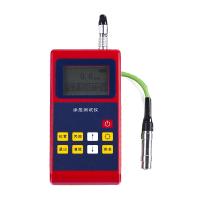
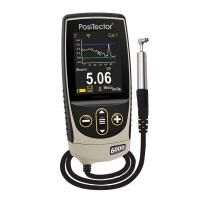
What is coated Film thickness measurement?
The production of color-coated boards needs to measure the thickness of the coating. The purpose is to ensure that the coating reaches the specified thickness. To avoid premature failure of the coating due to inappropriate thickness or excessive loss of coating due to excessive thickness of the legal layer. Due to the increase in cost, the current thickness measurement of color-coated board coatings is mainly divided into wet film thickness measurement and dry film thickness measurement. The wet thickness measurement is carried out at the production site.
 Determination of wet film thickness of A coating
 Determination of wet film thickness of A coating
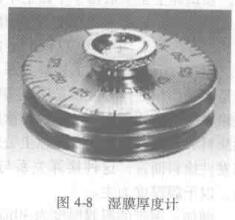
Coating wet film thickness measurement is usually carried out in the roller coating chamber with a wet Film Thickness Gauge (roller type wet Film Thickness Gauge). The instrument (Figure 4-8) consists of three wheels. Alignment, the edges of the three wheels are consistent at 0 point, and the middle wheel is recessed by the corresponding scale distance than the outer wheel at other scales, and the coating film thickness can be measured on the freshly coated wet film. When using, place the point where the difference between the inner and outer rings of the wet Film Thickness Gauge is the largest on the surface of the freshly coated wet film. Then turn the wet film wheel straight to 0 point (that is, where the edge of the inner wheel coincides), touching the surface. Check the initial position where the inner wheel sticks to the paint part, and the scale of the outer wheel corresponding to this position is the wet film thickness.
Determination of dry film thickness of B coating
In addition to the same purpose as the wet film thickness measurement mentioned above, the dry film thickness measurement of the coating can also reasonably select and effectively monitor the coating thickness of different types of coatings used. To obtain the associated mechanical and physical properties and Maximum application data for weather resistance.
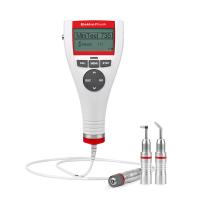
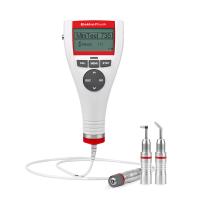
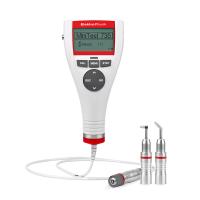
The dry film thickness of the coating can be measured in various forms. At present, the most representative ones are the magnetic Thickness Gauge method (Figure 4-9a), the lever micrometer method (Figure 4-9b), and the metallographic microscope method (Figure 4-9b). 4-9c) and drilling destructive microscopic method and other four determination methods.
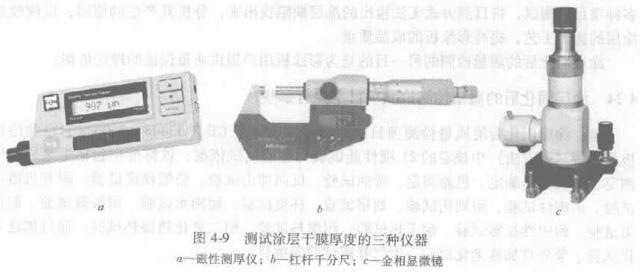
It is measured by a magnetic Thickness Gauge. The dry film thickness of the coating is required to be accurate to 1 μm below 50 μm; it is accurate to 2 μm above 50 μm. When measuring with a lever micrometer, the reading is required to be accurate to 2 μm, and the measurement result is the coating thickness measured at three different locations, which is the difference between the total thickness of the sample and the thickness of the substrate, and then the thickness of the removed layer measured three times. The arithmetic mean value is used as the dry film thickness of the sample coating. When the metallographic microscope is used to measure the reading, it is required that the reading be accurate to 2.5 μm, and the calculation of the coating thickness measured at the 5 o’clock position of the cut section of the sample with the eyepiece ruler is used. The average value of wood represents the coating thickness of the sample. When using the drilling destructive microscopic observation method, the sample is required to be placed on the drilling depth control wheel of the drilling device, so that the drill bit just penetrates the substrate and drills a circle. Shallow-angle shrinkage cavity, and then use the scale of the microscopic video image system to directly read the thickness of each coating, and obtain the arithmetic mean value of at least 3 different measurement positions on the sample as the coating thickness of the sample.
In addition, the dry film thickness of the coating has the following conversion relationship with the wet film thickness;
Dry film thickness (mm) = wet film thickness (mm) x coating volume solids (%)
Through the conversion relationship described by the above formula, the conversion between the dry film thickness and the wet film thickness can be conveniently performed, but the volume solid content of the coating should be the result of the experimental measurement. Or the calculation result of the experimental correction. Instead of The theoretical volume solid content of the coating. Because the drying and film-forming process of the coating is relatively complicated, for volatile coatings and two-component coatings with high solid content, the conversion relationship of the above formula is more consistent with the actual; for the solid content For low volatile paints, this conversion relationship has a large difference from the actual calculation. In practical applications, the experimental measurement results should be the main one. The dry film thickness should be the main one.
For example: the wet film thickness of the steel strip is 40µm. The volume solids of the coating used is 60%, and the dry film thickness DFT can be obtained according to the conversion formula:
DFT=40µmx60%=24µm
Similarly. When the construction process requires a dry film thickness of 30 μm, the operator can obtain the wet film thickness by conversion:
WFT=30µm/60%=50µm


- 1Nondestructive measurement of dry coating thickness
- 2Coated steel coatings - Determination of dry-film thickness
- 3Application scheme of coating thickness test on wood board [with test video]
- 4Curved plastic coating thickness test application scheme [with test video]
- 5PosiTector200C ultrasonic coating Thickness Gauge on concrete coating thickness measurement application
- 6Coating Metering rodsFAQ
- 7Measuring method of nondestructive heat spray-on lining thickness
- 8Coulomb Thickness Gauge FAQ and Its Solutions
- 9What are the FAQs for paints Thickness Gauges? How to solve it?