What is the organic solvent resistance test?
The resistance to organic solvent test is also called resistance to MEK (methyl ethyl ketone) wiping. This method is mainly used to determine the quality of coating curing and the evaluation of organic solvent resistance in the production process of color-coated boards. The old test method mainly refers to the American Coil Coating Association NCCAII-18 solvent wiping method to evaluate the solvent resistance specification, which is to evaluate the crosslinking degree of the paint film by the number of wiping times that the cured paint film is resistant to a specific solvent. When measuring, other properties need to be considered at the same time , such as color, gloss, hardness, adhesion and toughness, and vary with the type of coating, film thickness, and surface state of the substrate. The solvent resistance of coatings can vary widely. Since 200, the country promulgated the national standard GB/T 13448-2006 "Test methods for color-coated steel sheets and steel strips". This color measurement has rules to follow in CHINA. The quality of the coating can be judged by the specifications of the manual method and the instrument method.
A manual method
During the test, use four layers of gauze rolled on the index finger and soaked in MEK solvent to move and wipe the surface of the product to be tested with a pressure of about 19.6~24.5N. The back and forth stroke is at least 200mm, and the wiping speed is about 100 times/min The previous time, the subsequent time is counted as a round trip), until the paint film is damaged or the predetermined number of round trips is reached. If the paint film is wiped off at any point within the middle 150mm of the 200mm wiping range, and the substrate is exposed, the paint film is damaged. Because some operators often use a lot of force at the back and forth of the stroke, the MEK wipe-resistant index topcoat of the coil coating in the wiping test diagram is generally 100 times. The unevenness of solid particles and substrates will obviously affect the test results. And this test should be carried out on multiple places on the sample. The error has been eliminated.
B instrument method
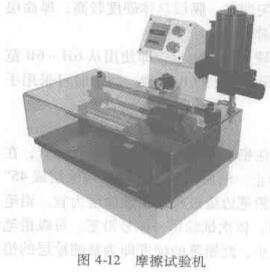
At present, there is a friction testing machine (Figure 4-12) for MEK testing in CHINA. During the test, wrap the artificial finger on the instrument with absorbent cotton, soak the artificial finger in the specified solvent, and then place the artificial fingertip on the surface of the sample, fully away from the edge of the sample to avoid wetting the edge. Then move the fingertip for the specified number of swipes, one back and forth per second. After the test, whether there is any damage to the coating on the square.