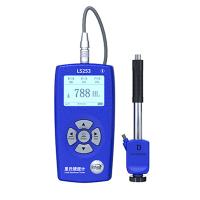
Beijing Times TH130 Integrated Richter Hardness Instrument Operation Instructions
Chapter 1 Introduction
1.1 Overview
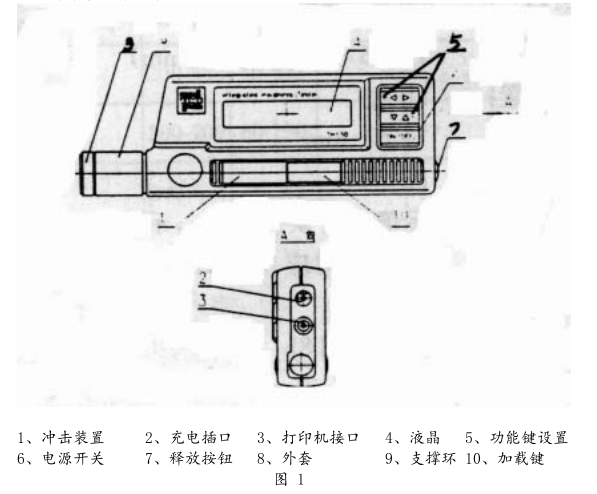
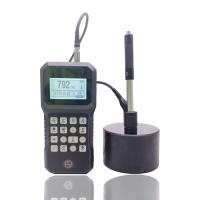
Times TH130 integrated Leeb Hardness Tester (hereinafter referred to as Hardness Tester) is a professional integrated hardness testing instrument, which has the advantages of compact structure, light weight, high measurement accuracy, wide measurement range, portability and easy operation.
The Hardness Tester integrates a D1 impact device and a data processing device. Can convert Brinell, Vickers, Rockwell B, Rockwell C or Shore hardness values, and can choose five impact directions.
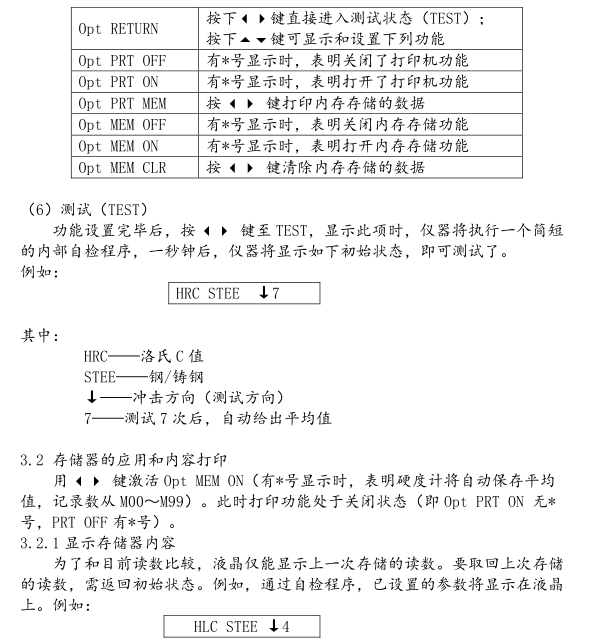
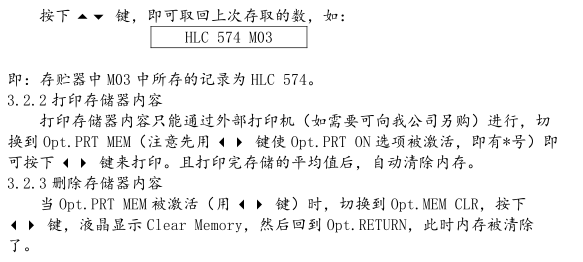
The instrument also has a storage function, which can store 99 averaged data. If it is connected with the era TA210 micro-printer, it can realize online printing and offline printing.
1.3 Main purpose
Direct measurement of large and/or heavy test pieces
Installed machinery or permanently assembled components
Material classification of metal material warehouse
Small spaces with large workpieces, etc.
1.4 Technical parameters
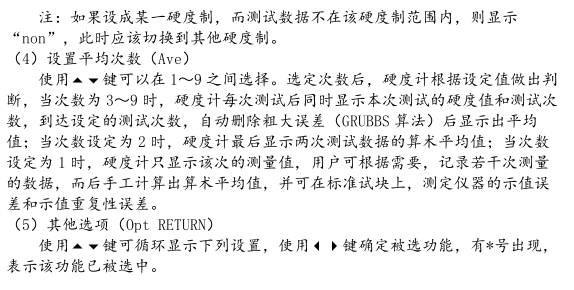
Hardness system: HLD, HB, HRC, HRB, HV, HS
Dimensions: 156.5×24×55.5(mm)
Impact device: D1 type
Impact energy: 11Nmm
Ball head: Tungsten carbide
Accuracy: relative error of indication value ± 1%; relative error of indication value repeatability 1% (corresponding to 800HLC standard test block)
Weight: 180g
Working time: continuous use 8h
Charging time: DC 9V, 75mA8-15 hours
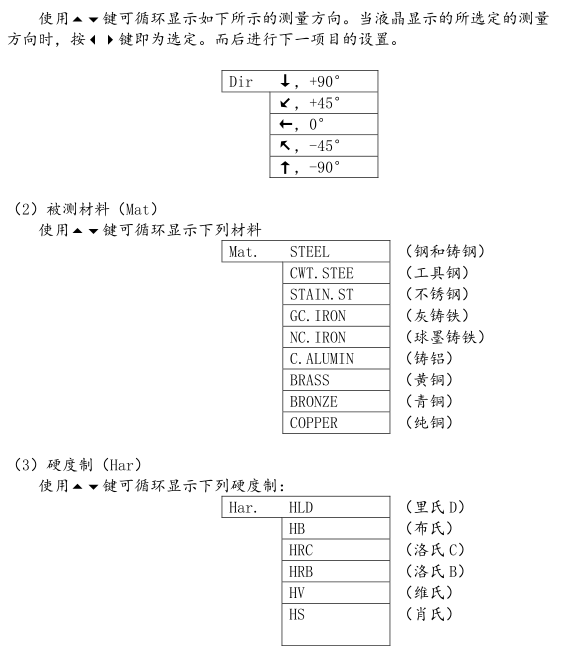
Measuring direction: ↓+90°; ↙+45°; ←0°; ↖-45°; ↑-90°
Working temperature: 0~50℃
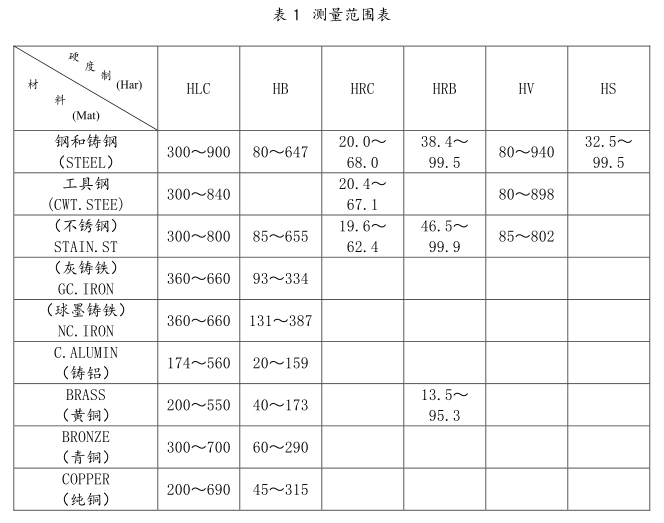
1.5 Measuring range
Chapter 2 Preparation of Specimen
2.1 Overview
In order to reduce the influence of the surface roughness of the test piece on the measurement results, the surface to be tested should be smooth enough, the surface roughness Ra value should not exceed 2 μm, and the surface of the test piece should be clean and free of oil.
2.2 The support and coupling of the specimen during the test
If the mass of the specimen is more than 5kg, no support is required.
For specimens with a mass of 2 to 5kg, specimens with overhanging parts and thin-walled specimens, mass
Objects weighing more than 5kg should be firmly supported to avoid bending deformation and movement of the test piece caused by the impact force.
For specimens with a mass of less than 2kg, it should be tightly coupled with a support greater than 5kg. The coupling surface of the specimen and the surface of the support should be flat and smooth, and there should be no excess couplant. The test direction should be perpendicular to the coupling surface.
The mass of the test piece should not be less than 0.1kg, the minimum thickness should not be less than 5mm, and the depth of the hardened layer should not be less than 0.8mm.
The clamping face of the fixture shall be perpendicular to the direction of testing.
When the test piece is a large-area plate, long rod, or curved workpiece, even if the mass and thickness are large, it is still
It may cause deformation and instability of the test piece, resulting in inaccurate test values, so the back of the test point should be reinforced or supported.
The test piece itself cannot be magnetic.
2.3 Selection of support rings when testing inner and outer cylinders and inner and outer spherical surfaces . When the radius of curvature is less than 30mm and greater than 11mm, you can use the small support ring provided with the machine for testing, or you can purchase our company’s special-shaped support ring separately to obtain the best test conditions.
Chapter 3 Operation Method
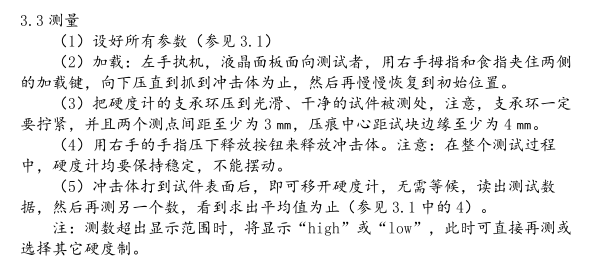
Chapter 4 Maintenance and Repair
4.1 Maintenance
The Hardness Tester should not be subjected to impact and heavy pressure as much as possible, and should not be placed in a strong magnetic field or in a humid environment, and should not be stained with oil. When the Hardness Tester is not in use, be sure to release the impact spring (that is, not in the loaded state).
cleaning catheter
After the measured value is 1000-2000 times, and a soft, long nylon brush is used to clean a conduit and impact body, unscrew the support ring and take out the impact body, screw the nylon brush into the conduit counterclockwise with the random nylon brush, and then Gently pull it out, repeat this 5-6 times, and then install the impact body and support ring.
Do not use any lubricant between the guide tube and the impact body!
Charge
Charge according to the following method: after 8 to 12 hours of working with the internal power supply, it should be charged, and the charging time is 1.5 hours.
The battery in the Hardness Tester is a Ni-Cd battery, which can generally be used for 2 years. If the battery is damaged, you can go to the Times Service Center to replace it with a new one. Do not open the machine by yourself!
Calibration with standard test block
The Hardness Tester can be calibrated by using the standard hardness test block that comes with it, that is, when the value is printed on the test block, the error between the arithmetic mean of the five-point test and the standard value does not exceed ±12HLC; the repeatability error does not exceed 12HLC. 4.2 Maintenance
If the liquid crystal display flickers during operation, it indicates that the voltage of the battery is lower than the working voltage, and it should be turned off and charged at this time.
If there is no display on the LCD after turning on the machine, please turn off the machine immediately and send it to the Time Repair Service Center.
- 1Beijing Times TH132 Integrated Richter Hardness Instrument Operation Instructions
- 2Beijing Times TH134 Integrated Richter Hardness Instrument Operation Instructions
- 3DHT-200 Leeb Hardness Tester operation manual
- 4DHT-300 Richter Hardness Instrument Operation Manual
- 5DHT-100 Leeb Hardness Tester manual instructions
- 6Evaluation of uncertainty of measurement results of Leeb Hardness Tester
- 7Hardness meter calibrating and maintenance
- 8Detailed explanation of the correct operation process of Richter Hardness instrument
- 9Preparation of Richter Hardness Meter Before Use