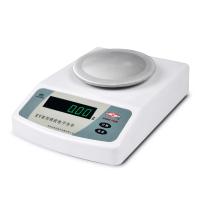
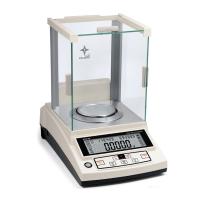
Two Main Factors Affecting the Weighing Accuracy of Electronic Balance
With the rapid development of modern electronic technology, electronic balances have been continuously improved and are gradually replacing mechanical balances. The electronic balance adopts modern sensor technology, electronic technology and microcomputer technology, and has the advantages of simple operation, fast weighing speed, high degree of automation, and strong intelligent function. However, if used incorrectly, large measurement errors will occur. Starting from the principle of electronic balance, this paper analyzes the two main sources of measurement errors and their elimination methods.
working principle
High-precision electronic balances usually use electromagnetic force balance sensors. The electromagnetic induction electronic balance is different from the electronic scale, and the electronic scale is designed by using the principle of the electromagnetic force balance of the electronic balance. According to the electromagnetic force formula: F=BLIsinθ In the formula, F is the electromagnetic force; B is the magnetic induction intensity; L is the length of the stressed wire; I is the current flowing through the wire; θ is the angle between the current-carrying conductor and the magnetic field. It can be seen from the formula that the size of F is proportional to B, L, I and sinθ. Due to the designed sensor, the size of its induction coil has been fixed, so its B and L will not change, and θ is 90°, so sinθ=1. Therefore, the size of F corresponds to I. The main components of the electronic balance are: power supply, electromagnetic force balance sensor, photoelectric sensor, keyboard, display and control circuit. The basic working principle of the electronic balance is: when the balance is empty, the electromagnetic force balance sensor is in a balanced state; after loading, the position of the induction coil changes. When the intensity of light received by the phototransistor in the photoelectric sensor changes, its output current also changes. After the change is micro-processed, the current of the electromagnetic coil is controlled, so that the electromagnetic force balance sensor is in a balanced state again. At the same time, the microprocessor converts the current change of the electromagnetic coil into a digital signal, which is quickly displayed on the display. .
The effect of the acceleration of gravity
Electronic Balances mainly use electromagnetic force balance sensors to realize the conversion of the measured mass to gravity and then to current signals, and the measurement results are closely related to the acceleration of gravity. The magnitude of the acceleration of gravity is related to many factors such as the latitude, altitude, crustal density, and groundwater changes of the place where the balance is used, and changes with the location. Therefore, electronic balances need to implement gravitational acceleration compensation according to the place where the balance is used. For example, if the electronic balance is calibrated with a 200g weight on the first floor, the weighing result is 200.000g, and the same weight is weighed after moving to the fourth floor (about 10m high), and the weighing result is 199.9994g. It can be seen that the acceleration of gravity changes with the place of use. Therefore, the electronic analytical balance needs to have the function of self-calibration and self-compensation anytime and anywhere. In the formula, the magnetic induction intensity B of the permanent magnet and the effective length L of the moving coil are fixed, and the output current I of the sensor can be accurately measured after passing through the amplifier circuit and A/D conversion. If the measured mass m is known and the accuracy is higher than that of the electronic balance, then the accurate local g value at that time can be obtained according to the formula by multiplying the known standard mass m. This standard mass is the mass of the calibration weight. 3.1 Compensation method of built-in calibration weight and its disadvantages The current electronic balance generally adopts the compensation method of built-in calibration weight, that is, a calibration weight is set inside the electronic balance, and the local g value is obtained by weighing the calibration weight. This compensation method needs to increase the mechanical loading mechanism of the electronic analytical balance and the special weight for self-calibration, which increases the product cost and process complexity. Moreover, after long-term use of the built-in weights, it is difficult to carry out weight verification and surface cleaning treatment, which may easily cause time drift errors of the electronic analytical balance. 3.2 The external calibration weight compensation method changes the calibration weight to a general standard weight. As an accessory of the electronic analytical balance, it can be loaded and weighed directly through the weighing pan, which can automatically calibrate the acceleration of gravity and realize the influence of acceleration of gravity on the weighing of the balance. automatic compensation. Because the accuracy of the external calibration weight can be guaranteed, the compensation accuracy of the acceleration of gravity is high, and it has been widely used.
Effect of Temperature Change
The temperature change of the electromagnetic force balance sensor mainly comes from the change of the ambient temperature and the heating of the overcurrent element. The basic working principle of the electronic balance is to balance. Once it is out of balance, the balance should be pulled back to balance by electromagnetic force. This electromagnetic force corresponds to the current flowing through the coil, and the change of the current is proportional to the change of the mass of the weighing object. When the balance is in the warm-up stage, as the internal temperature rises, the magnetic flux B will gradually decrease, and the current I will also decrease, which will cause the electromagnetic force F to become smaller, the balance will lose balance, and the indication will show a positive single value. The direction drifts, so the electronic balance must be fully preheated before weighing. Only after sufficient preheating, the magnetic steel reaches thermal equilibrium, and the balance reaches equilibrium when this change process is over. Then use the zero setting/tare function to set the display to zero, and the balance is really usable at this time. In order to reduce the influence of electronic devices, such as transformers, bridge rectifiers, three-terminal DC voltage regulator integrated circuits and other heating devices, the new generation of electronic balances has moved the main heating device, the transformer, to the outside of the balance to become an independent part. For micro and ultra-micro balances with an actual division value of 1 μg, the weighing chamber and the electronic part are divided into two independent parts. Its purpose is to reduce the thermal influence of thermal noise on the sensor for more stable and accurate weighing.
In addition, electronic balances usually do not have power switches similar to household appliances. As long as the balance is powered on, even if there is no display on the display, the balance is warmed up. The ON/OFF key on the balance is just to switch the display. Therefore, it is not necessary to unplug the power of the balance that is often weighed, especially the high-precision balance. If conditions permit, the long-term uninterrupted power supply can keep the balance in the preheating state. For micro and ultra-micro electronic balances whose actual graduation value d reaches 0.01 mg, it needs to be preheated for more than 24 hours. For the balance in use, the warm-up time can be appropriately reduced. When the indicated value on the display no longer drifts in one direction, it can be weighed after zero/tare. In addition, the change of temperature will also lead to the drift of electronic balance sensitivity, resulting in measurement deviation. The temperature coefficient of sensitivity, TC=2.5×10⁻⁶/℃, means that every time the temperature changes by 1℃, the sensitivity will change by 0.00025%. If a 100g object is weighed, when the environment changes by 5°C, the maximum error will be 2.5×10-6×5×100=1.25 (mg). Therefore, when the ambient temperature changes greatly, the electronic balance should be calibrated to ensure the accuracy of the weighing results.
Summarize
The correct maintenance and use of the electronic balance has a great influence on the accuracy of the weighing. It is necessary to ensure its good external use environment, such as: constant temperature, no airflow vibration, etc. At present, although electronic balances have certain anti-interference ability to voltage fluctuations, if the voltage fluctuations are large, in order to ensure the accuracy of the balance, a voltage stabilizer is required. In addition, full warm-up before use and frequent calibration can ensure high-precision weighing.
Source: Tang Tuqiang, Tang Hui, Gu Guangsheng, Tian Linhuai, Wang Weihua, Zhang Jian
Medical and Health Equipment ·April 2009, Volume 30, Issue 4 "Discussion on the Weighing Accuracy of Electronic Balances"

- 1Discussion on Balance Weighing Method
- 2Proper Use of Electronic Balance
- 3What is the difference between 10,000-level and 100,000-level Electronic Balance?
- 4Correct correction method of thousand electronic precision balance [including video demonstration]
- 5Selection scheme of solar cell slurry performance testing instrument
- 6Offset printing ink laboratory performance testing instrument scheme
- 7Method of using electronic balance and its structure
- 8How should the calibration weights of precision balances be handled and maintained?
- 9 What is the difference between readability and accuracy of a balance?