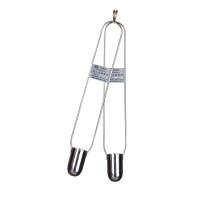
How to calibrate 4 viscosity cup _ commonly used methods for correcting viscosity cup
Whether the Tu-4 Viscosity Cup is qualified or whether it can continue to be used should be checked regularly. There are two commonly used calibration methods.
kinematic viscosity method
This method is based on the national standard "GB 265 Kinematic Viscosity Determination Method". The kinematic viscosity of various standard oils is measured by a capillary viscometer, and the standard outflow time T of Tu-4 cup is obtained by the formula.
T =0 .223 V +6 (23 s ≤ T <150 s) (1)
T =0.154 V +11 (T <23 s) (2)
In the formula:
T ——outflow time, s;
V ——kinematic viscosity, mm2/s.
The ratio of the standard outflow time T to the measured outflow time t is the correction coefficient K of the Viscosity Cup.
K =T/t (3)
A series of K1, K2, K3... can be obtained from formula (3), and the arithmetic mean value is taken as the correction coefficient K of the Viscosity Cup. If K is in the range of 0.95-1.05, the Viscosity Cup is qualified and can still be used, but the test data should be multiplied by the correction coefficient K, which is the real measured viscosity.
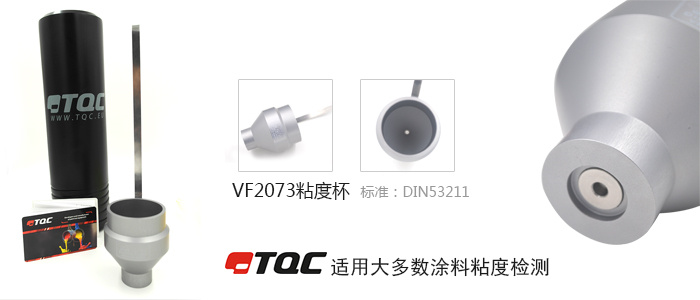
standard viscometer method
For users who do not have precise temperature control and a capillary viscometer, the standard viscometer method is more practical.
The standard Viscosity Cup is commonly known as the K-value cup. It is not used at ordinary times and is only used as a measurement standard. It is used regularly to check the Tu-4 cup used. When calibrating, it is necessary to prepare at least five aviation lubricating oils with different viscosities and the mixed oil of aviation lubricating oil and transformer oil. And calculate a series of time ratios K1...K5, and take the average value as the correction coefficient K of the Viscosity Cup.
In addition, there is the Engua condition degree method, which is to use the Engua viscometer to obtain the condition degree (°E), check the kinematic viscosity according to the corresponding table, calculate T with the formula (1) or formula (2), and the tested viscosity The ratio of the outflow time t measured by the cup is the correction coefficient K. As the viscosity of the standard oil increases, the data deviation gradually increases, so it is less used at present.




- 1Testing Principle, Advantages and Disadvantages of Capillary Viscometer
- 2Coating viscosity determination - viscosity cup Yiwen
- 3Working Principle, Classification and Application of Capillary Viscometer
- 4Principle Differences of Different Viscometers and Their Applications
- 5Measuring method of coating viscosity
- 6Principle, application and selection of ZAHN5 viscosity cup
- 7Corrugated fibreboard starch viscosity cup its principle, application and selection introduction
- 8Discussion on the calibration method of coating-4 viscosity cup
- 9Decryption paints original juice viscosity cup, principle, application and selection