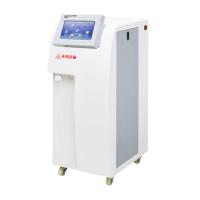
Fault Analysis and Countermeasures of Laboratory Ultrapure Water Machine
I. Introduction
With the advancement of material science and technology, the scope of application of new materials has been opened up, and the development of new materials has been promoted to a higher, newer, and purer direction. It also promotes the development of people's research on various new materials in the direction of microcosmization. As a result, many research institutions and testing centers have reached the requirements of impurity content in chemical reagents or raw and auxiliary materials and products to 10-6 or 10-9, and some even reached 10-12, such as microelectronics and superconducting materials. , life sciences and other research fields. In the process of material analysis and research, water is often inseparable. Therefore, the requirements for impurities such as soluble inorganic matter, organic matter, particulate matter, microorganisms, and soluble gases in water have been raised to a new height. The emergence of ultrapure water technology provides the possibility to effectively deal with these impurities.
Second, the process principle of ultrapure water
In the fields of materials, bioengineering analysis and research, pure water and ultrapure water are mainly used. The purification or purification process of water quality is roughly divided into 4 major steps, pretreatment (low-level purification), reverse osmosis (to produce pure water), ion exchange (to produce 18.2MΩ·cm ultrapure water) and terminal treatment (to produce Ultrapure water with special requirements for laboratories). Among them, ion exchange is the exchange of positive ions in water with hydrogen ions in ion exchange resin, and the exchange of negative ions in water with OH- ions on ion exchange resin, so as to achieve the purpose of purifying water. Removing ions by ion exchange can theoretically remove almost all ionic substances. At a room temperature of 25°C, the resistivity of the effluent reaches 18.2MΩ·cm.
When it comes to laboratory water, the ion-exchanged water often does not meet the requirements of purification and removal of impurities, especially when combined with ICP-MS (Inductively Coupled Plasma Mass Spectrometry, Inductively Coupled Plasma Mass Spectrometry), a sensitive application , you need to use an ultra-pure water machine with an ultra-purification column with some special requirements (ultra-low organic, sterile, etc.).
3. Selection of ultrapure water machine
Through the introduction of ultra- pure water , in practice, we believe that in the process of purchasing laboratory-grade pure water machines, in addition to considering the brand of the product, performance indicators, quality of equipment spare parts, In addition to the price factor, another important factor is ease of maintenance. Because the pure water machine is different from other laboratory analysis instruments, it mainly uses the filter element to filter. Since it is a filter, it has a certain service life and needs to be replaced when it expires, otherwise the resistivity and impurities cannot meet the requirements. To replace these filter elements, just like using printer cartridges, the user must replace them regularly. If the replacement process is too complicated, it is bound to waste a lot of energy and time of analysts. Therefore, the reliability of the ultrapure water machine, the degree of ease of maintenance, and the convenience of replacing the filter element are equally important with factors such as good brand, good performance indicators, easy procurement of spare parts, stable quality, and competitive price.
Fourth, ultrapure water machine failure analysis and countermeasures
The ultrapure water machine used in the laboratory as an auxiliary instrument for analysis is more and more popular and used in research institutions and testing centers. Whether it is an imported or domestic pure water machine, the principle is the same and the functions are similar. Therefore, the common faults and analysis of the pure water machine are basically the same.
1. The booster pump of the ultrapure water machine does not start and does not produce water
Check the power plug, the safety tube and the touch switch of the gun tip, and proceed to the next step of inspection according to the system prompts on the LCD panel of the ultrapure water machine. If the self-test of the system is normal, then check whether the booster pump is running by listening to the sound and using a hand or a screwdriver. If it does not work, check whether the power supply circuit of the booster pump of the ultrapure water machine and the system control board are normal. The main board is normal, replace the appropriate booster pump. Mammobol ultra-pure water machine uses the original American AC booster pump. Since there is no such type of booster pump in the domestic ultra-pure water machine market, it is self-improved and uses a DC booster pump that can be powered by DC. Otherwise, replace the system control board.
2. The booster pump of the ultrapure water machine operates normally but does not produce water
Check the front Water Tank or source water pipe of the ultrapure water machine. If there is water, check the water inlet solenoid valve. If the solenoid valve is faulty and cannot enter water, please replace it. Check the water outlet port of the filter element or purification column. If there is no water, it should be considered that there is a blockage failure, and the filter element or purification column should be replaced.
3. The booster pump of the ultrapure water machine is operating normally but the water output is small or there is no water pressure
Check whether the filter element or purification column is blocked. If the water outlet from their ports is normal, check whether the nozzle head of the water outlet is loose. If the ultrapure water machine pipeline is loose, there will be air and the water outlet will be abnormal. If the tip of the gun is not loose, check whether the terminal filter element is clogged or loose. If it is clogged, replace the terminal filter or filter element.
4. The resistivity of the outlet water is unstable or cannot reach 18.2MΩ·cm
Check the usage time of the ultrapure water column. If the usage time is short, turn on the ultrapure water machine for internal circulation, and wait for the resistivity to stabilize and pass it before use. If the resistivity is still not stable after internal circulation, replace the ultrapure water column. Replacing the purification column still cannot solve the problem. Consider checking whether the resistivity sensor of the ultrapure water machine is polluted or damaged.

- 1How to clean the laboratory water purifier?
- 2 How to judge whether laboratory ultrapure water equipment needs maintenance?
- 3What are the criteria for selecting laboratory purified water equipment?
- 4Precautions for cleaning ultrafiltration membranes in biopharmaceutical pure water equipment?
- 5What are the advantages of using ultrapure water equipment for the power industry?
- 6Ultra-pure water machine - triple filter element replacement method
- 7What should I do if the solenoid valve of the experimental ultra-pure water machine encounters these failures?
- 8Detailed purchase method of laboratory ultra-pure water machine [dry goods]
- 9What is the difference between "water intake flow" and "water intake flow rate" in laboratory ultrapure water machines?