How to choose a portable Thickness Gauge?
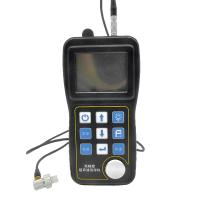
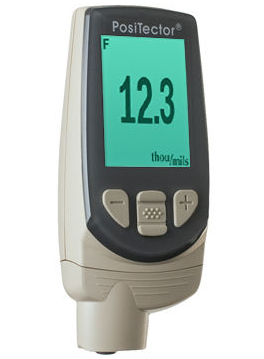 The portable Thickness Gauge adopts new high-performance, low-power microprocessor technology, based on the principle of ultrasonic measurement, can measure the thickness of metal and other materials, and can measure the sound velocity of the material. How should users choose a portable Thickness Gauge? Today we will introduce the selection method of a portable Thickness Gauge in detail, hoping to help everyone.
1: Copper and chromium layers on plastic: It is recommended to use a coulometric Thickness Gauge (which will damage the coating) or an X-ray Thickness Gauge (nondestructive measurement). If the copper layer is 10m~200m, an eddy current Thickness Gauge (nondestructive measurement) can be considered Measurement).
2: Galvanized layer on metal parts: For example, an economical magnetic induction method Thickness Gauge (non-destructive measurement) should be used on the steel substrate. For other metal substrates, use a coulometric Thickness Gauge (which will destroy the coating) or an X-ray Thickness Gauge (non-destructive measurement).
3: The electrophoretic paint on the iron substrate should use an economical magnetic induction method Thickness Gauge (non-destructive measurement). For electrophoretic paint on other metal substrates, an economical eddy current Thickness Gauge (non-destructive measurement) should be used for the paint.
4: Dry film refers to the cured paint coating.
5: Refer to item 2 and item 1 for the chrome plating layer.
6: Only the chipping method (PIG, which will destroy the coating) is used for painting the interior and exterior parts of the car. The ultrasonic method (non-destructive measurement) can measure the coating above 10 microns, but sometimes it cannot be detected.
7: Thickness gauge price: magnetic induction method eddy current method 0.6~30 thousand; coulometric method 0.8~60 thousand; ultrasonic method 55~60 thousand; X-ray Thickness Gauge 250~400 thousand.
The ultrasonic Thickness Gauge is based on the principle of ultrasonic pulse reflection to measure the thickness. When the ultrasonic pulse emitted by the probe passes through the object to be measured and reaches the material interface, the pulse is reflected back to the probe. Measure the thickness of the material. All kinds of materials that can make ultrasonic waves propagate inside them at a constant speed can be measured by this principle.
Of course, after reading so much, it is estimated that many people are confused. For this reason, Beichao has developed a coating Thickness Gauge selection system, which can make suitable selection according to different needs of users in a simple and clear way.
Specifically click: Thickness Gauge Type Selector