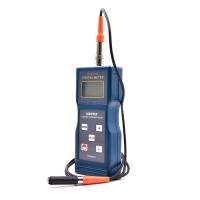
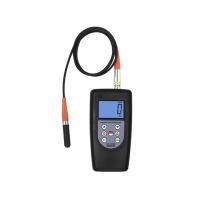
British Elcometer Elcometer 456 series Coating Thickness Gauge selection guide
Elcometer 456 Coating Thickness Gauge is widely acclaimed for its measurement accuracy and unmatched measurement response speed, and it is also the most widely used coating Thickness Gauge in the coating anti-corrosion industry.
In terms of use, Elcometer 456 coating Thickness Gauges are divided into iron-based, non-ferrous-based and dual-purpose types. The iron-based type is used to measure the thickness of non-magnetic coatings on ferromagnets, the non-ferrous-based type is used to measure the thickness of non-conductive coatings on non-ferrous metal substrates, and the dual-purpose instrument can be used for both ferrous and non-ferrous substrates application, with the function of automatically identifying the matrix. When choosing a coating Thickness Gauge, you should first choose the corresponding type according to the test conditions.
In terms of function, Elcometer 456 coating Thickness Gauge has 4 different models to choose from, entry-level 456E, basic 456B, standard 456S, and advanced 456T. The functions of each instrument are constantly increasing. When selecting a model, you should choose the corresponding type and range according to your needs.
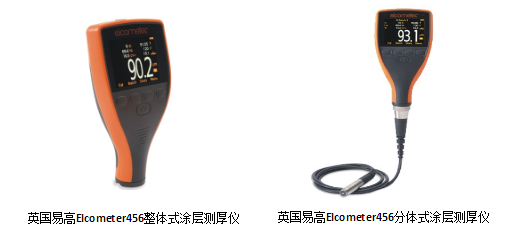
Elcometer 456 Integral Coating Thickness Gauge is suitable for one-handed operation, because the large contact surface of the "bigfoot probe" has better stability during measurement, enabling users to obtain continuous and repeatable accurate results. Elcometer 456 Split Coating Thickness Gauge provides a variety of probes, which makes the measurement more mobile. All Elocmeter 456 probes are completely interchangeable. Elocmeter456 ferrous-based instrument accepts any ferrous-based probe, Elocmeter456 non-ferrous-based instrument accepts any non-ferrous-based probe, and Elocmeter456 dual-purpose instrument accepts all ferrous-based, non-ferrous-based and dual-purpose FNF probes. And provide a large number of design and measurement range:
1. Straight Probe—Measures coatings on flat and curved surfaces
2. Miniature Probes—Excellent for measuring edge coatings, narrow tube coatings, or small surface area coatings
3. Right-angle probes—for measuring in hard-to-reach places
4. PINP probe—plug-in probe, which can convert the split instrument into an integral instrument
5. Far-end probe—extensible right-angle probe to reach places that are difficult to reach with general probes
6. Ultrasonic/Scanning Probes—These probes feature replaceable probe covers that allow the user to take single readings or scan large surface areas without damaging the probe
7. Waterproof probe - closed design, used in deep water, even wearing diving gloves will not affect the use
8. High temperature probe - can be used on coatings with temperatures up to 250°C (480°F)
9. Anodized probe - resistant to chemical solvent corrosion, very suitable for use in anodized environments
10. Armored Probe—Heavy-duty reinforced cable for probe belt, which can reduce the risk of cable damage
11. Soft Coating Probe—Large area surface probe for detecting soft covering materials (certified by HVCA)
12. Professional probes - these probes can be used to measure on professional substrates, such as: graphite or electroplated parts
- 1Nondestructive measurement Coating thickness
- 2Principle, application and selection of traffic coatings Coating Thickness Gauge
- 3Principle, Application and Selection of Eddy current Coating Thickness Gauge
- 4Principle, Application and Type Selection of Electronic Coating Thickness Gauge
- 5Explore the principle, application and selection of phosphating layer Coating Thickness Gauge
- 6Principle, Application and Type Selection Analysis of Chrome Coating Thickness Gauge
- 7Principle, Application and Selection of Coating Thickness Gauge for inner wall of small pipe
- 8Basic principle and application scenario of steel Coating Thickness Gauge
- 9Principle and Application Analysis of Coating Thickness Gauge