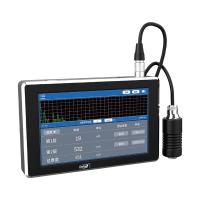
Application of Ultrasonic Thickness Measurement Technology- "Selection of Thickness Gauges"
Ultrasonic thickness measurement technology is a non-destructive test method widely used in the industrial field to measure the thickness of materials or components. It determines the thickness of materials by using the propagation speed and reflection characteristics of ultrasonic waves in materials. The following are several main application fields of ultrasonic thickness measurement technology:
Material Engineering:
Ultrasonic thickness measurement technology is used to measure the thickness of materials such as metals, plastics, glass, ceramics, etc. It can help detect the quality of materials, determine the durability of materials, and is used in the process of quality control and quality assurance.
Manufacturing:
In the manufacturing industry, ultrasonic thickness measurement technology is often used to measure the thickness of thin plates, pipes, containers and other components. It can be used to monitor the wear, corrosion and deformation of materials to ensure the safety and reliability of components.
Aerospace Industry:
Ultrasonic thickness measurement technology is widely used in the thickness detection of aircraft wings, fuselages, turbine blades and other components in the aerospace field. It can detect problems such as corrosion, fatigue cracks and material aging of components to ensure the structural integrity and flight safety of aircraft.
Petroleum and Chemical Industry:
Ultrasonic thickness measurement technology is used in the thickness monitoring of pipelines, storage tanks, containers and other equipment in the petroleum and chemical fields. It can help detect problems such as corrosion, wear and material damage, carry out maintenance and repair in a timely manner, and ensure the safe and efficient operation of equipment.
Non-destructive detection:
Ultrasonic thickness measurement technology is a non-destructive measurement method that can measure thickness without destroying materials. It is widely used in the fields of material evaluation, quality control, equipment monitoring and structural inspection to detect corrosion, damage and deformation of components.
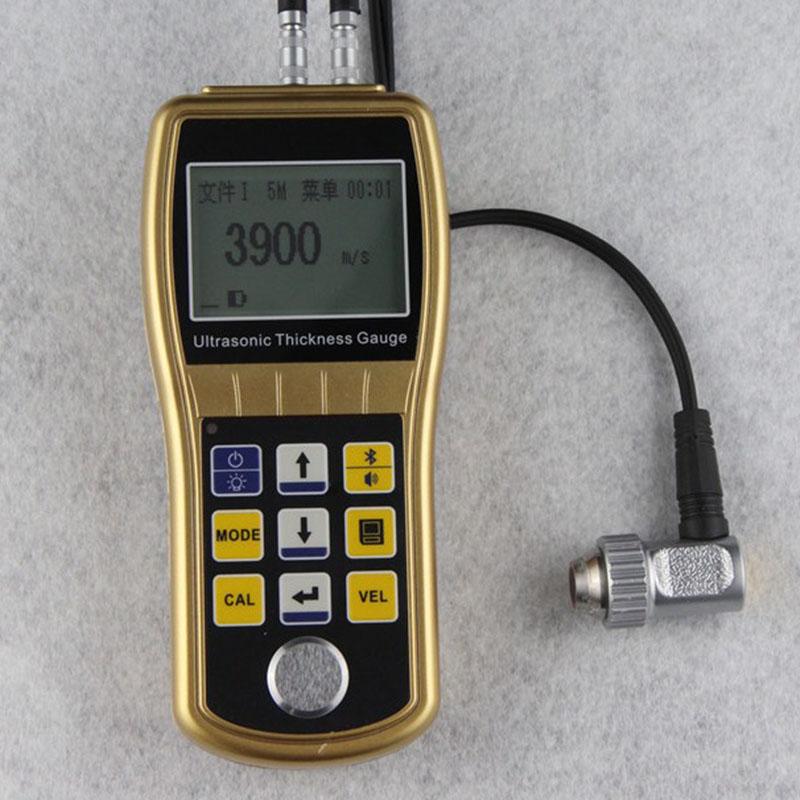
Common ultrasonic Thickness Gauges are of the following types:
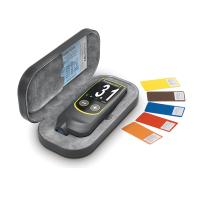
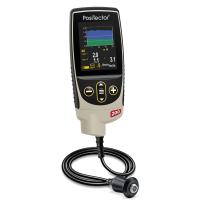
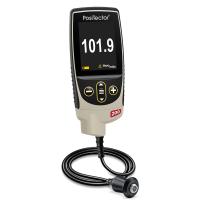
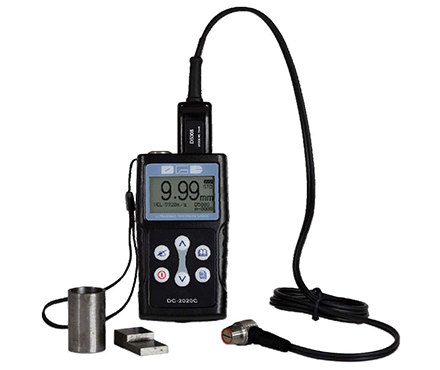
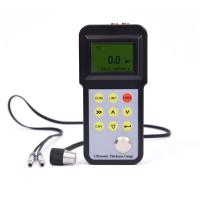
Handheld Ultrasonic Thickness Gauge: This Thickness Gauge is small and portable, suitable for field use. It usually has a simple operating interface and a digital display that can measure the thickness of the material by direct contact or by applying a coupling agent.
Stationary Ultrasonic Thickness Gauge: This Thickness Gauge is suitable for applications in fixed locations such as laboratories and production lines. It usually has higher measurement accuracy and functionality, and can perform multiple modes of measurement such as single-point measurement, continuous measurement, and scanning measurement.
Wall Thickness Gauge: A wall Thickness Gauge is an ultrasonic Thickness Gauge specially used to measure the wall thickness of pipes and containers. It usually has a special probe design that can accommodate curved or irregularly shaped workpieces and provide accurate wall thickness measurements.
Double Crystal Ultrasonic Thickness Gauge: Double Crystal Ultrasonic Thickness Gauge is an instrument used to measure the thickness of materials required for high temperature or high precision. It has high temperature stability and precise measurement capabilities, suitable for measurement under extreme conditions.
Multi-channel ultrasonic Thickness Gauge: The multi-channel ultrasonic Thickness Gauge can connect multiple probes at the same time to measure multiple positions in one measurement process. It can be used for quick scanning or simultaneous monitoring of thickness changes at multiple points.
These ultrasonic Thickness Gauges are usually equipped with data recording and storage functions, which can save the measurement results for subsequent analysis and reporting. At the same time, some Thickness Gauges are also equipped with data transmission interfaces, which can transmit the measurement data to a computer or other equipment for further processing and analysis. Different types of ultrasonic Thickness Gauges are suitable for different application scenarios and requirements. The selection of the appropriate Thickness Gauge depends on factors such as the type of material to be measured, the thickness range, the accuracy requirements and the use environment.
The principle of ultrasonic thickness measurement technology is simple and easy to operate, and it can be used in laboratory and field environments. It sends ultrasonic waves into the material through ultrasonic sensors, then receives reflected waves, and calculates the thickness of the material according to the propagation time and speed of the waves. Modern ultrasonic thickness Measurement Instruments are usually equipped with advanced digital display and data processing functions to make the measurement more accurate and reliable. In conclusion, ultrasonic thickness measurement technology has a wide range of applications in the industrial field, which can help monitor the thickness change, corrosion degree and structural integrity of materials, thereby ensuring the safe operation and quality control of equipment and components.


- 1Principle, Function, Application and Selection of Multifunctional Ultrasonic Thickness Gauge
- 2Principle, Application and Type Selection of Ultrasonic Thickness Gauge
- 3Principle, Application and Type Selection of Ultrasonic Thickness Gauge
- 4Principle, Application and Selection of Ceramic Ultrasonic Thickness Gauge
- 5The Principle, Application and Precautions of Copper Plate Ultrasonic Thickness Gauge
- 6Principle and Application of Ultrasonic Thickness Gauge
- 7Measurement principle and influencing factors of high temperature ultrasonic Thickness Gauge
- 8Principle of Portable Ultrasonic Thickness Gauge
- 9How does an ultrasonic Thickness Gauge work?