Design and establishment of high performance industrial Paints color scheme
With the continuous change of people's color concept, the color requirements for industrial coatings have also begun to be colorful and personalized. Colorful industrial solid-color paints must not only be limited by the order quantity but also be able to be supplied in time. Paint manufacturers can only pre-adjust various color paints to provide more color choices to timely and effectively deploy into the product. Paints required by customers.
To meet the needs of various industrial solid color paint color varieties, it is far from enough to rely on the colors of several existing pigments. However, most industrial paint manufacturers are currently facing practical problems such as many types of pigments, miscellaneous types of colorants, large internal friction and waste, and difficulty in changing colors. This requires the design and establishment of a general, simple and comprehensive high-performance industrial solid-color paint color matching system. The application of this color system can not only realize the deployment of various finished color paints to meet customer requirements in a timely manner, but also has high cost performance and is effective. Market Competitiveness.
Color matching principle
Colors can be simply classified into red, orange, yellow, green, blue, purple and black and white. The color can be determined by three parameters: hue, lightness and saturation. Hue is the main factor that distinguishes colors from each other. It depends on the chromatographic composition of the light source and the human eye's perception of the wavelength reflected by the surface of the object. Hue reflects the relationship between colors in terms of "quality". Hue can distinguish red and yellow , blue, green, purple and other characteristics. Lightness, also known as brightness, is the human eye's perception of the brightness of an object. Lightness represents the characteristic value of the change in the degree of lightness and darkness on the surface of an object. By comparing the lightness of various colors, the color can be divided into light and dark. Saturation, also known as chroma, is the color purity expressed on the basis of the "quality" of hue. Saturation is a characteristic value indicating the depth of the surface color of an object, which makes the color different from bright and dark.
Colors can be varied, but the most basic are red, yellow and blue, also known as the three primary colors; orange, purple and green are the three secondary colors; the colors obtained by mixing the above colors in different proportions are called complex colors. The relationship is shown in Figure 1.
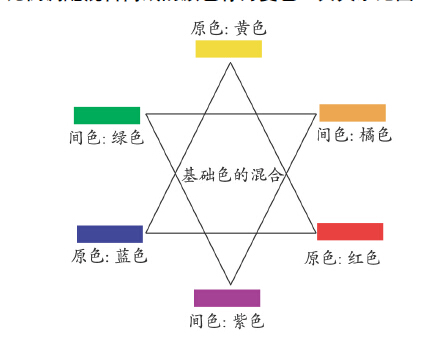
Figure 1 The relationship between the three primary colors, secondary colors and complex colors of colors
Paint color matching needs to be carried out in accordance with the basic principles of color science. There is a mutual canceling relationship between the three primary colors and other complex colors, that is, red, yellow, and blue are mutually offsetting colors, red and green are a set of offsetting colors; yellow and purple are a set of offsetting colors; blue and orange are a set of offsetting colors. Group of offset colors. According to this principle, the deviation that occurs during toning can also be eliminated. If the adjusted paint is somewhat yellowish, you can add purple according to the amount of yellowishness to eliminate the yellowness. When the yellowness is eliminated, the overall color will become slightly darker ( black) some. Add white to the color matching to dilute the primary color or secondary color, and you can get colors with different "saturation"; add different amounts of black, you can get various colors with different "brightness". Adding an offsetting color to a secondary color will darken the color, even to gray or black. The relationship is shown in Figure 2.

Figure 2 The relationship between the three primary colors, secondary colors and complex colors of pigment blending
The design and establishment of color matching and color system is not a simple and random collection of several colors, but a color family with a complete tone and color spectrum, so that different colors can be formulated to meet market demand.
For more details, please refer to the full text of "Design and Establishment of Color System of High-performance Industrial Solid Color Paint" (Dai Hongyan)
- 1The Difference Between RAL Formula Guide K5 and K7
- 2What are the main differences between Varnish and Paints?
- 3Paints gloss detection and measurement procedures
- 4Selection points of Color Chart reader
- 5Color card selection tool operation guide
- 6What are the characteristics of phenolic resin?
- 7Color spectrum computer color scheme software color scheme effect? Xiaotiao takes you to see
- 8Colormeter Color Difference Tester Realizes Color Card Query Color Number Video Tutorial
- 9Color difference meter applied to the appearance color difference detection of electric kettle