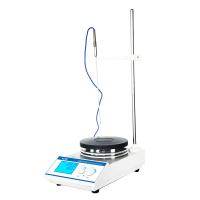
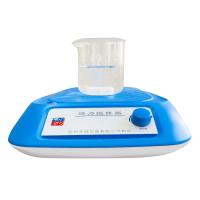
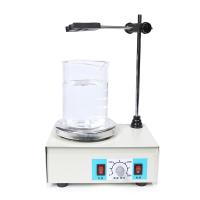
Application of Magnetic Stirrer in Titration Operation
In the titration operation of volumetric analysis, operators have been using manual stirring method for titration and stirring for a long time, which not only makes the titration operation cumbersome, the labor intensity of the analyst is high, but also often causes insufficient stirring, especially in the vicinity of It is difficult to master the coordination of stirring speed and titration speed at the end point, which often brings certain operational errors to the analysis results.
In order to effectively change this situation, simplify the operation method, and improve the accuracy and stability of the analysis results, the stirring function of the magnetic stirrer is introduced into the titration operation process. After nearly two years of practice, it has been proved that this method has achieved satisfactory results. This method basically solves various adverse effects caused by manual stirring, and makes the titration operation more standardized and programmed.
Application and Operation
In the cement industry, most manufacturers have magnetic stirrers, so with very little investment, only a little improvement on the stirring rod can be applied to the titration process.
To make the stirring rod, take an iron wire with a suitable thickness, cut it into sections according to the size of the stirring rod (the length of the stirring rod can be determined by the size of the beaker), and then put the wire into a white (or colorless) plastic tube, Closed at both ends. The quantity and the shape of the stirrer can be determined on demand.
The magnetic stirrer itself is also equipped with a stirring rod, which can also be purchased in the market, and can also be directly applied to the stirring operation.
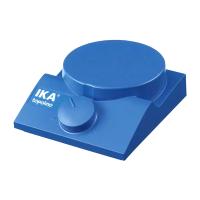
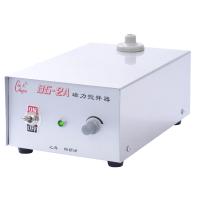
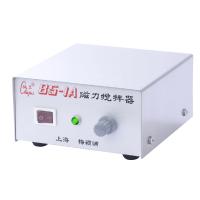
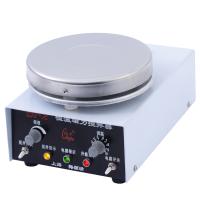
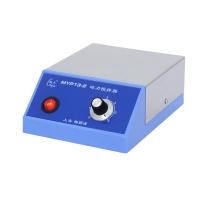
Before titration, put the stirring rod into the beaker, place the solution to be tested on the magnetic stirrer, turn on the speed adjustment switch, adjust the stirring speed to the best state, and then start the titration operation. For the titration of eFZO3, A12O3 and other solutions, you can also turn on the heating knob and adjust the temperature to the degree required by the solution to be tested. This will not only ensure that the temperature of the solution to be tested remains basically unchanged, but also help to speed up the complexation reaction. Eliminate the rigidity of the indicator, and make the color change of the titration end point more sensitive, so that the analysis result is accurate.
Precautions
(1) Stirring speed must be adjusted to a suitable speed, not only to make the stirring sufficient, but also to facilitate the diffusion of the titrated standard solution, so that the color change at the end point of the titration is more significant. If it is necessary to adjust the temperature, make corresponding adjustments according to the temperature required by the solution to be measured.
(2) When the end point is approaching, titrate slowly, and it is recommended to titrate drop by drop to avoid excessive titration and reduce titration errors.
(3) The two ends of the self-made stirring rod must be sealed well, otherwise it will bring some errors to the analysis results. At the same time, the stirring rod must be placed in the beaker only when the titration is in progress.
conclusion
(1) Stirring operation has always been a skill that analysts must master, so using a magnetic stirrer instead of manual stirring by analysts can effectively free analysts from unnecessary troubles and make titration operations for volumetric analysis easier Put it in the hands of analysts.
(2) When titrating a solution that needs to be kept at a certain temperature, the magnetic stirrer has an irreplaceable role of manual stirring. With the popularization and application of magnetic stirrer in titration operation, the titration operation will be easier and more convenient.
Author: Liu Gengye, Jiangsu Julong Cement Group


- 1Comparison and Application of Magnetic Stirring and Mechanical Stirring
- 2Application and Selection Guide of Electromagnetic Stirrer in Laboratory
- 3Describe 4 Common Stirrers in detail
- 4Principle and Application of Water Bath Magnetic Stirrer
- 5What is a mixer? Applications, advantages and disadvantages of mixers
- 6How to prepare polymer blended solid film materials?
- 7Agitators and their classification
裴梦琛 - 《西北大学》
- 8Testing Factors Affecting the Drying Properties of Plastic Water-based Gravure Ink with Agitator
- 9What are the characteristics of an overhead mixer?
-
![DaDi 85-2 digital temperature control magneticstirrer]()
-
![HUXI HMS-203D magneticstirrer]() HUXI HMS-203D magneticstirrer$ 251.00
HUXI HMS-203D magneticstirrer$ 251.00 -
![Qiwei CL-R magneticstirrer 1000ml]() Qiwei CL-R magneticstirrer 1000ml$ 103.00
Qiwei CL-R magneticstirrer 1000ml$ 103.00 -
![DADI CJJ78-1 Magnetic Stirrer]() DADI CJJ78-1 Magnetic Stirrer$ 101.00
DADI CJJ78-1 Magnetic Stirrer$ 101.00 -
![RONGHUA HJ-6 Six Head Magnetic Heating Stirrer]()
-
![RONGHUA Instrument 99-1A Dual digital display high power thermostatic magnetic heating Stirrer]()