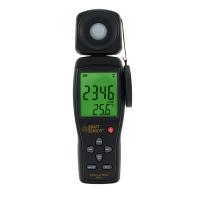
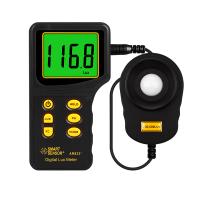
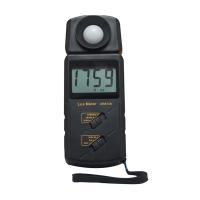
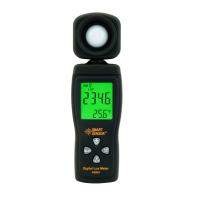
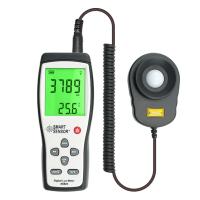
Luminometer principle, calibration, general requirements
Principle of illuminance meter
Photovoltaic cells are photoelectric components that directly convert light energy into electrical energy. When the light hits the surface of the selenium photovoltaic cell, the incident light passes through the metal thin film 4 and reaches the interface between the semiconductor selenium layer 2 and the metal thin film 4, generating a photoelectric effect on the interface. The magnitude of the generated photocurrent has a certain proportional relationship with the illuminance on the light-receiving surface of the photocell. At this time, if an external circuit is connected, a current will flow, and the current value will be indicated on the microammeter with lux (Lx) as the scale. The magnitude of the photocurrent depends on the intensity of the incident light. The illuminance meter has a shifting device, so it can measure high illuminance or low illuminance.
Types of illuminance meters:
1. Visual illuminance meter: it is inconvenient to use, the accuracy is not high, and it is rarely used;
2. Photoelectric illuminance meter: Selenium photocell illuminance meter and silicon photocell illuminance meter are commonly used.
Calibration of lux meters
Calibration principle:
Let Ls irradiate the photocell vertically → E=I/r2, change r to get the photocurrent value under different illuminance, and convert the current scale into the illuminance scale according to the corresponding relationship between E and i.
Calibration method:
Using the light intensity standard lamp, under the working distance of the approximate point light source, change the distance l between the photocell and the standard lamp, record the readings of the ammeter at each distance, and calculate the illuminance E by the inverse square law of distance E=I/r2, and then calculate the illuminance E by This can get a series of photocurrent values i with different illuminance, and make the change curve of photocurrent i and illuminance E, which is the calibration curve of the illuminance meter. From this, the calibration of the illuminance meter can be done by dividing the dial of the illuminance meter.
Factors Affecting Calibration Curves
The photocell and galvanometer need to be re-calibrated when they are replaced; the illuminance meter should be re-calibrated after a period of use (generally 1-2 times within a year); the high-precision illuminance meter can be calibrated with a light intensity standard lamp; The calibration range of the illuminance meter can change the distance r, or choose different standard lamps, and choose a small-range galvanometer
General Requirements for Luxmeters
● Small size and light weight (Compact Size, Light Weight)
The opportunity to use the illuminance meter is very wide, and the timing of application is often in different places, so the first prerequisite for the portable illuminance meter is small size and light weight.
● Accuracy﹝Accuracy﹞
Whether the illuminance meter is good or not is closely related to its accuracy. Of course, it is also closely related to its price, so it is necessary to buy a lux meter with high accuracy at a reasonable price. Generally, the error should not exceed ±15%.
● Color Compensation﹝Color Compensation﹞
The types of light sources are all-encompassing, some focus on red high-pressure lamps with longer wavelengths, or blue-violet ones with shorter wavelengths such as Daylight fluorescent lamps; there are also more evenly distributed ones such as incandescent bulb series, the same illuminance meter may have slightly different sensitivity to different wavelengths Therefore, appropriate compensation is necessary.
● Cosine Compensation﹝Cosine Compensation﹞
We all know that the brightness of the illuminated surface is related to the incident angle of the light source. In the same way, when measuring with a light meter, the incident angle between the sensor (Sensor) and the light source will naturally affect the reading value of the light meter. Therefore, whether a good illuminance meter has the function of cosine compensation cannot be ignored.


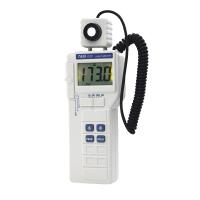
- 1Forest UV Illuminance Meter FAQ
- 2MS6610 Digital luminometer operating instructions
- 3ST-86L luminometer manual
- 4ST-85 luminometer instruction manual
- 5ST-80C luminometer manual
- 6Precautions for the use of luminometers
- 7Ultraviolet Spectrophotometer inspection
- 8Fault Analysis and Removal of Ultraviolet Illuminometer
- 9How does a luminometer calculate illuminance?