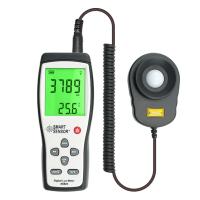
Precautions for the use of luminometers
Introduction to Light Meter
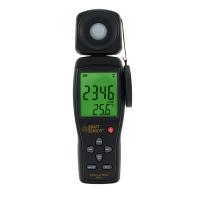
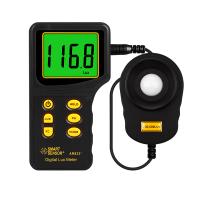
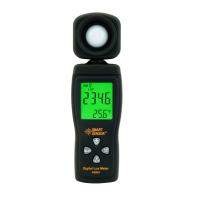
An illuminance meter (or lux meter) is an instrument that specializes in measuring luminosity and brightness. It consists of a host and a light sensor. The measurement range is 0-50000. The average indoor illuminance is from 100-1000lux, and the outdoor sunlight illuminance is about 50000lux. Lux is a unit of illuminance, indicating the density of light shining on a surface. Its applications are mainly indoors, offices, experiments
Light Meter Precautions
1. The light meter probe is made of glass, which is easy to break and break, and the waterproof effect is poor when used.
2. Requirements for use:
① Photovoltaic cells use selenium (Se) photocells or silicon (Si) photocells with good linearity; they can maintain good stability and high sensitivity after working for a long time; when E is high, choose photocells with high internal resistance, which have low sensitivity and good linearity , not easily damaged by strong light
② There is a V(λ) correction filter inside, which is suitable for the illumination of light sources with different color temperatures, and the error is small
③Add a cosine angle compensator (opalescent glass or white plastic) in front of the photocell because when the incident angle is large, the photocell deviates from the cosine rule
④ The illuminance meter should work at room temperature or close to room temperature (photocell drift changes with temperature)
Calibration of the lux meter:
Calibration principle:
Let Ls irradiate the photocell vertically → E=I/r2, change r to get the photocurrent value under different illuminance, and convert the current scale into the illuminance scale according to the corresponding relationship between E and i.
Calibration method:
Using the light intensity standard lamp, under the working distance of the approximate point light source, change the distance l between the photocell and the standard lamp, record the readings of the ammeter at each distance, and calculate the illuminance E by the inverse square law of distance E=I/r2, and then calculate the illuminance E by This can get a series of photocurrent values i with different illuminance, and make the change curve of photocurrent i and illuminance E, which is the calibration curve of the illuminance meter. From this, the calibration of the illuminance meter can be done by dividing the dial of the illuminance meter.
Factors affecting the calibration curve:
The photocell and galvanometer need to be re-calibrated when they are replaced; the illuminance meter should be re-calibrated after a period of use (generally 1-2 times within a year); the high-precision illuminance meter can be calibrated with a light intensity standard lamp; The calibration range of the illuminance meter can be changed from the distance r, and different standard lamps can also be selected, and a small-range ammeter can be selected.
Pay attention to the ambient temperature when using the UV light meter:
When using, you need to pay attention to avoid receiving strong light, because the cathode of the phototube is exposed to strong light for a long time, and fatigue will occur, which will make the photocathode emit abnormally. Therefore, the protective cover of the window should be covered when the illuminance meter is not used. In addition, the ambient temperature of the ultraviolet illuminance meter should not be very high or low. Especially for the ultraviolet illuminance meter that uses the thermoelectric effect element as the receiver, the requirements on the ambient temperature are more stringent (generally at 20°C); and when the photoelectric cell GD-5 is used as the receiver, the requirements on the ambient temperature are not very strict. Generally speaking, the lower the temperature, the better; to reduce the dark current. In addition, when measuring the radiation of the light source, it should be perpendicular to the window of the receiver. If it is tilted, it will produce a large error.


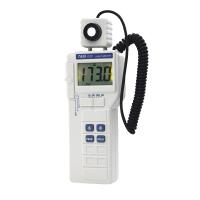
- 1Forest UV Illuminance Meter FAQ
- 2MS6610 Digital luminometer operating instructions
- 3ST-86L luminometer manual
- 4ST-85 luminometer instruction manual
- 5ST-80C luminometer manual
- 6Luminometer principle, calibration, general requirements
- 7Ultraviolet Spectrophotometer inspection
- 8Fault Analysis and Removal of Ultraviolet Illuminometer
- 9How does a luminometer calculate illuminance?