Concept and classification of Densitometer
What is a Density Meter?
A densitometer is an optical instrument that measures optical density. Optical density is a measure of the transmittance or reflectance of the surface of an object, expressed in the formula: D= log( 1/d)
In the formula, D is the optical density, and d is the transmittance or reflectance of the object.
Basic Classification of Density Meters
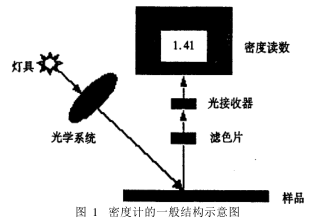
The densitometer indirectly measures the amount of light absorbed by an object, and then expresses it in a mathematical form that conforms to the logic of human observation. Densitometers can be generally divided into transmission densitometers (to measure the transmitted light of transparent objects) and reflection densitometers (to measure the reflected light of non-transparent objects), and can be divided into black and white densitometers and color densitometers according to the color of the measured light. The structural schematic diagram of the reflection densitometer is shown in Figure 1, and the transmission densitometer is similar to this, as long as the structure is slightly adjusted to measure the transmitted light. The color filter of the black and white densitometer is often one piece, often called blackness measurement. For example: measure the density of black and white photos, black and white negatives.
The color densitometer measures colored light, measures the light intensity of the red, green, and blue components of reflected or transmitted light after passing through three color filters of red, green, and blue, and then directly displays the three-color density of the object through logic or electronic devices. Generally expressed by DR, DG, and DB, from which the relative proportional relationship of the absorption of these three basic components by the object can be judged. Because the amount of light absorbed has a certain correspondence with the concentration or thickness of colorants such as pigments, dyes, and inks on the surface of objects, the relative proportion of colorant components can be adjusted according to the density value to achieve color balance and vivid pictures. It can be seen from the working principle of the density meter that although the density meter does not measure color, it can still be used as a tool for color measurement. With the development of science and technology, people's requirements for color are increasing day by day. Density meter has become an important tool for color quality control and management, and has been widely used in printing, photography, medicine, textile and other industries. Especially in the production control process of the printing photography industry, a densitometer, especially a color densitometer, has become an important tool required.
This article is excerpted from "The Development Status and Trend of Color Densitometer" by Ning Hongna and Ni Xuxiang.




- 1Correct operation steps of liquid density meter [video demonstration]
- 2Installation, Calibration and Measurement of Density Meters [Video Demonstration]
- 3How does a density meter test the density of a product with a density < 1? [Video explanation]
- 4How does a density meter detect the density of bulk products?
- 5Densitometer calibration
- 6Color and Gloss Calibration
- 7What is a density meter? How to calibrate?
- 8Outdoor steel structure fireproof coating performance testing instrument scheme [mid-range version]
- 9Density measurement method basic knowledge
Siegfried Hold