How to choose a Multimeter
The multimeter is widely used in technical fields such as national defense, scientific research, factories, schools, measurement and testing due to its high accuracy, wide measurement range, fast measurement speed, small size, strong anti-interference ability, and convenient use, but its specifications are different. There are a variety of performance indicators, and the use environment and working conditions are also different, so the appropriate multimeter should be selected according to the specific situation.
1. Select by function
In addition to the five functions of measuring AC and DC voltage, AC and DC current, and resistance, the current digital multimeter also has digital calculation, self-test, reading hold, error readout, diode detection, word length selection, and IEEE-488 interface. Or RS-232 interface and other functions should be selected according to specific requirements.
In addition, you should also consider choosing a multimeter according to special requirements. For example, if you encounter work requirements to measure non-sine waves, you need to choose a multimeter with a true RMS function. This type of multimeter uses an integrated circuit operational amplifier to convert the effective value voltage, rather than simply converting the average value.
If you encounter a situation where a large current needs to be measured, you should choose a clamp multimeter according to the specific situation to be measured. The clamp-on multimeter is mainly based on the clamp-on ammeter, which also has the function of a multimeter, such as the DT9205 digital clamp-on multimeter. NBCHAO reminds you: the digital clamp multimeters currently on the market have different functions and ranges when measuring large currents. For example, the UT209 digital clamp multimeter produced by Unilever Co., Ltd. It has the function of measuring DC large current (1 000 A), but most of the clamp multimeters on the market do not have this function. The size of the pointer clamp meter is relatively small, and its accuracy is low due to the limitation of its manufacturing process. Some of them add a clamp current transformer to the multimeter, so that the accuracy cannot be guaranteed. Except for the AC current, the range of the clamp multimeter is small, usually only for indication, and there is basically no small range, such as the 266 digital clamp multimeter produced by Fujian Zhangzhou Matt Company. Users should pay attention to these problems when choosing.
2. Select by accuracy
The maximum error allowed by a digital multimeter depends not only on its variable error, but also on its fixed error. When choosing, it also depends on the requirements of stability error and linearity error, and whether the resolution meets the requirements. If the general digital multimeter requires grade 0.02 to grade 0.05, it should have at least 4 and a half digits display; if it is below grade 0.1, it should have at least 3 and a half digits display.
Digital multimeters have many ranges, but the basic range is the most accurate. Many digital multimeters have automatic range function, no need to manually adjust the range, making the measurement convenient, safe and fast. There are also many digital multimeters with over-range capability. When the measured value exceeds the range but has not reached the maximum display, it is not necessary to change the range, thereby improving the accuracy and resolution.
Compared with the digital multimeter, the accuracy level of the pointer multimeter is much lower. The accuracy level of the DC voltage is basically 1.5 to 2.5, while the accuracy level of the AC voltage is 2.5 to 5.
3. Select according to the maximum range
Most digital multimeters not only have a wide range distribution, but also have a high maximum range. Generally speaking, the DC part voltage can reach 1000 V, the current can reach 20 A, the AC voltage can reach 750 V or 1000 V, and the current is the same. 20A. NBCHAO reminds you: The principle of large current range measurement is to convert the current value into a voltage value through a shunt, so its accuracy will be affected to a certain extent. The resistance range is 20 MΩ to 200MΩ, which can basically meet the needs of use. However, most pointer multimeters have a small range, and the maximum range of AC and DC voltage is 500 V, and the AC and DC current is mostly 0.5 A or 5 A, which may not meet the needs of some users.
4. Select by display type
Compared with the pointer multimeter, the digital multimeter has the following advantages: first, the digital multimeter has high measurement accuracy, wide range, small size, and the measured value can be directly displayed without conversion; second, the extended function of the instrument is easy Realization, some digital meters can be equipped with corresponding options to complete the detection of other measured objects, such as temperature, capacitance, inductance, frequency, etc.; third, digital multimeters have data retention functions, display power shortage functions, and automatic shutdown. Convenient functions.
However, compared with the pointer multimeter, the digital multimeter has obvious disadvantages: first, it is not as intuitive as the pointer multimeter for the measured readings that need to monitor its continuous change, which is why some large digital multimeter manufacturers will include it in their product series. A new product called analog/digital multimeter is added to the digital multimeter. The method is to add an analog bar graph while the digital multimeter is displayed. The length of the lit segment indicates the measured size, which is consistent with the indication The method is similar; second, the digital multimeter generally needs to be powered by a battery, and it cannot be used when the battery is dead, and if the battery voltage is insufficient during use, the indication value will be seriously inaccurate, which will directly affect the accuracy of the measurement result. , and in terms of price, digital multimeters are higher than pointer meters.
Although the pointer watch is bulky in appearance and its function is not as professional as that of the digital watch, its obvious advantages are intuitive reading, low price and easy repair. It is based on these aspects that pointer multimeters still occupy a considerable market share.
5. Select according to its safety performance index
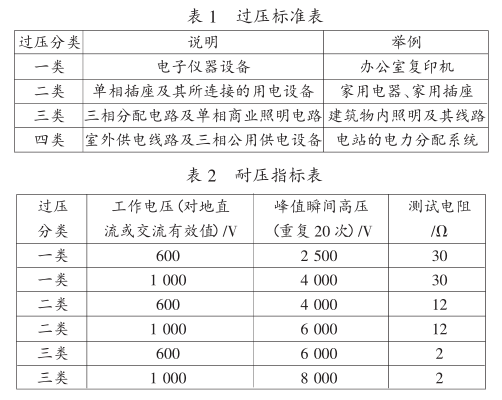
The multimeter usually needs to be carried by the user and used to measure the measured object on site, which involves safety issues. When safety gradually becomes a consideration for users, how to ensure safety, or what indicators should be used to judge its safety, has become a common sense that people need to understand. Before choosing a multimeter, you should first analyze the worst case of the use environment to select the overvoltage standard (see Table 1), and then select the withstand voltage index under the same overvoltage standard (see Table 2).
To sum up, although the accuracy of the multimeter used as a tool meter is not high, it has a wide variety of specifications, and it needs to be carefully selected when using it.
This article is excerpted from Peng Yang's "Classification and Selection of Multimeters", please read the full text for more information.


