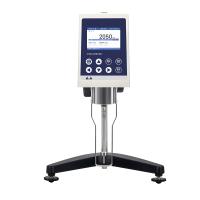
Can Rotational Viscometers measure non-newtonian fluid Viscosity?

Should be measurable.
When the Newtonian fluid flows, the required shear stress does not change with the change of the flow velocity, and the solution of pure liquid and low molecular substance belongs to this category; when the non-Newtonian fluid flows, the required shear stress changes with the change of the flow velocity, and the solution of the polymer, the mixture Suspensions, emulsions and solutions of surfactants generally fall into this category.
When we study the rheological characteristics of fluids, we generally assume that the measured liquid is Newtonian fluid, but in fact, 90% of the fluids in nature are non-Newtonian fluids. However, the viscosity of most fluids varies with the shear force. Not much, so we still use the mathematical model of Newtonian mechanics to research and measure. Therefore, when measuring the viscosity, the measurement results sometimes have some changes, and the measured value drifts a little. I always feel that the reading is not stable enough for other analysis methods. In fact, this is normal. Yes, at this point we should understand that the sample to be tested is a non-Newtonian fluid, so we recommend DV data acquisition and program-controlled analysis software or DV program-controlled offline download software to monitor the change of viscosity through the viscosity change curve. , sometimes the drift is very small, but we can judge the nature of the fluid from this trend, which can obtain more information than pure single-point measurement.
Viscosity and kinematic viscosity are physical constants of fluids. Its value is determined experimentally. In general, the viscosity of liquids decreases with increasing temperature, and the viscosity of gases increases with increasing temperature. When the pressure changes, the viscosity of the gas or liquid basically remains unchanged, but the viscosity of the gas under extremely high pressure increases with the increase of the pressure, and the viscosity of the gas under extremely low pressure also needs to consider the influence of pressure, which is often required in engineering For the viscosity of mixed liquid and mixed gas, if there is no experimental data, the corresponding formula can be used to estimate the viscosity of the pure substance. According to Newton's law of viscosity, for a given fluid, a straight line passing through the origin can be obtained by plotting the shear stress against the velocity gradient, and its slope is the viscosity of the fluid at a given temperature. Experiments have shown that for gases and most liquids with low molar mass, they are Newtonian fluids. There are quite a few fluids that do not follow this rule, called non-Newtonian fluids, described by apparent viscosity. Apparent viscosity is no longer a pure physical property. According to the relationship between the surface viscosity of non-Newtonian fluids and the velocity gradient, non-Newtonian fluids can be divided into the following categories: ① Pseudoplastic fluid ② Expandable fluid ③ Viscoplastic fluid ④ Thixotropic fluid ⑤ Viscoelastic fluid.
The phenomenon that the apparent viscosity of the pseudoplastic fluid decreases with the increase of the velocity gradient is called the "shear thinning" phenomenon. Other non-Newtonian fluids also have interesting phenomena such as "climbing rods" and "tubeless siphons". Adding a small amount of high-molecular substances to the Newtonian fluid may turn the fluid into a viscoelastic fluid, which greatly reduces the resistance to flow and produces the so-called drag reduction phenomenon.
For example, adding a drag reducer to water can reduce the fluid flow resistance in the fire hose, thereby increasing the spraying distance; in the petroleum industry, long-distance pipelines are used to transport oil, and if an appropriate drag reducer is added, the transportation cost can be reduced.
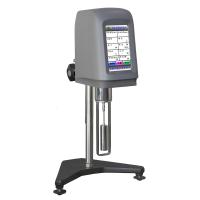

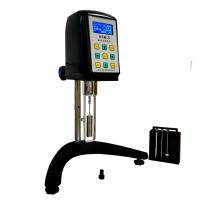
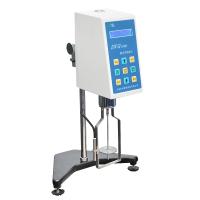


- 1Rotational viscometer - principle, classification, application and calibrating
- 2Application of NDJ-8S digital Rotational Viscometer in viscosity measurement of cosmetic raw materials
- 3NDJ-5S digital Rotational Viscometer accurate measurement of natural oil viscosity
- 4Application of HBDV-1H swirl/spin High Temperature Viscometer in Viscosity Determination of Plastic Particles
- 5Rotational viscometer selection guide: How to choose the right viscosity equipment for you?
- 6Principle, type and accuracy control of Rotational Viscometer
- 7Which Viscometer to Choose for Licorice Extract Viscosity Testing? How to Test?
- 8Application of Rotational viscometer in Waterborne Polyurethane Adhesive
- 9Application of Rotational Viscometer in cellulose material