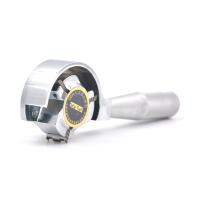
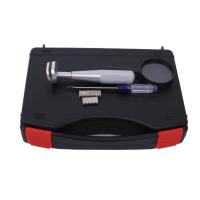
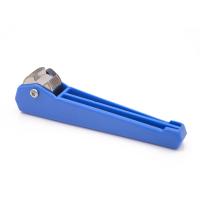
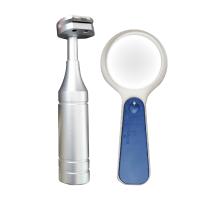
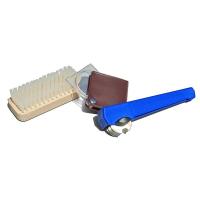
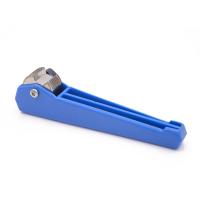
Scratch knife operation and use method
How to use the grid knife
1. The test piece needs to be prepared according to the provisions of ISOR1514 and ISO2828.
2. Place the test piece on a flat plate with sufficient hardness.
3. Hold the handle of the scratcher and make the multi-blade cutting knife perpendicular to the plane of the test piece.
4. Cut with uniform pressure, steady and non-vibrating technique and cutting speed of 20-50mm/S.
5. Rotate the test piece by 90 degrees, and repeat the above operation on the incision made to form a lattice pattern.
6. Use a soft brush to brush the diagonal lines on both sides of the grid pattern and gently brush the test piece backward 5 times and forward 5 times.
7. The test of the hundred-grid knife is completed on at least three different positions of the test piece. If the test results of the three positions are different, the test should be repeated on more than three positions, and all the results should be recorded at the same time.
8. If you need to replace the multi-blade cutting knife, you can use a screwdriver to loosen the two screws on the knife body, replace it with the knife you are using, stick the edge of the knife to the side of the handle, and tighten the screws.
Precautions for using the grid knife
1. All cuts should penetrate the coating, but not too deep into the substrate.
2. If the coating is too thick and hard to penetrate the substrate, the test is invalid, but it should be stated in the test report.
3. Stick the tape on the entire grid, and then tear it off at the smallest angle. The result can be obtained according to the ratio of the glued area on the surface of the paint film.
4. The test should be carried out at a temperature of 23±2°C and a relative humidity of 50±5%.
- 1The principle, application, test procedure and result evaluation of cross-cut Tester
- 2Drawing adhesion test purpose, operation method and common problem
吉姆·布朗
- 3What are the ASTM D3359 Method B and ISO 2409 compliant paint film scribes?
- 4Two Methods of Adhesion Testing
- 5What are the characteristics of unsaturated polyester coatings?
- 6Drawing method test principle [with schematic diagram]
- 7Standard Test Method for Adhesion
- 8Paint Adhesion Test - Paint Film Scratch
- 9What performance subjects should be tested for amino alkyd resin coatings? How to judge the results?