Current Situation and Research Direction of VOC Detection Methods in Air
Due to the rapid development of the real estate industry, the problem of air pollution caused by interior decoration has also come one after another. Volatile Organic Compounds (Volatile Or-ganic Compounds, VOC) are the culprits of air pollution, including benzene series, organic chlorides, Freon series, organic ketones, alcohols, ethers, esters and petroleum hydrocarbon compounds, etc., are mainly derived from latex paint, wallpaper, floor tiles, thermal insulation materials, adhesives and other decoration materials and furniture. The article "The Current Situation and Research Direction of VOC Detection Methods in the Air" mainly expounds and compares the five methods of VOC detection in the air. The specific content is as follows:
1. Gas chromatography
Gas chromatography is a chromatographic column separation technique with gas as the mobile phase. The separated substance flows with the carrier gas, and the measured component is adsorbed by the adsorbent or dissolved by the stationary solution. Repeated adsorption or dissolution makes the separation of different substances in the chromatographic column with different retention times.
1) Determination of formaldehyde in air by gas chromatography
In some water-soluble paints or packaging materials, the detection methods of formaldehyde generally use basic fuchsin colorimetric method, colorimetric acid colorimetric method, phenylhydrazine hydrochloride colorimetric method and acetylacetone colorimetric method, etc. The use of gas chromatography to determine formaldehyde is currently the most accurate method for quantifying formaldehyde. Literature [3] proposed a headspace gas chromatography for the rapid determination of formaldehyde, with a detection limit of 5 mg/m 3 . Bao Li et al. [4-5] studied the use of Gas chromatography is used to determine formaldehyde content in workshop air. Its advantages are rapidity, high sensitivity, formaldehyde detection limit is 0.75 mg/m3, and recovery rate is high. It can meet the requirements of formaldehyde determination in workshop air, but the operation is cumbersome. Chromatography can also be separated by direct injection capillary column, and then determined by gas chromatography (FID). Fan Yanqiong et al [6] studied this method and measured the concentration of formaldehyde in the air. The detection limit of formaldehyde was 43 mg /m3, which is characterized by high sensitivity and good separation effect, and is suitable for the determination of formaldehyde concentration in public places and family rooms. Literature [7] analyzed the formaldehyde content in the room by gas chromatography. Table 1 is the comparison of the results of gas chromatography and phenol reagent method for the detection of formaldehyde concentration in decorated houses.
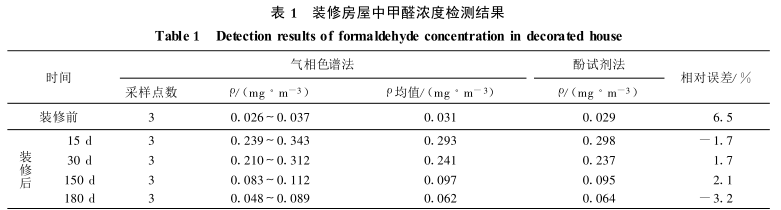
Analysis of Table 1 shows that the relative error is -3.2% to 6.5%. This method is sensitive, accurate, and non-interfering, but there is an obvious hysteresis in analysis and monitoring, complex sample pretreatment is time-consuming and laborious, and consumes a large amount of samples and solvent .
2) Determination of benzene series in the air by gas chromatography
At present, the existing method for detecting benzene series is the national standard GB11737-1989 "Standard Method for Hygienic Inspection of Benzene, Toluene and Xylene in the Atmosphere of Residential Areas Gas Chromatography", etc. Gao Ruiying et al [8] conducted a study on the influencing factors of activated carbon adsorption VOC According to the research, the sample gases are benzene toluene and xylene. The results show that the concentration of benzene series, physical and chemical properties, and gas flow all have an impact on the adsorption of activated carbon. In addition to the adsorption of activated carbon, Tenax-TA adsorbent (2,6 - diphenylfuran porous polymer resin), which is widely used in the collection of volatile or semi-volatile substances in gases, liquids and solids. Literature [9-10], the use of thermal desorption for the determination of benzene series in the air Attachment-gas chromatography/mass spectrometry (ATD-GC/MS) method, this method uses Tenax-TA adsorption tube, the results are shown in Table 2.
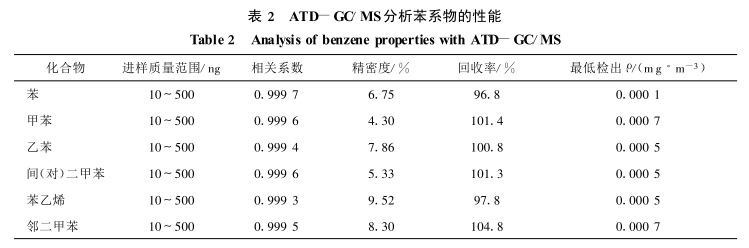
Analysis of Table 2 shows that the adsorption efficiency of each benzene series is above 97%, the analysis efficiency is above 99%, the recovery rate is 96.8%-104.8%, and the minimum detection concentration is lower than 0.001 mg/m 3 . Compared with the national standard analysis method, a large amount of solvent is saved, the analysis error is relatively small, the recovery rate is high, and the detection concentration is low. However, in terms of the detection process, the operation is more complicated and the steps are too cumbersome. If it can be optimized, this The utility and scope of this approach will expand.
3) Determination of other VOCs in the air by gas chromatography
There are also some other VOCs in the air, such as esters, alkanes, ketones, etc. The determination method of total volatile organic compounds (TVOC) in the air is the national standard GB 50325-2001 "Control of Indoor Environmental Pollutants in Civil Construction Engineering The VOCs obtained from the analysis include not only benzene series, but also other aldehydes, ketones, esters and alkanes. For example, in the literature [12-13], the detected samples are benzene, Toluene, butyl acetate, ethylbenzene, m-(p-)xylene, benzene and other VOCs. Some studies also use full-sampling gas chromatography, and the operation is also too cumbersome. Wu Long et al. used capillary gas chromatography to simultaneously measure Eight kinds of toxic substances in the workshop were detected, and the detection limit reached 0.200 mg/L. Table 3 shows the determination and recovery rate of the eight kinds of samples.
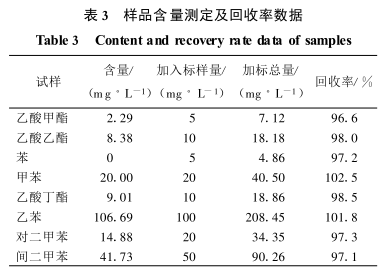
It can be seen from the data in Table 3 that the recoveries of the eight substances are all above 95%, and the recovery rates are relatively high. Like other gas chromatography methods, this method also needs to use standard solutions to draw a standard curve and calculate the relative standard deviation. In the research, the test is carried out for a specific volatile organic compound such as methanol, and the actually detected VOCs will have a certain influence on each other or cause interference.
2. Determination of formaldehyde by effective liquid chromatography (HPLC)
Effective liquid chromatography is suitable for separating substances with high boiling point, poor thermal stability, physiological activity and relatively large relative molecular mass, so it is widely used in the analysis of nucleic acids, peptides, lactones, fused ring aromatics, polymers and other substances. However, because of its high cost, HPLC is rarely used in experiments to analyze volatile organic compounds. Chen Haiping studied the determination of free formaldehyde in textiles by effective liquid chromatography, and compared it with the acetylacetone method. The data are shown in Table 4.
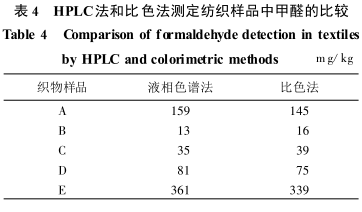
From the data comparison in Table 4, it can be found that there is no significant difference between the results obtained by liquid chromatography and colorimetry, indicating that liquid chromatography achieves relatively accurate results with relatively simple operations, and has high sensitivity, high resolution, and high resolution. Accuracy and other advantages, but the price is expensive, the capacity is not large, the mobile phase consumption is large, and most of them are toxic.
3. Membrane technology to deal with volatile organic compounds
Membrane is a medium for molecular-level separation and filtration. It is different from traditional filtration in that membranes can separate within the molecular range, and it is a physical process that does not require phase changes and additives. For the application of membrane technology in the treatment of VOC, reference can be made to [18]. Generally, rubbery polymer membranes are used to treat VOC, such as silicone rubber membranes. As a separation technology, membrane technology plays a great role in the recovery of VOC , and often has a high recovery rate, which is of great help to the recycling of resources.
4. Chemical analysis of volatile organic compounds
化学法分析 VOC 是常见的检测甲醛的方法。传统的方法一般采用分光光度法。乙酰丙酮分光光度法因其稳定、准确而被作为常用的方法。化学法相对于色谱法来说 , 检测时间周期长, 要配制多种溶液 ,操作重复性高.例如运用乙酰丙酮法测甲醛 ,甲醛用水吸收后, 在 pH 值为 6 的乙酸 -乙酸铵缓冲溶液中, 与乙酰丙酮作用 ,在沸水浴条件下,迅速生成稳定的黄色化合物,在波长为 413 nm处测定吸光度 .整个过程需要配制乙酰丙酮溶液 、甲醛标准贮备液,需绘制校正曲线 ,花费时间长.所以, 化学法适合在试验室使用 , 还可作为色谱法或者仪器法的一种对比,用来评价其他方法的误差是否在允许的范围,是否具有实用性。
5、 仪器法测定 VOC
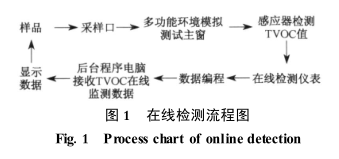
1)纺织材料 TVOC 在线检测系统沈勇等展示了自行研发的 TVOC 在线检测试验舱 ,其主要由采样口、多功能环境模拟测试主舱 、在线检测仪表、数据编程和后台程序电脑接收 TVOC 在线监测数据等装置组成.流程示意图如图 1 所示。
多功能环境模拟测试舱为一个密闭检测舱, 通过控制温度和湿度来模拟环境 , 由感应器测得TVOC 值,并实现在线跟踪检测 ,将数据传送至后台程序控制电脑 .当 VOC 吸附于传感器表面时 ,在一定温度下(270 ℃左右),VOC 与气体氧在感应器的感应电作用下,发生氧化还原反应而产生热量, 导致传感器回路中某一特定电阻的阻值改变 ,从而使电路中的某一输出分压值改变 .According to该电阻的变化而得到 TVOC 的相对值, 并通过数据线传输到电脑上, 可用于测试光触媒纺织品对 TVOC的降解性能 , 纺织材料本身 TVOC 污染物的释放特性, 及其他高分子材料降解 TVOC 的性能.可连续测试和记录检测数据, 具有速度快、测试周期短 、可定性和定量监测等特点。但这种仪器要定时进行校正 ,温度 、压力和湿度等都对检测有一定的影响 ,且稳定性也有待进一步提高。
2)其他检测仪
Some instruments can be specially used to measure a specific VOC, such as a formaldehyde Detector. The 4160-II formaldehyde Detector produced in the United States has a minimum detection concentration of 0.01 × 10⁻⁶mg/m3. Comparing this formaldehyde Detector method with the traditional acetylacetone spectrophotometric method, there is no significant difference in the obtained results. Instrument It saves the trouble of preparation of various reagents and calibration of formaldehyde standard samples in chemical methods, and is relatively practical. There are also some instruments similar to the membrane technology mentioned above, which can be used to recycle VOC, such as activated carbon fiber adsorption devices.
This article only extracts part of the original text, please read the original text of "Current Status and Research Direction of VOC Detection Methods in Air" for complete content.


