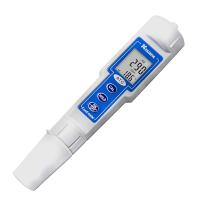
Detection principle and application of conductivity meter
Overview of Conductivity Meter and Its Application
Conductivity meter is a precision instrument .
Since the ions in various liquids vary in their composition and concentration, their electrical conductivity is different. Therefore, the composition and concentration of the solute contained in the detected liquid can be determined by measuring the conductivity of the liquid, that is, the conductivity . Usually, a conductivity meter is used to determine the components contained in the solution. Under the known premise, only one component contains a different ratio of the conductivity caused by the difference, so as to measure the concentration of the component contained in the solution. Conductivity meter is widely used in scientific research, teaching , industry, agriculture, environmental protection and other fields; it is also used to prepare standard solution in measurement, and use conductivity meter to measure the conductivity of liquid medium to detect the production process of industry and agriculture Whether it is normal and whether the discharge of waste liquid meets the standard data. Whether the conductivity meter is accurate is a part of the measurement work.
Detection principle of conductivity meter
The block diagram of the measurement principle of the conductivity meter is shown in Figure 1.

During the measurement of conductivity, a constant amplitude voltage signal is applied between the two electrodes, and a certain current flows through the electrodes. The magnitude of the current depends on the number of ions contained in the solution, the conductivity of the measured medium and the operational amplifier proportional to the output voltage.
When using the conductivity meter, turn on the power switch, set the function switch of the instrument to the calibration position, set the temperature compensation to 25 ℃, and adjust the constant correction knob so that the instrument displays the actual constant value of the conductivity cell as 1.
Then, set the function switch to the "Measurement" position, insert one end into the "conductivity electrode socket of the instrument", and connect the two wires at the other end to the standard resistance box terminal.
This article is excerpted from "Discussion on the Verification Principle of Conductivity Meter" by Qiu Guijing



- 1The Working Principle of Gel Conductivity Meter Has Been Detailed
- 2Detection Principle and Application Analysis of Conductivity Meter
- 3Principle of Conductivity Analyzer
- 4Several common electrode types for Conductivity Meters
- 5Differences between three STIP-scans: pH Meter, Conductivity Meter, and Dissolved Oxygen Meter
- 6Conductivity Meter and Ion Meter specific differences
- 7Common types and application differences of STIP-scan
- 8How to detect the conductivity of lithium battery coating slurry?
- 9How to choose a high-precision conductivity meter?