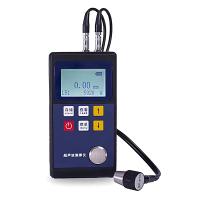
Factors Affecting the Accuracy of Ultrasonic Thickness Measurement
Ultrasonic thickness measurement is a simple and widely non-destructive testing method. However, since the working media of chemical enterprises are mostly high temperature, high pressure, corrosion and other characteristics, the thickness measurement conditions are complicated, so it is not easy to ensure the data . In this paper , on the basis of summarizing the laboratory test results and combining field practice, some measures to ensure the accuracy of thickness measurement are proposed.
1. Principle of ultrasonic thickness measurement and analysis of influencing factors
Ultrasonic Thickness Gauges are divided into resonance type, pulse reflection type and Lamb wave type, and the pulse reflection type is generally used . The pulse reflection Thickness Gauge is based on the principle that the ultrasonic pulse emitted by the probe chip will be reflected when it encounters a different medium interface when it propagates in the workpiece. Its working principle is that the transmitting circuit sends a periodic pulse, which is added to the probe through the cable, and the piezoelectric chip in the probe is excited to generate ultrasonic waves. The ultrasonic waves are reflected multiple times on the upper and lower surfaces of the workpiece. The reflected waves are received by the probe , converted into electrical signals, amplified by the amplifier, and then input to the calculation circuit. Converted to workpiece thickness and displayed. The calculation formula is

(where c- is the wave speed in the workpiece; t- is the travel time of the ultrasonic wave in the workpiece for one round trip). During the measurement, mechanical or chemical methods are often used to remove the oxide skin on the surface of the measured object, and a couplant that facilitates ultrasonic transmission is added between the probe and the workpiece (commonly used couplants include glycerin, engine oil, and water glass). According to the principle of ultrasonic thickness measurement, it can be deduced that the factors affecting the accuracy should at least include several aspects such as the quality state of the inside and outside of the measured object, instrument performance, coupling agent properties, and human factors in the operation process.
1.1 The influence of the surface quality of the measured object on the thickness measurement accuracy
Ultrasonic Thickness Gauge is used to measure the thickness of carbon steel plate and 18-8 stainless steel pipe with clean surface at room temperature , and then measure the test plate with oxide layer and dirt layer on the surface of the same material . The measurement results are shown in Table 1. Table 1 The comparison of the measured data before and after the change of the external quality state The following conclusions can be drawn by comparing and analyzing the measurement results :
1.1.1 The oxide layer and grease layer on the back of the probe contact have no obvious influence on the measured value of the wall thickness;
1.1.2 The oxide layer and grease will increase the reading of the measured value of the wall thickness.
1.2 The influence of the internal quality of the measured object on the thickness measurement accuracy
At the site, the arc of the U-shaped elbow of the 2N compressor water-cooled tube with a nominal size of φ68mm× l5mm was measured, and the wall thickness measured many times was 5.5mm. 6mm, and considered to be fluid erosion thinning. However, after removal, the wall thickness was measured with a ruler to reach 12.4mm. It is still 5.6mm when measured with domestic and imported Thickness Gauges. Later, the ultrasonic flaw Detector was used to measure the thickness, and it was found that there was a defect reflection at the wall thickness of 4.8-7.2mm, and the bottom wave was reduced by half, so it can be judged that the value measured by the Thickness Gauge is Depth, not real thickness. Through a large number of tests, it has also been confirmed that the internal also have a direct impact on the thickness measurement results. Its content includes: grain anisotropy of materials, alloy composition of materials, metallographic structure distribution of materials and inclusions in materials, etc. From this, the following conclusions can be drawn: the internal quality defects of the measured object have a direct impact on the results of ultrasonic thickness measurement.
1.3 Influence of instrument performance on thickness measurement results
Tests have shown that when a general Thickness Gauge measures the thickness of a coated object , there is a large difference between the measured thickness and the actual thickness of the measured point. Using a digital ultrasonic flaw Detector and using the echo-echo method to measure the thickness of the same object is basically consistent with the actual wall thickness. That is to say , for the thickness measurement of objects whose surfaces are difficult to clean, the thickness measurement results obtained by digital ultrasonic flaw Detectors are more accurate than those obtained by ordinary ultrasonic Thickness Gauges.
1.4 Influence of coupling agent on thickness measurement results
Practice has found that the coupling effect of the couplant used in the thickness measurement process has a great influence on the thickness measurement results, especially the high temperature thickness measurement. The thickness measurement error of different coupling effects is as high as 20 %, and most of the thickness measurement data are greater than the actual value, which has obvious unsafe factors for judging the safety of equipment. Therefore, under different thickness measurement conditions, it is very important to properly select couplant and coupling operation skills.
1.5 Influence of operational factors on thickness measurement results
In the high-temperature thickness test, the 10mm carbon steel plate measured under the same conditions , the thickness error measured by different operators is as high as 2mm. When measuring the thickness of the same part of the same pipe , the positions of the probes are different, which can cause thick
The accuracy error is up to 1mm.
2. Several measures to ensure the accuracy of thickness measurement
2.1 Selection of thickness measuring instruments and their accessories
2.1.1 For the thickness measurement of objects whose surface is easy to be purified, a digital ultrasonic Thickness Gauge should be selected, and the accuracy range should reach H± 0.1mm (H—wall thickness mm); for the thickness measurement of objects whose surface is not easy to be purified, it is better to choose Use a digital ultrasonic flaw Detector.
2.1.2 The straight probe direct contact method is adopted, and the measurement at high temperature (greater than 100°C) should use an appropriate high temperature probe.
2.1.3 When measuring the thickness of a round pipe, a probe with a smaller diameter should be selected as much as possible.
2.2 Selection of coupling agent
The appropriate type should be selected according to the application situation. When using on a smooth material surface, a low-viscosity coupling agent can be used ; when using on a rough surface, vertical surface and top surface, a high-viscosity coupling agent should be used. High temperature workpieces should use high temperature couplant. Secondly, the couplant should be used in an appropriate amount and applied evenly. Generally, the couplant should be applied to the surface of the material to be tested, but when the measurement temperature is high, the couplant should be applied to the probe.
2.3 Application of Pipe Thickness Measuring Fixture
When measuring the thickness, the surface of the workpiece is required to be smooth and smooth, and if it fails to meet the requirements , it must be polished. When measuring, the probe should be placed steadily and the pressure should be appropriate. For pipes with small diameters , when measuring the thickness, ensure that the plane of the probe is perpendicular to reduce errors, and measure once in each test position in the direction perpendicular to each other. If necessary, use a special pipe measuring instrument. Thick mount. For sediment , when the acoustic impedance of the sediment is not much different from that of the workpiece, it is necessary to tap the pipe wall with a small hammer a few times before testing to prevent misjudgment .
2.4 Processing of abnormal thickness measurement data
In the practice of thickness measurement, it is possible that a certain set of data deviates from . In this case, the thickness measurement deviation caused by the poor contact between the probe and the surface to be measured should be excluded first , and then a larger area of repeated verification should be carried out. If the verification data still deviates from the normal value, it is better to use an ultrasonic Detector or other non-destructive testing methods to detect whether there are defects mentioned in Section 1.2 inside the object. If it is found that there are indeed defects inside the object, it will be further .


- 1Principle, Function, Application and Selection of Multifunctional Ultrasonic Thickness Gauge
- 2Principle, Application and Type Selection of Ultrasonic Thickness Gauge
- 3Principle, Application and Type Selection of Ultrasonic Thickness Gauge
- 4Principle, Application and Selection of Ceramic Ultrasonic Thickness Gauge
- 5The Principle, Application and Precautions of Copper Plate Ultrasonic Thickness Gauge
- 6Principle and Application of Ultrasonic Thickness Gauge
- 7Measurement principle and influencing factors of high temperature ultrasonic Thickness Gauge
- 8Principle of Portable Ultrasonic Thickness Gauge
- 9How does an ultrasonic Thickness Gauge work?