The function of temperature compensator of pH meter and its influence on pH value
The over-tolerance of the temperature compensator of the pH meter is a main factor affecting the failure of the pH meter. The accuracy of the pH meter measurement will directly affect the correct acquisition of experimental data. This article analyzes the function of the temperature compensator of the pH meter and its influence on the indication value.
The pH meter uses the potential relative measurement method to determine the pH value of the solution, and its theoretical basis comes from the Nernst equation:

In the formula: E—battery electromotive force; E0—standard electrode potential; R—gas constant; F—Faraday constant; T—absolute temperature scale (273.15 +t ℃).
The above formula shows the relationship between the electrode potential and the pH value of the solution when the temperature is constant. Under the same conditions for measuring the pH value, the following formula is deduced from the above formula:

Where △E is the electrode potential difference between the standard buffer solution and the solution to be tested, so that

We call K the conversion factor. It represents the amount of change in the electrode potential when the pH value of the solution changes by one unit. It can be seen from the expression of K that it is a function of temperature. At different temperatures, the change of electrode potential is different. Therefore, in order to adapt to the measurement of pH value under various temperature conditions, the pH meter is equipped with a temperature compensation device. The temperature compensation range is usually between 5°C and 60°C.
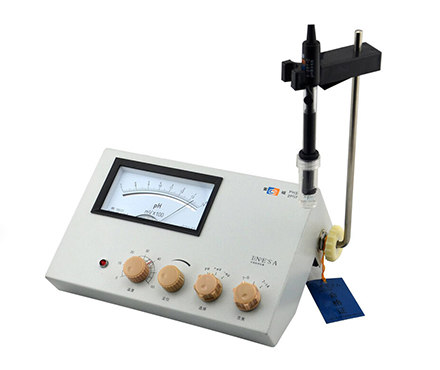
Taking a pHS-73 pH meter (measurement accuracy of 0.02 level) as an example, the error measured by the three items of its input current, input impedance, and repeatability of the meter’s indication value The values are all in line with the metrological verification standards, only the temperature compensation does not meet the standards, which leads to errors in indication values, see the following table for specific data:
As shown in the table, the actual value is higher than the standard in the range of 7~14pH.

The actual value is lower than the standard value in the range of 7-0pH, and the error decreases with the decrease of pH value, and the error can reach ±0.08pH.
The temperature compensator of the PHS-73 pH meter is a linear adjustable potentiometer with a stable voltage on it, usually set on the panel, and marked with different compensation temperature scales according to the position of the knob. The plastic knob is fixed on the round shaft of the potentiometer by two auxiliary screws. As the ambient temperature changes, the knob should be turned frequently during use, which will easily cause loosening and misalignment, and eventually lead to changes in the pH value. The measure we take is to use a file to file a plane on the side of the round shaft of the potentiometer, and after installing the knob, make an auxiliary screw withstand the plane (the original screw is on the shaft surface, and the knob is easy to shift), and at the same time put the The other screw is tightened, so as to prevent the pH indication value from being out of tolerance due to looseness and misalignment of the knob-type temperature compensation. Finally, use a standard calibration pH generator (which can generate corresponding potentials for pH values at different temperature points from 0°C to 100°C) to re-calibrate the knob position of the temperature compensator of the pH meter and give correct temperature compensation to overcome the problem. The resulting indication error. The other pH meters repaired by the above method all meet the measurement verification standards after re-measurement verification.
To sum up, the knob-type temperature compensator is more prone to misalignment faults. If the pH indication value takes 7pH (zero electric pH value) as the center point, the indication value increases, and the error also increases (or decreases): the indication value decreases, and the error decreases (or increases), and it can be determined The temperature compensator compensates the indication error caused by the incorrect voltage. If it is a knob-type temperature compensator, use the above method to solve it; if it is a digital button-type temperature compensator, you should disassemble the instrument, adjust the corresponding internal adjustable potentiometer, and change its compensation voltage to achieve.

- 1Principle and Application of Standard pH Meter
- 2Method for determining amino acid pH value
- 3Basic principle and application analysis of anti-fluorine pH meter
- 4Proper use and maintenance of pH meters
- 5Understanding and Addressing Common Challenges in the Use of pH Meters
- 6How to use pH meter
- 7Differences between three STIP-scans: pH Meter, Conductivity Meter, and Dissolved Oxygen Meter
- 8PH meter conversion of mv and ph value
- 9Common types and application differences of STIP-scan