Film Film thickness determination
Instruments and reagents
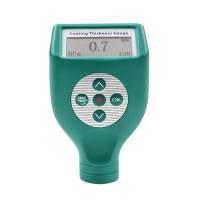
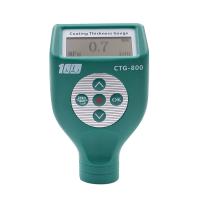
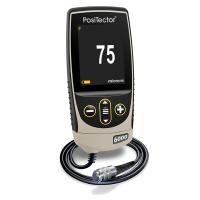
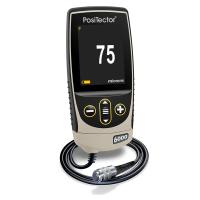
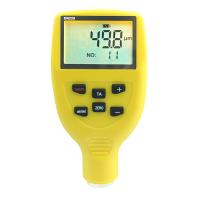
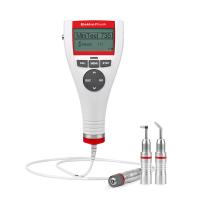
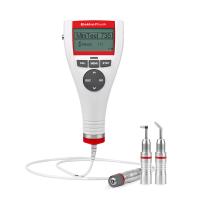
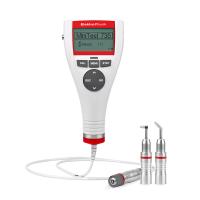
Standard Fiberboard, Comb Gauge (Figure 5-9), Wheel Gauge (Figure 5-10), Magnetic Thickness Gauge


Method and principle
1. Basic principles of comb gauge and wheel gauge thickness measurement
The thickness of the wet film is determined by the contact point of the wet film tangent to the comb or wheel gauge.
2. Basic principle of magnetic Thickness Gauge
The magnetic Thickness Gauge uses the electromagnetic induction method to measure the thickness of the magnetic metal surface coating layer coated (locked). The probe located on the surface of the component generates a closed magnetic circuit. As the distance between the probe and the ferromagnetic material changes, the magnetic circuit will change to varying degrees, causing changes in the magnetic resistance and inductance of the probe coil (Figure 5-12). This principle can be used to accurately measure the distance between the probe and the ferromagnetic material, that is, the thickness of the coating (locking) layer.

1 — Substrate; 2 — Coating; 3 — Ferromagnetic core; 4 — Alternating field (LF); 5 — Measurement signal; 6 — Current
Measurement steps
1. Determination of wet film thickness with comb gauge
Make sure the teeth are clean and free from wear, place the comb gauge on a flat specimen surface so that the teeth are perpendicular to the surface of the specimen; allow sufficient time for the paint to wet the teeth; The maximum gap depth reading is recorded as the wet film thickness.
2. Determination of wet film thickness by wheel gauge
Hold the wheel gauge with your thumb and forefinger gripping the wheel gauge shaft; press the concentric circle against the surface where the largest reading on the scale is in contact with the surface; roll the wheel gauge in the same direction and read that the eccentric rim can still be read Maximum reading for paint wet-out; clean the wheel gage and repeat this procedure from the other direction; use the arithmetic mean of these readings to calculate the wet film thickness.
3. Magnetic Thickness Gauge to measure paint film thickness
Calibrate the magnetic Thickness Gauge first, and calibrate the thickness of 0, 94 μm±1 μm and 465 μm±1 μm respectively; place the instrument vertically on the paint film surface, and read the paint film thickness from the display.
5. Matters needing attention
① When combing the thickness of the wet film, the sample is a curved surface and needs to be placed at a position parallel to the axis of the curved surface; the thickness measurement result is related to the measurement time, and the thickness should be measured as soon as possible after the coating is applied.
② When the wheel gauge measures the wet film thickness, the sample is a curved surface, which needs to be placed at a position parallel to the axis of the curved surface; the thickness measurement result is related to the measurement time, and the maximum thickness should be measured as soon as possible after the coating is applied; record the first time Scale readout of contact point. @Magnetic Thickness Gauge needs to be calibrated before use.
testing report
The test results of paint film thickness are shown in Table 5-4.





- 1Principle, Characteristics and Application of Wet Film Comb
- 2Determination method of dry and wet paint film thickness
- 3Coated steel coatings - Determination of dry-film thickness
- 4Wet film thickness measurement tool and applicable method
- 5Wet film thickness measurement and coating mass control
- 6Measuring method of wet film thickness: Thickness Wheel and Wet Film Comb
- 7Dry-film thickness measurement: an important step before Coating mass evaluation
- 8How to detect the thickness of steel structure paint?
- 9How to convert Dry-Film and wet film thickness of concrete structure paintings?