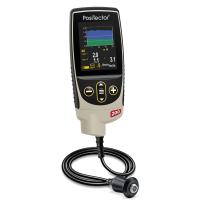
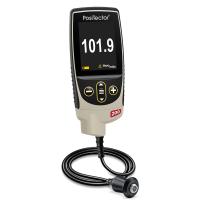
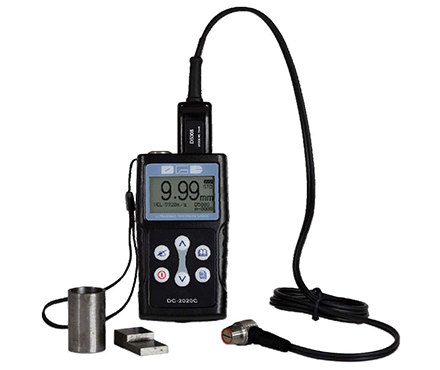
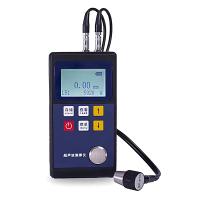
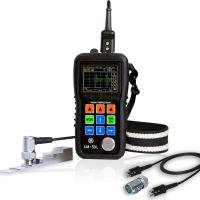
How does Ultrasonic Thickness Gauge pass through the coating measurement Film thickness?
The typical sound velocity of longitudinal waves in steel is 5.900m/s (0.2320in/us), but the sound velocity in paint or similar coatings is generally lower than 2.500m/s (0.1000in/us). Conventional ultrasonic equipment, when measuring the total thickness of painted metal, will incorrectly measure the coating at the sound velocity of the steel, meaning that the coating will show a value of at least 2.35 times (the ratio of the two sound velocities) its true thickness. Where thick coatings and tight tolerances are involved, this error introduced by the coating can be a significant fraction of the total thickness measurement. The solution to this problem is to measure or calculate thickness in such a way that the coating component is removed from the measurement.
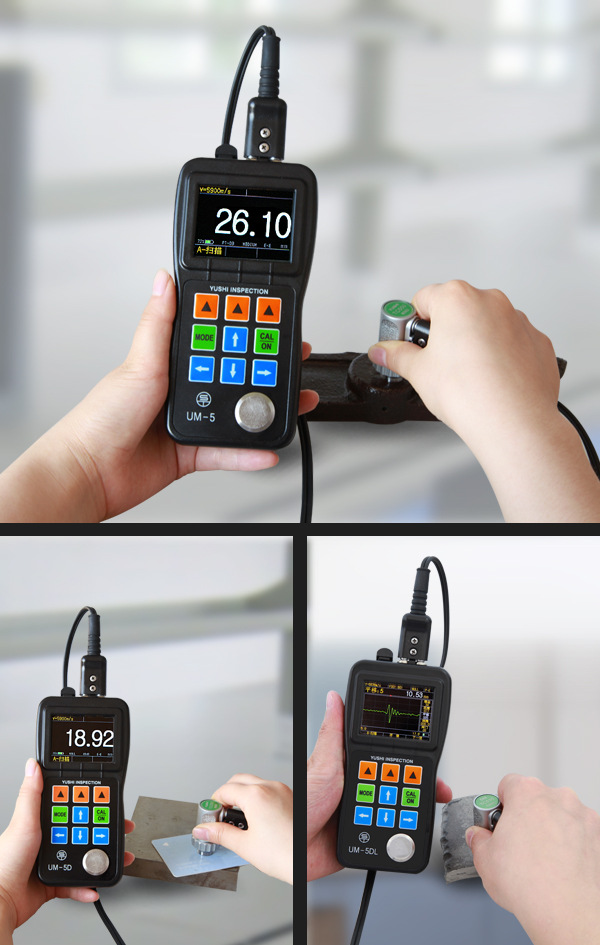
Echo-echo measurements simply apply the well-established technique of the time interval between two adjacent backwall echoes, which represents the continuous round trip time of the sound wave through the test material. In the case of those coated metals, these multiple echoes can only occur in the metal and not in the coating, so the spacing of any pair of echoes (backwall 1 to 2, backwall 2 to 3, etc.) , represents only the metal thickness after the coating thickness has been removed. Through coating measurements use a proprietary software to determine the time interval represented by one round trip in the coating. This time interval is used to calculate and display the coating thickness, and by subtracting this time interval from the total measurement, the instrument is also able to calculate and display the underlying metal thickness.
Each of the above techniques has advantages and disadvantages, and it should be considered which method is better for a particular application:
Advantages of measuring through coatings:
1. It can measure the thickness of a variety of metals, typically from 1mm to 50mm in steel
2. Only one echo is needed
3. In the case of pitting corrosion, the remaining minimum thickness can be measured more accurately
Measuring Through Coating Disadvantages:
1. The thinnest coating is 0.125mm
2. The coating surface should be relatively smooth
3. Need to use one of 2 specific probes
4. The highest surface temperature is about 50°C or 51.67°C
Echo-Echo Measurement Advantages:
1. It can work with a variety of common probes
2. Can often penetrate rough surface coating work
3. With a proper probe, it can work at a high temperature close to 500°C or 498.89°C
Echo-echo measurement disadvantages:
1. Multiple bottom echoes are required, which may not exist in severely corroded metals
2. The thickness range is more limited than that measured through the coating


- 1Principle, Function, Application and Selection of Multifunctional Ultrasonic Thickness Gauge
- 2Principle, Application and Type Selection of Ultrasonic Thickness Gauge
- 3Principle, Application and Type Selection of Ultrasonic Thickness Gauge
- 4Principle, Application and Selection of Ceramic Ultrasonic Thickness Gauge
- 5The Principle, Application and Precautions of Copper Plate Ultrasonic Thickness Gauge
- 6Principle and Application of Ultrasonic Thickness Gauge
- 7Measurement principle and influencing factors of high temperature ultrasonic Thickness Gauge
- 8Principle of Portable Ultrasonic Thickness Gauge
- 9How does an ultrasonic Thickness Gauge work?