PosiTector SPG Roughness Profile Gauge FAQ
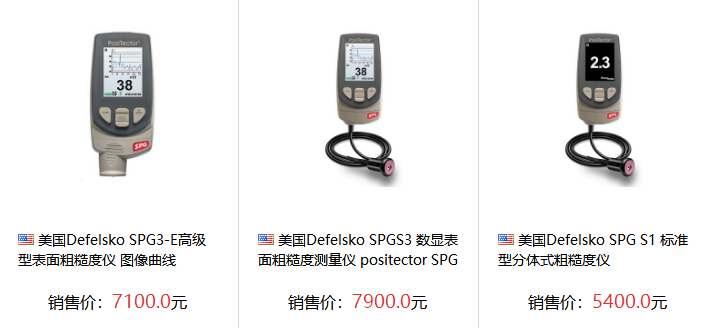
Does PosiTector SPG TS have lower spring pressure than SPG CS?
The spring pressure is slightly higher than the SPG TS to give the tip enough seating in the profile. Keep in mind that there is no standard for this approach, so we designed the stress based on internal testing.
Is PosiTector SPG TS traceable to PTB or NIST?
All PosiTector SPG probes including the SPG TS are traceable to PTB.
Does your instrument require any formal training to use it? Do you offer 'demo' models?
Can't. Our instruments are designed simply, with easy-to-use menus, full and quick instruction manuals, and helpful videos. In lieu of a demo model, we offer unlimited technical support by phone and/or email with a limited 30-day money-back guarantee.
Is the PosiTector SPG calibrated at the factory?
The PosiTector SHD arrives fully calibrated and ready to measure. Includes a long-term calibration certificate traceable to NIST or PTB that documents the actual readings of your instrument recorded in our calibration laboratory against standards traceable to national metrology institutes. Watch out for "certificates" or "attestations of conformity" offered by competitors. These usually do not include actual instrument readings and are often insufficient for common quality requirements.
Metrological accuracy and correct operation can be verified using the included metal spacer and glass zero plate.
Can I use PosiTector SPG to measure curved surfaces?
To measure accurately, the probe feet of the PosiTector SPG need to contact the surface over the entire area. On tightly curved surfaces, the edge of the probe will not rest on the surface, skewing the reading.
Our PosiTector SPG instruments comply with Method B as described in ASTM D 4417 "Standard Test Method for Field Measurement of Surface Profile of Explosion Cleaned Steel". The entirety of ASTM D 4417 is specific to flat blasted steel surfaces. Therefore, any depth micrometer used to measure the surface profile of a curved blasted steel surface does not comply with ASTM D 4417.
Replica tape is excellent for recording blast profiles of curved surfaces, and DeFelsko recommends the PosiTector RTR Replica Tape Reader as a reliable measurement option.
Can PosiTector SPG be used on non-metallic substrates?
Yes! Although primarily intended for measuring grit blasted steel, the PosiTector SPG can be used in many applications. PosiTector SPG TS and PosiTector SPG CS also feature extended reach and larger radius probe tips to suit a variety of applications:
The PosiTector SPG CS will quickly and accurately measure the surface profile of textured coatings.
The PosiTector SPG TS will quickly and accurately measure the surface profile of concrete.
Why does PosiTector SPG have 30˚ and 60˚ tips?
PosiTector SPG uses durable tungsten carbide tips for long life and consistent accuracy. The SPG probe tip can be replaced by the gage operator if required.
60° tip meets most testing standards including ASTM D 4417 B.
30° tip conforms to Australian Standard AS 3994.5-C.
PosiTector SPG can move on the surface to provide "scanning"?
no. The PosiTector SPG is a depth micrometer that quickly and accurately measures and records peak-to-valley surface profile heights on blasted steel surfaces.
Like other instruments of this type, the PosiTector SPG is not dragged across the blasted surface: the instrument operator takes individual readings at one location on the surface, lifts and places the instrument at another location on the surface for Another separate reading, and so on.
Can PosiTector SPG measure pit depth?
Numbered pit gauges are a general class of instruments used to measure pits and other surface variations. The PosiTector SPG is specifically designed to measure and record peak and valley surface profile heights on blasted steel surfaces.
Should I purchase PosiTector RTR or PosiTector SPG for my application?
Both instruments conform to ASTM D 4417 "Standard Test Method for Field Measurement of Surface Profile of Blast-Cleaned Steel."
PosiTector SPG complies with ASTM D 4417 Method B. PosiTector SPG measures quickly with no cost per test. It keeps a digital record of each measurement and is operator-independent as no sanding of the replica tape is required. It also has a greater range than replica tape.
PosiTector RTR complies with ASTM D 4417, Method C. It is used with Testex Replica tape, a widely used and respected method of measuring surface profile. It is capable of taking measurements on curved surfaces and gives the user the option to keep a replica tape; a physical replica of the surface being measured.
How often should PosiTector probes be recalibrated?
PosiTector probes include a calibration certificate with no expiration or end date. They have no shelf life, so the length of time in the field does not lend itself to recalibration intervals. Many organizations with quality programs and recertification programs require annual recalibration, which is a good starting point for most users. DeFelsko recommends customers establish calibration intervals based on their own experience and work environment. Based on our product knowledge, data and customer feedback, a one-year calibration interval from the date the instrument is placed into service is a good starting point.
- 1Measure gloss with a PosiTector GLS gloss meter
Defelsko
- 2What is a Profiler? Types of Profilers
- 3Netherlands TQC SP1570 Copy Tape Tester Operation Manual
- 4PosiTector 200 ® Operation Manual V 3.1
- 5PosiTector UTG Ultrasonic Film thickness probe - Operating principle
- 6PosiTector Software Update Instructions
- 7Which probes is the PosiTector host suitable for? A table tells you
- 8PosiTector 6000 Coating Thickness Gauge FAQ
- 9Why the measurement of steel surface profile?
Defelsko
-
![Defelsko PosiTector BDYSTD Standard host, new, probe available separately]()
-
![Defelsko PosiTector 6000 FNS3 Coating Thickness Gauge metal substrate Automatic substrate type identification and measurement]()
-
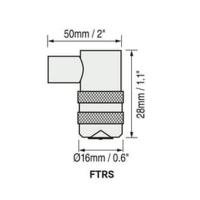
![Defelsko FTRS Thickness Gauge Probe]() Defelsko FTRS Thickness Gauge Probe$ 904.00
Defelsko FTRS Thickness Gauge Probe$ 904.00 -
![Defelsko PosiTector 6000 FRS3 Coating Thickness Gauge 90 ° probe]()
-
![Defelsko PosiTector 6000 FNTS1 Coating Thickness Gauge magnetic eddy current dual-use Thickness Gauge]()
-
![Defelsko PosiTector 6000 FNGS3 Coating Thickness Gauge 63.5mm Ultra thick probe]()