Determination of film drying performance
1 Introduction
The drying performance measurement of the paint film can be said to be very simple in the measurement of the physical properties of the paint, and almost everyone in the industry understands it. The drying performance of the paint film is expressed in terms of drying time. Drying time refers to the time for a certain thickness of coating (i.e., paint film) to reach a specified dry state from a liquid state under certain conditions, and is divided into surface dry time and hard dry time. The surface dry time refers to the time when the surface layer is formed into a film, and the hard dry time refers to the time when all the solid coating film is formed (also called the actual drying time), which are expressed in hours (h) or minutes (min).
For coating construction, the drying time is shorter, but not as short as possible. An excessively long drying process will easily cause dust and impurities to adhere to the coating during the drying process, affecting appearance and performance, occupying the production site and prolonging the construction period. However, if the drying time is too short, it will also affect the workability, and it will easily cause the paint film to be rough and affect the leveling.
The time for the coating to reach a certain dry state is related to factors such as the type of coating, coating thickness, temperature, humidity and construction environment. Even for the same paint, when the solvents and thinners used are different, the drying time is not the same. Nitro paint, perchlorethylene paint, etc. dry quickly, and the solvent and thinner contained in it will form a paint film after volatilization; while alkyd paint, epoxy paint, etc. that need to be "oxidized" and "condensed" to dry into a film, It dries slowly, and even needs to be heated and baked to cure; self-drying paint is easy to dry in a ventilated environment.
Hard drying of the coating does not mean that it is completely dry, nor does it mean that the protective performance of the coating has reached a good state. The complete drying time of the coating varies with the variety of paint. For example, alkyd resin paint is cured by oxidative polymerization to form a film, which is slower to dry and slower to dry completely. Polyurethane paint generally takes no more than 24 hours to dry, but it takes 7 days to dry completely. Since the complete drying time is difficult to define, coatings generally do not measure the complete drying time.
The American Society for Testing and Materials (ASTM) has made a very fine division of the drying performance of the paint film, which is divided into finger-touch drying, non-sticky dust drying, finger pressure drying, surface dry, hard dry, dry or hard dry, recoat dry, and no dryness. Indentation dry etc.
Correctly determining the drying time of the paint film is beneficial to the construction management of the coating, and is beneficial to the performance of the coating and the improvement of the quality.
2 Test method for drying performance of paint film
2.1 Determination of surface dry time
GB/T 1728-1979 (1989) "Determination of drying time of paint film and putty film" stipulates two methods for measuring surface drying time by blowing cotton balls and touching with fingers. GB/T 6753.2-1986 "Small Glass Ball Method for Surface Drying Test of Coatings" stipulates the method for measuring the surface drying time of self-drying coatings with small glass balls. This standard is equivalent to the international standard ISO 1517:1973 Paints and varnishes—Surface -drying test—Ballotini method.
2.1.1 Blowing cotton ball method
Gently place a loose absorbent cotton ball of about 1 cm3 on the surface of the paint film, and gently blow the cotton ball in a horizontal direction with a mouth distance of 10 to 15 cm from the cotton ball. If the cotton balls can be blown away and no cotton threads are left on the surface of the paint film, the surface is dry.
2. 1. 2-finger touch method
Lightly touch the surface of the paint film with your fingers, if you feel a little sticky, but no paint sticks to your fingers, the surface is dry.
2.1.3 small glass ball method will be at temperature (23 ± 2) ℃ or (25 ± 1) ℃, relative humidity (50 ±
5)% or (65 ± 5)% of the sample after drying, placed horizontally after a certain period of time or after reaching the specified time of the coating product, from a height of not less than 50mm and not greater than 150mm, and about 0.5 g Small glass balls (φ125 ~ 250 μm) are poured on the surface of the paint film. After 10 s, tilt the sample panel at 20°, lightly brush the paint film with a soft brush, and visually inspect it. If all the small glass balls can be brushed off without damaging the surface, the surface is dry.
In order to prevent the small glass balls from being too scattered, the small glass balls can be poured through a glass tube of appropriate length with an inner diameter of φ25 mm (be careful not to let the glass tube mouth touch the paint film).
2.2 Determination of hard drying time
GB/T 1728-1979 (1989) "Determination of Drying Time of Paint Films and Putty Films" stipulates four methods to measure the hard drying time: the filter paper method, the cotton ball method, the blade method, and the thick layer drying method.
2. 2. 1 Filter paper method
Put a piece of qualitative filter paper with a standard weight of 75 g/cm2 and 15 cm × 15 cm on the paint film (the smooth side is in contact with the paint film), and lightly place a drying Tester with a weight of 200 g and a bottom area of 1 cm2 on the filter paper (see Figure 1 ), and start the stopwatch at the same time. After 30 s, remove the drying Tester, turn the model over, the filter paper can fall freely, or tap the back with the index finger of the hand holding the board a few times, the filter paper can fall, and the filter paper fiber does not stick to the paint film, which is the paint film Actually dry.

Fig.1 Schematic diagram of drying Tester
Figure 1 Schematic diagram of drying Tester
For the paint film specified in the product standard, a slightly viscous paint is allowed. If the filter paper still cannot fall freely after the sample is turned over and tapped with the index finger, place the sample flat on the glass plate and fold it in advance with a clip. Pull the filter paper lightly in the horizontal direction, the filter paper is pulled down but the sample does not move, even if there are filter paper fibers sticking to the paint film, it can be considered that the paint film has actually dried, but it should be marked that the paint film is slightly sticky.
2. 2. 2 Cotton ball pressing method
Gently place a loose absorbent cotton ball of about 1 cm3 on the surface of the paint film, gently place the drying Tester (see Figure 1) on the cotton ball, and start the stopwatch. After 30 s, remove the drying Tester, remove the cotton ball, and leave it for 5 minutes to observe the paint film. If there is no trace of cotton ball and loss of gloss, or there are 1 to 2 cotton threads left on the paint film, but the cotton ball can Dust lightly and the paint film is actually dry.
2. 2. 3 blade method
Use a safety blade to cut and scrape the paint film or putty film on the sample board, observe the bottom layer and the inside of the film, if there is no sticking phenomenon, it is actually dry.
If it is a putty film, it is necessary to wet the sample with water and sand it with the water sandpaper specified by the product. If it can form a uniform and smooth surface without sticking to the sandpaper, it is actually dry.
2. 2. 4 thick layer drying method
厚层干燥法适用于绝缘漆。用二甲苯或乙醇将45 mm × 45 mm × 20 mm 的铝片盒(铝片厚 0.05 ~0.10 mm)擦净、干燥,然后加入试样 20 g(以 50%的固体含量计,固体含量不同时应进行换算),静止至试样内无气泡(不消失的气泡用针挑出)。将铝片盒水平放入加热至规定温度的电热鼓风箱内,按产品规定的升温速度和时间进行干燥,然后取出冷,小心撕开铝片盒,将试块完整剥出。检查试块表面、内部和底层是否符合产品标准规定。试块从中间剪开成两份,应没有黏液状物。剪开两份沿剪截面合拢再拉开,亦无拉丝现象,则认为厚层实际干燥。
2. 2. 5 仪器测试法
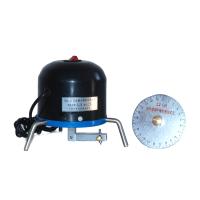
漆膜的干燥是一个缓慢而连续的物理化学过程,其成膜机理According to所测涂料属挥发型还是反应型而不同。但只要是液态涂料,其成膜过程都要经过由流体到黏弹性、最后成固体的几个阶段。上述测试漆膜干燥性能的方法只能判断漆膜在某一阶段内达到何种干燥状态,而不能反映在干燥过程中的整个变化,这个变化的过程只能用自动干燥测试仪来观察。观察的方法一种是利用电动机减速后带动齿轮,以 30 mm/h 的缓慢速度在漆膜上直线移动,全程 24 h。随着漆膜的干燥,齿轮压痕逐渐由深至浅,直到全部消失。另一种是利用电动机带动盛有细砂的漏斗在漆膜上缓慢移动,砂子不断掉落在漆膜上,形成直线状的砂粒痕迹,用以测定干燥的不同阶段所需的时间。再一种是利用针尖缓慢在漆膜上画出半径 5 cm 的圆圈,速度为 24 h/圈,在试板上观察漆膜随时间变化的干燥程度。这种方法通常用于干燥过程机理的研究。
2. 3 回黏性测定
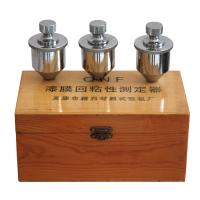
漆膜干燥后,因受一定温度湿度的影响,漆膜发生黏附的现象称为回黏性。测定回黏性采用回黏性测定器,它与干燥试验器类似,重 500 g、底面积 1 cm 2 。试样为马口铁板,50 mm × 120 mm × (0.2 ~ 0.3) mm,按规定制备漆膜并恒温恒湿干燥 48 h。
测试时,滤纸光面向下置于漆膜上,放入调温调湿箱,将在温度(40 ± 1) °C、相对湿度(80 ± 20)%的条件下预热的回黏性测定器放在滤纸正中,关闭调温调湿箱。5 min内升温至(40 ± 1) °C,相对湿度 (80 ± 2)%,保持 10 min。打开恒温恒湿箱,迅速向上拿起测定器,取出试样,在恒温恒湿条件下放置 15 min,用 4倍放大镜观察评级:1级──试样翻转,滤纸能自由落下,或用握板之手食指轻敲几下,滤纸能落下; 2级──轻轻掀起滤纸,允许有印痕,粘有稀疏、轻微的滤纸纤维,纤维总面积在 1/3 cm2以下; 3级──轻轻掀起滤纸,允许有印痕,粘有密集滤纸纤维,纤维总面积在 1/3 ~ 1/2 cm2。GB/T 1762–1980《漆膜回粘性测定法》对测定方法有详细描述。
2. 4无印痕试验
GB/T 9273–1988《漆膜无印痕试验》规定了用一种经验测定方法评价色漆和清漆涂层的干燥程度。该标准等效采用国际标准 ISO 3678–1976 Paints and varnishes—Print-free test。
所谓无印痕是指在干燥后的漆膜表面放置一块规定的尼龙丝网及一定质量的重物,经一定时间后,漆膜表面不留有丝网的印痕。从涂料涂覆于试板上开始,至按本法测定漆膜刚好无印痕为止,所用的时间为无印痕时间。
试样为玻璃板、磨光钢板、磨光马口铁板或磨光铝板,按规定制备漆膜,试样在 (23 ± 2) °C、相对湿度 (50 ± 5)%的标准环境中进行干燥,需要烘烤的产品在规定条件下烘烤后,放置于上述标准环境中。
测定时将试样水平放置于实验台上,把一块 25 mm × 25 mm的正方形聚酰胺丝网(单丝直径 0.12 mm,孔径 0.2 mm)放在漆膜表面,并在正方形中心放一块 φ22 mm × 5 mm的橡皮圆板(邵氏硬度 A50 ± 3),在橡皮圆板上小心放上所需质量的砝码(砝码重为 200 g、500 g、1 000 g 3种,直径不小于 22 mm),使中心重合。启动秒表, 10 min后移去重物、橡皮圆板和丝网,目视漆膜表面情况,看不见印痕即为无印痕。从试验开始至刚好无印痕为止的时间即为无印痕时间。
橡皮圆板直径及砝码质量可能有所不同,但漆膜所受的压力应等于标准规定的压力,即 5.2 kPa(200 g砝码)、13.15 kPa(500 g砝码)和 26.34 kPa(1 000 g砝码)。
2. 5码垛性试验
GB/T 9280–1988《色漆和清漆耐码垛性试验》规定了漆膜在规定的干燥时间内充分干燥后,两个涂漆表面或一个涂漆表面与另一种表面在受压条件下接触放置时耐损坏性的试验方法,模拟漆膜干燥后互相堆垛起来的条件。该标准等效采用国际标准 ISO 4622– 1980 Paints and varnishes—Pressure test for stackability。
试验采用码垛试验仪,如图 2a所示。它由底座和能自由滑动的压柱所组成,压柱最大质量为 250 g,通常使用的砝码质量为 100 ~ 1 000 g。
试样底材尽可能According to实际用途来选择,按规定制备漆膜,经规定时间干燥后,尽快在试样上切出 1 ~ 2片试片(30 mm × 150 mm,避免损伤漆膜),尽量减少底材变形。试片边缘隆起应整平。试片以 (90 ± 2)°互相交叠(见图 2b),使漆膜表面紧密接触,确保测试面积为正方形。试验在 (23 ± 2) °C、相对湿度 (50 ± 5)%的条件下进行。
(a) 码垛试验仪 (b)交叠的试片
(a) Stackability Tester (b) Stacked coupons

Figure 2 Schematic diagram of stacking Tester and overlap of test pieces
Figure 2 Schematic diagram of Tester for stackability and stacking of test coupons
When testing, put the test piece on the base, and put the specified weight on the pressure column. Then slowly place all the mass on the contact surface of the test piece, so that the pressure column covers the overlap (square part) of the test piece as shown in Figure 3. After holding for a specified time, remove the pressure column, separate the test pieces, and check whether the coating on the contact surface is damaged, visible marks, adhesion and paint film peeling off.
If necessary, calculate the pressure on the surface of the paint film as follows:

In the formula, P is the pressure (Pa), m1 is the mass of the pressure column (g), m2 is the mass of the weight (g), L is the width of the test piece (mm), and g is the acceleration of gravity.
3 Conclusion
Only when the paint film is actually dry and completely dry can it play its due protective role. The several methods introduced in this article have a certain scope of application, and there is no fixed conversion relationship between them. Except for the relevant standards or product technical requirements, the method and degree of adoption should be agreed upon by both parties.




- 1Basic Principle and Application Analysis of Paints drying time Tester
- 2Waterborne architectural coatings detection method
- 3Summary of drying time determination method for paint film and putty film
- 4Viscosity of paint film and its determination
- 5Several Determination Methods of Coating drying time
- 6Coating performance testing: ensuring the efficiency and mass of the painting process
- 7Film drying method: natural drying, heating drying, irradiation curing and gas phase curing
- 8Difference between acupressure method and blown cotton ball method in evaluating surface drying time
- 9How to detect the drying time of architectural coatings (surface drying)?
-
![TQC sheen AB3600 Drying Time Recorder BK method, six-track -20 ℃ to 70 ℃ test]()
-
![MODERNER ZGY automatic drying Tester for determining inks drying time QB562-83 standard]()
-
![MODERNER GKL-II drying anti-crack Tester, determination of initial drying anti-crack of laminated architectural coatings]()
-
![JINGKELIAN QGZ-A Drying Time Recorder GB/T1728-89 Standard, Scribing stroke 305mm]()
-
![JINGKELIAN QNF Backtack Tester 3 pcs]() JINGKELIAN QNF Backtack Tester 3 pcs$ 190.00
JINGKELIAN QNF Backtack Tester 3 pcs$ 190.00 -
![JINGKELIAN QGZ-6 12 24 Film Drying Time Recorder Scribing radius: 0.25/0 5/1.0/1.5mm]()