Preparation of alginate biofilm
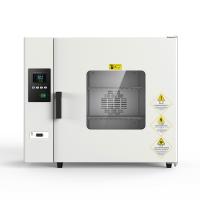
In a constant temperature Water Bath, pour a certain amount of glycerin into the steaming water, then slowly add the powder of alginate and sodium carboxymethyl cellulose, mix and stir with a high-power electric mixer until the powder is completely dissolved. The uniformly stirred mixture glue was degassed under vacuum, and left standing at room temperature overnight to eliminate air bubbles in the glue. After degassing, pour the mixture glue on a clean acrylic glass plate, spread it evenly with a wire Bar Coater, and immerse . After the cross-linking is completed, rinse it with flowing water, and then put the acrylic glass plate into digital display Forced Air Drying Oven, and dry it at a certain temperature. After drying, the film was peeled off and stored at 25±2°C for determining the water vapor transmission coefficient of the alginate biofilm.
Film Thickness Measurement
Randomly pick five different points on the membrane, measure the thickness of the membrane with a Thickness Gauge with an accuracy of
water vapor transmission coefficient
The water vapor transmission coefficient of the film refers to the amount of water vapor per unit thickness and unit area of the film per unit time and unit water vapor pressure difference in an environment of specified temperature and specified relative humidity . waterPreparation technology of alginate ion-crosslinked enteric-coated hollow hard capsules The smaller the vapor transmission coefficient, the better the moisture resistance of the film. According to the national standard, the cup method is used to measure the water vapor transmission coefficient of the membrane, and a slight modification is made according to the actual situation. The specific method is as follows:
Put the anhydrous chloride into the mortar for crushing, and dry it under the condition after crushing. After the anhydrous chloride is cooled, add it into the moisture-permeable cup, and make the amount added until it is different from the mouth of the moisture-permeable cup. . Use melted paraffin to seal on the mouth of the moisture-permeable cup (keep the relative humidity inside the film at Put the moisture-permeable cup into the deionized water at the bottom (keep the relative humidity on the outside of the membrane at a temperature of °°C), so that a certain vapor pressure difference between the inside and outside of the membrane is maintained. Every once in a while, use the moisture-permeable cup The balance of the accuracy is weighing until the water vapor stabilizes through the stability of the water vapor (the difference between the mass increase in two times before and after the difference is less than removed. Each group is repeated three times, and the average value of the calculation is calculated .
The calculation formula of WVP (g·mm/m 2 ·H·kPa) is:
WVP=△M*D/(A*△T*△P)
In the formula: WVP—water vapor transmission coefficient (g·mm/m 2 ·H·kPa); △M—increased weight of moisture permeable cup (g), D—film thickness (mm); A—film permeability Area (m2); △T—measured time interval (h); △P—water vapor pressure difference on both sides of the membrane.
experimental design
In this experiment, aiming at obtaining the minimum water vapor transmission coefficient of alginate biofilm, a two-step method was adopted to optimize the production process of alginate biofilm: firstly, single factor experiment was used to design the production parameters of alginate biofilm, Then use the response surface method to conduct experiments, obtain the second-order multinomial response surface regression model through multiple regression fitting of experimental data, determine the optimal manufacturing process, and conduct verification experiments.
single-factor experiment
In the single factor experiment, glycerol concentration, algin concentration, sodium methylcellulose concentration, cross-linking time in Korean chloride solution and concentration of Korean chloride all affect the water vapor transmission coefficient of algin biofilm.
Effect of glycerol concentration on water vapor transmission coefficient of alginate biofilm Add 5%/10%/15%/20%/25% (W/V) glycerol to distilled water, then add 8% alginate and 0.1% sodium methylcellulose, mix and stir evenly, and prepare mixed glue. The mixed glue solution was vacuum degassed and allowed to stand overnight at room temperature, then poured onto a clean acrylic glass plate, and the mixed glueExposing the preparation technology of alginate trans-ion cross-linking system enteric-coated hollow hard capsules, spread the glue solution evenly with a wire Bar Coater, and then immerse the acrylic glass plate coated with the glue solution in the vaporized Korean solution for cross-linking for 1 minute Finally, rinse the cross-linked film with running water, put it in a digital display blast Drying Oven for drying, and then peel off the film for testing.
Effect of Alginate Concentration on Water Vapor Transmission Coefficient of Alginate Biofilm
Add a good amount of glycerin and 0.1% sodium carboxymethyl cellulose obtained from the above experiment in the steamed water, and then add 6%/8%/10%/12%/14% (W/V) of brown algae Glue, mix and stir evenly, and configure it as a mixed glue solution. Vacuum degas the mixed glue and let it stand overnight at room temperature, then pour it on a clean acrylic glass plate , spread the mixed glue evenly with a wire Bar Coater, and then spread the mixed glue on the acrylic glass After immersing the board in the chloroform solution for 12 minutes and cross-linking, rinse the cross-linked film with running water, put it in a digital display Forced Air Drying Oven for drying, and then peel off the film for testing.
Effect of sodium carboxymethyl cellulose concentration on water vapor transmission coefficient of alginate biofilm
Add the best glycerin and alginate amount obtained by the above experiment into the steamed water, and then add 0%/0.1%/0.3%/0.5%/0.7% (W/V) sodium methyl cellulose, mix Stir evenly to prepare a mixed glue. Vacuum degas the mixed glue and let it stand overnight at room temperature, then pour it on a clean acrylic glass plate , spread the mixed glue evenly with a wire Bar Coater, and then spread the mixed glue on the acrylic glass plate After immersing in a digital display Forced Air Drying Oven, and peel off the film for testing.
Effect of Crosslinking Time in Chlorination on Water Vapor Transmission Coefficient of Alginate Biofilms
Add glycerin, alginate and sodium carboxymethyl cellulose content , mix and stir evenly, and prepare a mixed glue. Vacuum degas the mixed glue and let it stand overnight at room temperature, then pour it on a clean acrylic glass plate, spread the mixed glue evenly with a wire Bar Coater, and then spread the mixed glue on the acrylic glass After immersing the board in 2% Korean chloride solution for cross-linking for 4/8/12/16/20 minutes respectively , rinse the cross-linked film with flowing water, put it in a digital display Forced Air Drying Oven and dry it. Peel test.
Effect of concentration of Korean chloride on water vapor transmission coefficient of alginate biofilm
Add glycerin, alginate and sodium carboxymethyl cellulose content , mix and stir evenly, and prepare a mixed glue. Vacuum degas the mixed glue and let it stand overnight at room temperature, then pour it on a clean acrylic glass plate, spread the mixed glue evenly with a wire Bar Coater, and then spread the mixed glue on the acrylic glass After immersing the board in 2%/4%/6%/8%/10% Korean chloride solution cross-linking for 12 minutes, rinse the cross-linked film with running water and put it in a digital display Forced Air Drying Oven Medium bakeExposing alginate to evaluate ion cross-linking system enteric-coated hollow hard capsule preparation technology After drying, peel off the film for testing.

- 1Application of Mayer Rods in protective coating prepative
- 2Comparison and Application of Magnetic Stirring and Mechanical Stirring
- 3Application of Mayer Rods in 2D Single Crystal Copper Nanosheet Films
- 4Polyurethane-graphene composite prepative film
- 5Application of Mayer Rods in composite coating prepative
- 6Several Common Experimental Spreader Methods and Their Applications
- 7Describe 4 Common Stirrers in detail
- 8Application of Mayer Rods in Water-based ink Moulding
- 9Principle, application and selection of vertical Electric Forced Air Drying Oven