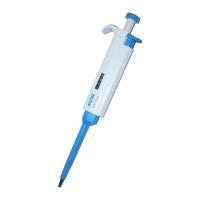
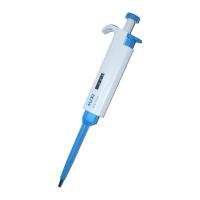
Pipette uses little common sense
1. Use the right tip
To ensure better accuracy and precision, it is recommended that the pipetting volume be within the range of 35%-100% of the volume of the tip.
2. Tip installation
For most brands of pipettes, especially multi-channel pipettes, it is not easy to install the tip: in order to achieve a good seal, you need to insert the pipette handle into the tip, turn it left and right or shake it back and forth to tighten it firmly . Some people will use the pipette to repeatedly bump the tip to tighten it, but this operation will cause the tip to deform and affect the accuracy, and in severe cases, the pipette will be damaged, so such an operation should be avoided. DLAB multi-channel pipettes do not have O-rings, and with tips with front stops, they can achieve a satisfactory seal with just a light press, which is really good news for multi-channel pipette users
3. Tip immersion angle and depth
The immersion angle of the tip is controlled within 20 degrees of inclination, and it is better to keep it vertical; the recommended immersion depth of the tip is as follows:
Pipette Size Tip Immersion Depth
2 µL and 10 µL 1 mm
20µL and 100µL 2-3mm
200µL and 1000µL 3-6mm
5000 µL and 10 mL 6-10 mm
4. Tip rinse
For samples at room temperature, tip rinsing helps to improve accuracy; but for high-temperature or low-temperature samples, tip rinsing will reduce the accuracy of operation, please pay special attention to the user.
5. Suction speed
The pipetting operation should maintain a smooth and appropriate suction speed; too fast aspiration speed will easily cause the sample to enter the sleeve handle, causing damage to the piston and sealing ring and cross-contamination of the sample.
6. Different pipetting methods
Forward pipetting (low density solutions):
1. Press the button to the first stop;
2. Gently release the button to the starting point to complete the suction;
3. Press the button lightly to the first stop point to drain the liquid; pause for a while, continue to press the button to the second stop point to drain the liquid;
4. Release the button and return to the origin. Continue pipetting after changing tips, if necessary.
Reverse pipetting (suitable for viscous liquids or volatile liquids):
1. Press the button to the second stop point to aspirate liquid, then release the button gently to the starting point to complete aspiration. Draw more liquid than the set capacity;
2. Lightly press the button to the first stop point to remove the liquid of the set volume;
3. The excess liquid remaining in the tip is discarded with the tip.
7. Recommendations for pipette use
1. Maintain the correct posture when pipetting; do not hold the pipette tightly all the time, use a pipette with a finger hook to help relieve hand fatigue; change hands frequently if possible.
2. Regularly check the sealing condition of the pipette. Once the sealing is found to be aging or leaking, the sealing ring must be replaced in time.
3. Calibrate the pipette 1-2 times a year (depending on the frequency of use).
4. For most pipettes, before use and after a period of use, the piston should be coated with a layer of lubricating oil to maintain sealing; for pipettes with conventional ranges, no lubricating oil is also satisfactory. tightness.


- 1How should I store the correct micropipette?
- 2Pipette Tips - Technique and Pipette Maintenance
- 3Four ways to use an electronic pipette
- 4How to store micropipettes properly?
- 5Structure, principle, usage and calibration maintenance of micropipette
- 6How to use a micropipette for liquid handling?
- 7Pipette uses common sense - Dlab