Determination of Coating Density: Density Cup
1. Scope and Description
Density is a property of matter. The ratio of the mass of a certain substance to its volume, that is, the ratio of a certain substance per unit volume
33. The physical meaning is the mass per cubic meter, which is called the density of this substance. Take water as an example. The density of water is 10 kg/m at 4"C. The mass of water in a meter is 1.0X10³ kg, and the density is usually represented by "p". Density is one of the characteristics of substances, and each substance has a certain density The density of different substances is generally different. Therefore, we can use density to identify substances. The method is to measure the density of the substance to be measured, and compare the measured density with the density of various substances in the density table to identify whether the object is What substance is it made of.
This method is applicable to the determination of the density of liquid paints, varnishes and related products at a specified temperature. The principle of the test is to first calibrate the volume of the pycnometer (mass/volume cup) with the density of distilled water, then use the pycnometer to weigh the mass of the sample at a certain temperature, and then according to the mass of the sample and the volume of the pycnometer , to calculate the density of the sample.
2 Instruments and materials
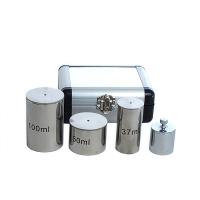
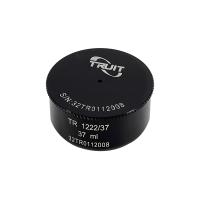
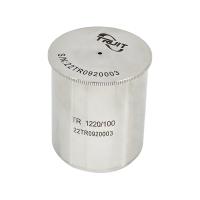
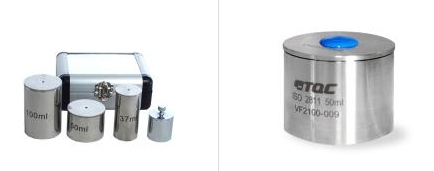
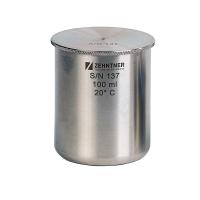
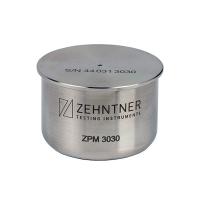
(1) One kind of pycnometer is a glass pycnometer with a capacity of 20-100mL, as shown in Figure 1-8 (1) and (2); the other is a metal pycnometer with a capacity of 37mL, as shown in Figure 1-8 ( 3) as shown.
(2) Hubband (Hubband) pycnometer; (3) Metal pycnometer
(2) The scale of the thermometer is 0.1"C, accurate to 0.2"C.
(3) When the Water Bath or thermostatic chamber requires high accuracy, it can be kept within the range of ± 0.5 "C of the test temperature. For production control, it can be kept within the range of ± 2 "C of the test temperature.
(4) Analytical balance When high precision is required, it can be accurate to 0.2mg. 3. Determination method (1) Calibration of the pycnometer Clean the glass pycnometer successively with chromium acid solution, distilled water and a solvent that does not leave residue after evaporation, and make it fully dry. Rinse the metal pycnometer with a solvent that evaporates without leaving a residue, and dry it. Bring the pycnometer to room temperature and weigh it. If very high accuracy is required, the pycnometer should be washed, dried and weighed continuously until the difference between two successive weighings does not exceed 0.5 mg. If higher accuracy is required, it is (23 ± 0.5)"C, and at a temperature not exceeding 1"C, fill the pycnometer with distilled water. Stopper or cap the pycnometer leaving the overflow hole open, taking strict care to prevent the formation of air bubbles in the pycnometer. Place the pycnometer in a constant temperature Water Bath or in a constant temperature chamber until the temperature of the bottle and the temperature of the contents of the bottle are constant. Use absorbent material. Wipe up spilled material and dry the exterior of the pycnometer effectively with absorbent material. No more wiping up any subsequent spills. . Immediately weigh the pycnometer filled with distilled water to an accuracy of 0.001%•0 of its mass (2) Calculation of the volume of the pycnometer according to the following formula:

(3) Determination of product density
Replace the distilled water with the sample, and repeat the above steps. Wipe off any sample residues on the outside of the pycnometer with absorbent material moistened with a suitable solvent and wipe with clean absorbent material, allowing to dry completely.
Analytical gloves should be worn during operation, and avoid touching the pycnometer directly with hands. Before weighing, the pycnometer should be filled quickly to minimize the mass loss of volatile samples.
When the sample is poured into the pycnometer, air bubbles should be prevented. Effectively wipe up spills around the overflow to ensure accurate weighing.
4. Result representation
Calculate the density p (expressed in g/mL) of the product at the test temperature (<23°c or other agreed temperature) according to the following formula:
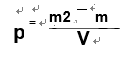
V is the volume of the pycnometer measured according to the determination methods (1) and (2) at the test temperature, mL.
Note: In the inspection of finished products in the factory, metal pycnometers are often used because they are easy to operate and clean.
5. Reference standard
National standard GB/T 6750-2007.
- 1How to measure Coating varnishes Density with Specific Gravity Bottles
- 2Application of Specific Gravity Cup in Coating Density Detection
- 3Specific Gravity bottle Density Error
- 4Paint specific gravity detection method
- 5Frequently Asked Questions about the 2022 Gravity Cup
- 6What is specific gravity? How to measure it?
- 7Main test subjects of powder coatings and their reference standards
- 8What is the specific gravity of ink? How to measure?
- 9Determination of paint density