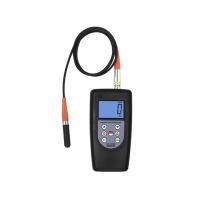
Coating Thickness Gauge measurement results error analysis
The reason why the coating Thickness Gauge can measure to the micron level is that it can take the small change of magnetic flux and convert it into a digital signal. Therefore, when the instrument works in a place very close to the electromagnetic field, the measurement will be seriously disturbed, and there may be a crash phenomenon.
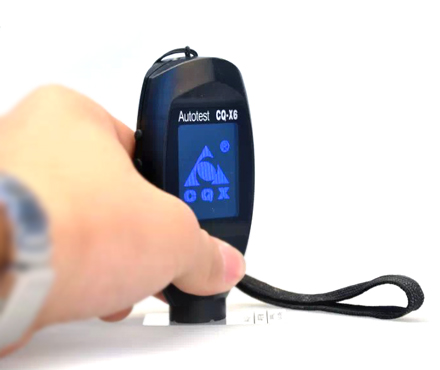
The main reasons for large measurement errors are:
Base metal magnetization
(The magnetic properties of the base metal will affect the accuracy of the measurement value, and the influence of heat treatment and cold working factors will have an impact, so it is better to use a standard piece with the same properties as the base metal of the test piece to calibrate the coating Thickness Gauge);
Base metal thickness is too small
(If the thickness is too small, the deviation of the measurement results will be too large, and should not be less than the critical thickness of the base metal of the coating Thickness Gauge);
edge effect
(When measuring the edge of the sample, due to the irregular shape of the edge of the sample and the roughness during processing, it is easy to affect the measurement of the Thickness Gauge);
Workpiece curvature is too small
(Curvature changes have a great influence on the coating Thickness Gauge. If you directly measure the curved surface after calibrating the zero point on the flat substrate, the measured value must be biased. The correct operation needs to be done on the unpainted workpiece substrate with the same curvature radius. Carry out zero point calibration on the material, and then measure the coating thickness);
Surface roughness is too large
(Soft overlay specimens may be deformed during measurement and thus affect accuracy. The greater the surface roughness of the base metal and overlay, the greater the impact on measurement accuracy)
Magnetic field interference probe
(The strong magnetic fields generated by various electrical equipment around, the attached substances that prevent the close contact between the probe and the surface of the covering layer, the pressure exerted by the probe on the test piece, and the way of preventing the probe will all affect the measurement accuracy. Therefore, when operating the coating Thickness Gauge, it is better to stay away from strong magnetic fields, remove attached substances, keep the pressure constant, and keep the probe perpendicular to the surface of the sample to ensure the accuracy of the measured value)




- 1Nondestructive measurement Coating thickness
- 2Principle, application and selection of traffic coatings Coating Thickness Gauge
- 3Principle, Application and Selection of Eddy current Coating Thickness Gauge
- 4Principle, Application and Type Selection of Electronic Coating Thickness Gauge
- 5Explore the principle, application and selection of phosphating layer Coating Thickness Gauge
- 6Principle, Application and Type Selection Analysis of Chrome Coating Thickness Gauge
- 7Principle, Application and Selection of Coating Thickness Gauge for inner wall of small pipe
- 8Basic principle and application scenario of steel Coating Thickness Gauge
- 9Principle and Application Analysis of Coating Thickness Gauge