How does the YT-Cobb125 absorbency Tester work?
YT-Cobb125 Absorbency Tester is mainly used to measure the surface water absorption of sized paper and cardboard including corrugated cardboard. However, it may not be suitable for paper and embossed paper with a basis weight of less than 50g/m2, and it may not be suitable for loose paper (such as newsprint) or unsized paper (such as blotting paper) or other paper with high water absorption .
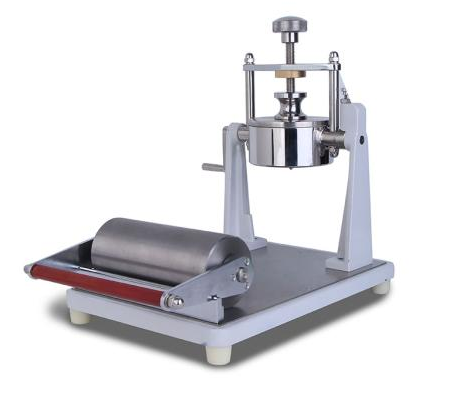
Operation Guide
1. Preparation
Sample: Cut the sample into 10 circular test pieces with a diameter of 125mm (5 pieces on the front and back sides) to cover the test area of 100cm2 for each piece.
2. Place the sample
Before placing the sample, ensure that the annulus of the cylinder in contact with the sample is dry. Use a glass measuring cylinder to accurately measure 100mL of distilled water and pour it into the cylinder, then place the weighed circular test piece on the circular surface of the cylinder, with the surface to be measured facing the direction of water (downward), and
Put the sample gland on the sample to fix it with the cylinder, and tighten it with the compression nut. Gently pull out the spring pin, shake the handle to turn the cylinder 180o, and then put the spring pin
Insert it into the slot and time it at the same time.
3. Water absorption time
Water absorption time refers to the time from the beginning of water contact with the sample to the end of water absorption. This time can be selected according to the different water absorption properties of paper and cardboard, and is consistent with the table below. The time may be extended or shortened as necessary. , but it should be noted in the test report. 10~15s before the end of water absorption, gently pull out the spring pin again, shake the handle to turn the cylinder over 180o, and straighten the cylinder.
4. Press paper
Put a piece of absorbent paper on the instrument table first, remove the sample from the cylinder, put it on the absorbent paper, pay attention to the absorbent side of the sample facing down, and put two sheets on the sample 2 seconds before reaching the absorbent time. Absorbent paper, on the flat and hard surface of the instrument, use a smooth roller to go back and forth within 4s
Press it once to make the surface of the sample dry, take out the sample quickly and weigh it to an accuracy of 0.001g. Note that each sample can only be tested once and cannot be reused. Absorbent paper can be reused many times as long as its absorbency is guaranteed.
5. Discard the sample
If there is still excess water on the surface after absorbing water with absorbent paper or the sample itself has been permeated by water, the sample should be discarded. If the discard exceeds 20%, the test time should be shortened until a satisfactory result is obtained, but the minimum test time should be for 10s.
6. Add water
For every 5 measurements, add a certain amount of water according to the water absorption of the paper.
7. Test results and reports
(1) Test results
a. The test result is calculated according to the following formula, expressed in g/m2, accurate to one decimal place.
C = (G2-G1) x 100
In the formula: C—copper water absorption value;
G2—Weigh the mass of the sample after absorbing water, g
G1—Weigh the mass of the sample before absorbing water, g
b. Calculate the average of the water absorption value of each test surface, and calculate the standard deviation.
c. Use standard notation, eg Cobb60 in toC.
maintenance
a. The instrument should be placed horizontally.
b. The location where the instrument is placed should be dry and ventilated.
c. After the test, the instrument should be cleaned and kept dry.
- 1How to do a good job in food packaging?
- 2How to perform COBB testing on non-absorbent paper and cardboard?
-
![CHINA NBC-5684 Cobb Absorption Tester]()
-
![Cobb absorbency Tester ZY-XS-KB Cobb absorbency Tester paper surface absorption weight Tester]()
-
![CHENCHI KBY-1 Cobb Absorption Tester]() CHENCHI KBY-1 Cobb Absorption Tester$ 539.00
CHENCHI KBY-1 Cobb Absorption Tester$ 539.00 -
![YANTE YT-Cobb125 Cobb absorptivity Tester paper surface absorption weight Tester]()


