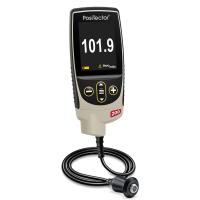
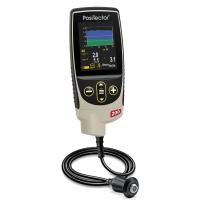
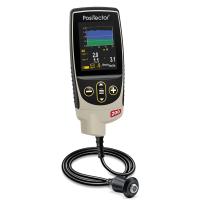
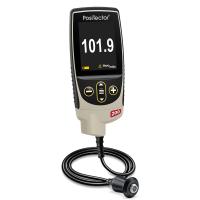
Principle and Application of PosiTector 200 Ultrasonic Coating Thickness Gauge
The PosiTector 200 uses ultrasonic principles to measure the coating thickness of most coatings on most substrates. Ultrasonic signals are very high frequency sound waves. Just like the echo you hear when you shout in a hall or canyon, the PosiTector 200 listens to the echo of the acoustic boundary in your application.
The PosiTector 200 probe emits high-frequency sound pulses that pass through the coupling gel into the coating and bounce off any surface that differs in density. Coating thickness readings are obtained by measuring the time it takes for an ultrasonic signal to travel from the probe to the coating/substrate interface and back. Divide the travel time by 2 and multiply by the speed of sound in the coating to obtain the thickness of the coating. The strength of the reflected signal from the coating/substrate interface determines the Gage's ability to measure coating thickness. Since most applications are uneven, the Gage will "hear" many echoes when placed on the coating/substrate. Gage "hears" all reflections within the gage's measurement range and assumes the largest "echo" is the coating/substrate echo (single-coat applications only). An adjustable measurement range has been provided for the user, forcing the Gage to ignore echoes from unwanted boundaries in the sample. Here are a few examples to help illustrate the use of the Set Ranges feature for specific applications.
Measuring Coatings with Rough Surfaces
When measuring rough coatings, the Gage will usually identify the thickness from the top to the bottom of the coating (#1). Couplant fills the void (#2) between the probe and the coating, creating an additional interface. If the echo from the couplant/coating interface (#2) is stronger than the coating/substrate interface (#1), the Lo value may need to be adjusted (increased) to reveal the weaker (#1) echo.

Measuring dense (hard) coatings
Significant echogenicity occurs at the probe/coating interface. The relative intensity of this echo requires an increased Lo value compared to the coating/substrate echo.
Measurement of total thickness in multilayer coating applications
Multiple coating/coating/substrate interfaces can generate several echoes. The user may need to adjust the Gage setting range to ignore echoes from the coating/coating interface.
- 1Application scheme of coating thickness test on wood board [with test video]
- 2Curved plastic coating thickness test application scheme [with test video]
- 3PosiTector200C ultrasonic coating Thickness Gauge on concrete coating thickness measurement application
- 4Defelsko PosiTector 200 Ultrasonic coating Thickness Gauge Chinese version Instructions for use [2023 new version]
Defelsko
- 5Why do Defelsko 200 Series Ultrasonic Coating Thickness Gauges measure incorrectly?
- 6What is the difference in the application of Defelsko Ultrasonic Coating Thickness Gauges 200B, 200C, 200D?
- 7Gypsum board for paint thickness measurement
- 8Application of PosiTector 200 Ultrasonic Thickness Gauge in Measuring Dry Film Thickness on Non-metallic Substrates
- 9Film thickness measurement on glass fiber circuit board
蜈蚣 - 《南北潮商城》