Test principle of eddy current Thickness Gauge
An eddy current coating Thickness Gauge is usually a contact instrument, not a non-contact one. When measuring, the probe needs to be in contact with the surface of the coating under test and move over the coating surface to measure the coating thickness. The probe is usually a conical or disc-shaped sensor with an insulating base coated with a conductive coating at its lower end. The thickness of the coating can be calculated by detecting changes in capacitor capacitance.
The eddy current coating Thickness Gauge uses the principle of eddy current induction. When an alternating current passes through the coil of the probe, an alternating magnetic field is generated on the surface of the tested coating. The eddy current inside the coating cancels out the magnetic field generated by the probe coil, weakening the magnetic field induced by the probe. The strength of the eddy current is inversely proportional to the thickness of the coating, so the thickness of the coating can be calculated by measuring the change in the magnetic field induced by the probe.
North-South Tide reminds you: Eddy Current Coating Thickness Gauges are suitable for measuring the thickness of electrically insulating or partially insulating coatings on the surface of conductors. For non-insulating coatings, the accuracy of eddy current Thickness Gauges may be disturbed, so calibration is required during use, and the appropriate probe is selected according to the type and characteristics of the coating being tested.
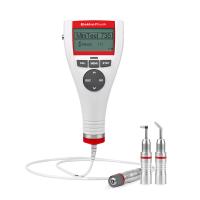
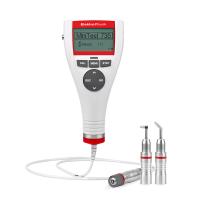
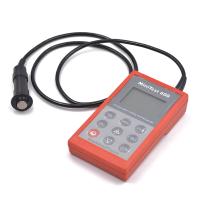

- 1Eddy current Thickness Gauge FAQ and countermeasures
- 2Principle, characteristics and application of TASI eddy current Thickness Gauge
- 3What is the principle of coating Thickness Gauge?
- 4Huayang HCC-25 Eddy Current Thickness Gauge Operation Instructions
- 5HS160 Ultrasonic Thickness Gauge Manual
- 6Reasons for measurement deviation of Coating Thickness Gauge
- 7Film Film thickness determination method
- 8Coating thickness measurement technology--eddy current method
- 9Coating thickness measurement technology---magnetic method