Requirements for Casting Hardness in American Standard ASTM and Selection of Sclerometer
The foundry industry is an important branch of the machinery industry. Due to the presence of graphite, cast iron has excellent casting performance, cutting performance, wear reduction performance, vibration reduction performance and low notch sensitivity. Moreover, the casting production equipment is simple and the manufacturing cost is low, so it is widely used in industrial production. Among all kinds of mechanical products, castings account for more than 50% by mass.
The first quality index of castings is mechanical properties. There are two main methods to test the mechanical properties of workpieces, one is tensile test, and the other is hardness test. The tensile test tests the tensile strength, yield strength and elongation of the workpiece, while the hardness test reflects the comprehensive performance of various physical quantities such as elasticity, plasticity, strength, toughness and wear resistance of the material under the respective specified conditions. Tensile testing is specified for almost every product in the American casting standards. Most products specify a hardness test.
The tensile test equipment is complicated, the investment is high, professionals are needed, and samples need to be prepared. The test efficiency is low and the cost is high. The hardness test equipment is simple, easy to master, and the indentation is very small, which can be regarded as non-destructive testing, and can directly test finished or semi-finished workpieces. The test efficiency is high, and it can be used for piece-by-piece inspection of batches of workpieces. With the advancement of Hardness Tester manufacturing technology, various portable instruments, especially high-precision portable instruments, are emerging, making hardness testing simple, fast and accurate. Make on-site hardness testing, hardness control on the production line and accurate hardness testing of large workpieces possible.
Hardness testing and tensile testing are basically testing the ability of metals to resist plastic deformation. Both tests are to some extent detecting similar properties of metals. The test results of the two are completely comparable to each other. For most metal materials, the hardness value and tensile strength value can be converted into each other by looking up the table. Therefore, when testing the mechanical properties of materials, more and more people choose to use hardness test instead of tensile test.
The following are the provisions of the American Standard ASTM on the hardness requirements of castings.
1. Requirements for hardness of castings in American standard ASTM
Gray Iron Castings (ASTM A48-92)
It is suitable for general engineering gray iron castings mainly considering the tensile strength, and the castings are graded according to the tensile strength of different casting test bars. In such castings, chemical composition is of secondary importance to tensile strength. When ordering or producing castings, they are divided into several grades according to the properties of individually cast samples. Each grade is represented by a number followed by a letter. The number indicates the minimum tensile strength of the individually cast test bar, and the letter indicates the specification of the test bar. For example: gray iron castings, ASTM A48, grade 30B means that they are produced according to standard ASTM A48, the minimum tensile strength is 30 thousand pounds per inch 2 (207MPa), and the nominal diameter of the test rod is 1.2 inches (30.5mm). The standard mentions that "when the manufacturer and the purchaser reach a written agreement, it is necessary to require the casting to meet the requirements of hardness, chemical composition, microstructure, pressure leakage, X-ray inspection without defects, size, and surface accuracy."
Gray Iron Castings for Motor Vehicles (ASTM A159-88)
Suitable for sand casting gray iron castings used in automobiles, tractors and related industries. Hardness requirements:
The foundry should adopt necessary control and inspection techniques to ensure that the castings meet the specified hardness range. The Brinell hardness is tested according to the ASTME10 test method after sufficient thickness of material has been removed from the surface of the casting to ensure the representativeness of the hardness readings. Unless otherwise agreed, steel balls of 10 mm and a load of 3000 kg shall be used. The area and location of hardness testing on castings shall be agreed upon by both the supplier and the buyer, and shall be marked on the drawing.
Ductile Iron Castings (ASTM A536-84)
For castings made from ductile iron, which contains nodular graphite and essentially no other forms of graphite. Casting grades are expressed by "tensile strength-yield strength-elongation", for example: grade: 80-55-06 represents tensile strength 80000 lb/in2 (552MPa), yield strength 55000 lb/in2 (379MPa), Elongation 6.0% (2 inches or 50mm). Castings should be properly heat treated, such as annealing, normalizing, quenching and tempering, etc. When stipulated in the contract or order, the castings shall meet the requirements of hardness, chemical composition, microstructure, etc.
Austenitic Ductile Iron Castings (ASTM A439-89)
It is suitable for austenitic ductile iron castings mainly used for heat resistance, corrosion resistance and wear resistance. Castings should be subjected to heat treatments such as stress relief, stabilization treatment or annealing. Austempering Ductile Iron Castings (ASTM A897M-90) For ductile iron castings that require an austempering heat treatment. Austempering can reduce the difference in mechanical properties between different parts of the same casting or different castings cast from the same furnace of molten iron. The application of the austempering heat treatment can expand the range of properties obtainable on ductile iron castings.
Pearlitic Malleable Castings (ASTM A220 M-88)
It is suitable for general engineering pearlitic malleable iron castings working from normal temperature to 400 °C. If the hardness test is required in the purchase contract, the acceptable hardness range should be stated, and the test site should be clearly shown on the attached drawing. Whenever possible, the Brinell hardness test method specified in ASTM E10 should be used. And the test condition of 3000kg/10mm ball should be adopted as far as possible, if the size or shape of the workpiece does not permit, 1500kg/10mm ball can be used. In special cases where the Brinell Hardness Tester cannot be used, the Rockwell hardness test method can be used instead in accordance with ASTM E18.
Malleable Iron Castings for Automobiles (ASTM A602-87)
Suitable for ferritic, pearlitic, tempered pearlitic and tempered martensitic grades of malleable iron castings for the automotive industry and similar industrial products. Castings shall be heat treated. Hardness requirements Castings should implement necessary control and inspection procedures to ensure compliance with the specified hardness range. Hardness readings shall be taken in accordance with ASTM E10 after a sufficient thickness of material has been removed from the surface of the casting to ensure representative hardness values. The surfaces or areas of the castings to be checked for hardness shall be determined through consultation between the supplier and the purchaser and as shown in the drawings.
Wear-resistant cast iron (ASTM A532/A532M-87)
This standard applies to a group of alloyed white cast irons to ensure high wear resistance for applications in the mining, beneficiation, earth handling and manufacturing industries. Class II and Class III alloys are often ordered in the heat-treated state, with a maximum hardness of 400HB. Hardness testing can be performed on any part of the original surface of the casting. Indentations may be made on the original surface of the casting or as deep as 1/8 inch into the original surface. Hardness was tested according to the method specified in the following ASTM standard. The preferred method is the ASTM E10 Brinell test method using tungsten carbide balls and 3000 kg force. As an optional method, the Rockwell method in ASTM E18 standard can be used, using Rockwell C scale, diamond cone indenter and 150 kg force.
2. Application of Hardness Tester in castings
1. Brinell Hardness Tester
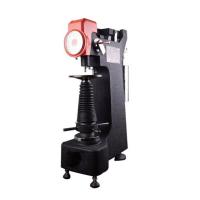
Brinell Hardness Tester is preferred for hardness testing of castings, especially for gray iron castings with relatively coarse grains, only Brinell Hardness Tester can be used, and the test conditions of 3000kg load and 10mm ball should be selected as far as possible. When the size of castings is small, Rockwell Hardness Tester can also be used.
The reason why the Brinell Hardness Tester is preferred in the hardness testing of castings is due to the following two points:
a. Iron castings usually have uneven structure, large grains, and contain more carbon, silicon and other impurities than steel. The hardness will vary in different small areas or at different points. However, the indenter of the Brinell Hardness Tester has a larger size and a larger indentation area, and can measure the average value of material hardness within a certain range. Therefore, the Brinell Hardness Tester has a higher test accuracy and a smaller dispersion of hardness values. The measured hardness value is more representative of the actual hardness of the workpiece. Therefore, the Brinell Hardness Tester is widely used in the foundry industry.
b. Tensile strength is the first mechanical performance index of castings. Almost all casting standards have requirements on tensile strength. The Brinell hardness value and the tensile strength value of castings have a very close relationship, and the values of the two can be converted into each other. The tensile strength of gray cast iron can be calculated by the following formula:
σb=1.82 (HB) 1.85
The relationship between the two can also be obtained by looking up the table. By testing the Brinell hardness value, the tensile strength value of the workpiece can be obtained quickly and conveniently. Thereby improving the detection efficiency and reducing the test cost.
2. Rockwell Hardness Tester
Rockwell Hardness Testers are also commonly used for hardness testing of cast iron. For workpieces with fine grains, if there is not enough area for Brinell hardness test, Rockwell hardness test can also be carried out. For pearlitic malleable cast iron, chilled cast iron and steel castings, HRB or HRC scale can be used. If the material is not Evenly, several readings should be measured and the average value should be taken. The Rockwell Hardness Tester is fast, convenient, and has small indentation. It can directly test finished workpieces, and is suitable for piece-by-piece inspection of finished or semi-finished workpieces produced in batches.
3. Shore Hardness Tester
In individual cases, for some castings with larger shapes, it is not allowed to cut the sample, and it is not allowed to cast additional test blocks for hardness testing. At this time, hardness testing will encounter difficulties. For this case, the common method is to test the hardness with a portable Shore Hardness Tester on the smooth surface after the casting is finished. For example, in the roll standard widely used in the metallurgical industry, it is stipulated that the Shore Hardness Tester should be used to test the hardness. Since the Shore Hardness Tester adopts the principle of dynamic hardness testing, there are many factors that affect the hardness test results, and the test accuracy is far lower than that of the Brinell Hardness Tester and Rockwell Hardness Tester that use the static indentation hardness test principle. For this reason, it is also recommended to use a hardness contrast roll in the roll standard. The hardness contrast roll acts as a standard sample, and its hardness value is accurately tested by cutting the sample. After using the Shore Hardness Tester to test the roll, check the detection accuracy of the Shore Hardness Tester on the comparison roll.
4. Leeb Hardness Tester
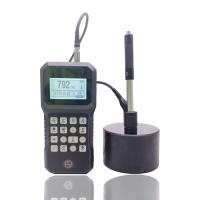
At present, the Leeb Hardness Tester is widely used in the hardness testing of castings. The Leeb Hardness Tester is an improvement on the Shore Hardness Tester. It also adopts the principle of dynamic hardness testing, and uses computer technology to realize the miniaturization and electronicization of the Hardness Tester. It is simple and convenient to use, and the test results can be easily converted into Brinell hardness values, so it is widely welcomed. However, like the Shore Hardness Tester, the Leeb Hardness Tester has low accuracy, and there are many factors that affect the test accuracy. The surface of the workpiece is required to have a high degree of smoothness, and there is a lack of credible hardness conversion tables. Hardness conversion will also bring to a larger error. Therefore, the measurement results of the Leeb Hardness Tester are often used as reference values in CHINA, and the Leeb Hardness Tester is mainly used in occasions that require a wide range of workpiece hardness. In addition, as an informal hardness testing method, the Leeb Hardness Tester has not been widely recognized in the International Organization for Standardization, and has not been adopted in the product standards of foreign castings. In international trade, the measurement results of the Leeb Hardness Tester will not be accepted by most foreign businessmen. Many castings are medium-to-large workpieces, some weighing several tons, and cannot be moved to a benchtop Hardness Tester for testing. The precise hardness test of castings mainly adopts test rods cast separately or test blocks attached to castings. However, neither the test bar nor the test block can completely replace the workpiece itself. Even if it is the same furnace of molten iron, the casting process and heat treatment conditions are the same, because the huge difference in size will cause the heating rate, especially the cooling rate, of the two to be different. It is difficult to make the two have exactly the same hardness. For this reason, many customers care more about and believe in the hardness of the workpiece itself. This requires a portable and accurate Hardness Tester to test the hardness of castings.



- 1Read the Leeb Hardness Tester in one article
- 2Leeb Hardness Tester different hardness system difference
- 3Frequently Asked Questions about Hardness Testers in 2022
- 4What products is the Leeb Hardness Tester with D probe suitable for measuring?
- 5What is the purpose of the Brinell Hardness Tester?
- 6Factors Affecting the Accuracy of Leeb Hardness Tester Testing
- 7Leeb Hardness Tester measurement requirements
- 8Test method for roll hardness
- 9How many Hardness Testers do you know?
-
![JFL QDX film multi-purpose Detector film thickness, Hardness, adhesion and other performance detection]()
-
![Leeb Hardness Tester AMITTARI AL-150A split Leeb Hardness Tester]()
-
![PRLH150 Leeb Hardness Tester]() PRLH150 Leeb Hardness Tester$ 259.00
PRLH150 Leeb Hardness Tester$ 259.00 -
![Hypertherm LSY-W Leeb Hardness Tester]()
-
![JINGKELIAN QHY Buchholz indentation Tester for the determination of the technical characteristics of the film Hardness test]()
-
![KAIRDA NDT271 Ultrasonic hardness gauge display]()